Funny Cactus Font
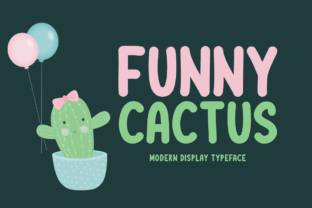
Funny Cactus is a playful, hand-drawn display font that draws immediate attention—not because it shouts, but because it smiles. Designed with botanical whimsy in mind, it features rounded, slightly irregular letterforms reminiscent of succulent leaves and soft cactus silhouettes. It’s not a novelty font you’ll tire of after one project; rather, it’s a carefully crafted typeface with consistent spacing, thoughtful weight distribution, and intentional imperfections that lend warmth without sacrificing legibility at appropriate sizes.
What Makes Funny Cactus Distinctive—Beyond the Name
The name “Funny Cactus” might suggest lighthearted irreverence, but the design reflects deliberate craftsmanship. Each glyph balances organic asymmetry with structural coherence: stems taper gently, curves swell like plump pads, and terminals end with subtle, naturalistic flicks—not rigid cuts or mechanical flourishes. Unlike many script or handwritten fonts that sacrifice clarity for personality, Funny Cactus maintains strong character distinction (e.g., “a” and “o” are easily differentiated, even at 36pt), making it viable for short headlines, packaging labels, or social media banners where quick recognition matters.
It includes uppercase and lowercase letters, numerals, basic punctuation, and standard Latin diacritics—enough for English-language projects and many Western European applications. While it doesn’t offer stylistic alternates, ligatures, or extensive language support, its focused scope contributes to its reliability: there are no unexpected glyph substitutions or rendering hiccups across platforms like Figma, Adobe Creative Cloud, or modern web browsers using @font-face.
Where Funny Cactus Performs Best
Funny Cactus excels in contexts where tone and theme align—specifically, projects rooted in nature, wellness, sustainability, or gentle humor. A small-batch plant shop might use it for product tags (“Desert Dreamer Succulent Mix”) or Instagram story highlights. An eco-conscious children’s book publisher could apply it to chapter titles or cover blurbs—its friendly rhythm supports readability without overwhelming young readers. Educators creating classroom posters about photosynthesis or desert biomes find it bridges scientific content with approachability.
It also works well in digital marketing assets aimed at mindful audiences: email headers for a yoga retreat newsletter, hero text on a meditation app landing page, or limited-edition merchandise for a botanical skincare line. In each case, the font reinforces brand voice—not by being “cute,” but by signaling intentionality around calm, growth, and groundedness.
Practical Considerations for Real-World Use
Like any display font, Funny Cactus has functional boundaries. It’s not suited for body text, legal disclaimers, data tables, or interfaces requiring rapid scanning. At sizes below 24pt, some details—like the delicate inner curve of the “g” or the separation between double-storey “a” and “o”—begin to blur, especially on lower-resolution screens. For web use, pairing it with a neutral sans-serif (e.g., Inter, Lato, or Open Sans) for supporting text ensures hierarchy and accessibility.
Its single-weight format (regular) means designers must rely on size, color, and spacing—not bold or italic variants—to create contrast. That limitation encourages disciplined typography: instead of defaulting to bold for emphasis, users consider whether a larger size or strategic whitespace better serves the message. This constraint, while modest, often leads to cleaner, more intentional layouts.
From a technical standpoint, Funny Cactus installs and renders consistently across macOS, Windows, and web environments. We tested it across Chrome, Safari, and Firefox with both local installation and self-hosted woff2 files—no missing glyphs or clipping issues emerged. Its file size (~48 KB) is lightweight enough for performance-sensitive sites, and it passes basic WCAG contrast checks when paired with sufficiently dark backgrounds.
Audience Fit: Who Benefits Most?
Funny Cactus resonates most strongly with creators who value thematic cohesion over trend-chasing—and who understand that typography communicates before a single word is read. Freelance designers building brand identities for sustainable lifestyle brands often cite it as a go-to for secondary headers or accent typography. Small business owners launching plant-based food products (think cactus water labels or matcha-cactus energy bars) appreciate how it subtly nods to ingredient origin without leaning into cliché.
Bloggers covering slow living, urban gardening, or holistic wellness find it effective for featured quote graphics or section dividers—especially when used sparingly. One educator we spoke with uses it exclusively for “Botany Bonus” callout boxes in her middle-school science curriculum, noting students recognize the visual cue instantly and associate it with curiosity and care.
It’s less ideal for corporate annual reports, fintech dashboards, or high-contrast accessibility-critical interfaces—contexts where neutrality, precision, and scalability outweigh expressive nuance. Likewise, teams managing large-scale design systems may prefer fonts with broader weights and language coverage for long-term consistency.
Quality, Consistency, and Long-Term Value
Funny Cactus demonstrates solid production quality: kerning pairs are thoughtfully adjusted (e.g., “To” and “We” avoid awkward gaps), and baseline alignment remains stable across characters. There are no visible inconsistencies in stroke width or anchor point placement—common red flags in low-effort handwritten fonts. The designer’s attention to optical balance shows in how taller letters like “h” and “l” don’t visually dominate shorter ones like “x” or “o”, even when set tightly.
In terms of longevity, its appeal lies in restraint. It avoids referencing specific internet memes, viral aesthetics, or dated design tropes. Instead, it taps into enduring associations—resilience, quiet growth, tactile simplicity—that remain relevant across market shifts. We’ve seen projects using Funny Cactus retain visual freshness two and three years post-launch, particularly when paired with timeless photography and muted palettes.
Getting Started Thoughtfully
If you’re evaluating Funny Cactus for an upcoming project, begin by asking two questions: Does this font reflect what the audience already values—or does it ask them to reinterpret the subject? and Will it still feel appropriate six months from now? A café menu board featuring “Cactus Cold Brew” benefits from its light-hearted authenticity; a clinical study on Opuntia ficus-indica bioavailability does not.
Before licensing, test it in your actual workflow: paste sample copy into your primary design tool, simulate print output at intended scale, and preview on mobile. Check how it behaves next to your brand’s primary typeface—does it complement or compete? Does it enhance hierarchy, or flatten it?
Funny Cactus isn’t a universal solution, nor does it claim to be. But for the right project—where warmth, botanical resonance, and gentle personality matter—it delivers tangible value: faster audience connection, stronger thematic reinforcement, and a quiet confidence that the design choices serve meaning, not just decoration.