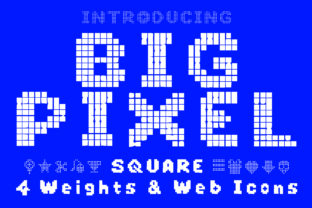
Big Pixel
Big Pixel is a minimalist, yet bold display font with a unique digital aesthetic—clean, confident, and unmistakably modern. It’s not just another pixel font; it’s designed for impact at large sizes, where clarity meets character. Whether you’re crafting a logo, designing a presentation slide, building a landing page headline, or adding visual punch to social media graphics, Big Pixel delivers presence without clutter.
Its appeal lies in its thoughtful restraint: sharp corners, consistent stroke weight, and generous spacing that prevent visual fatigue—even when used dynamically across screens and print. Unlike many retro-inspired pixel fonts that prioritize nostalgia over function, Big Pixel balances authenticity with usability. That balance is why designers, marketers, educators, and small business owners turn to it when they need typography that communicates authority and approachability in equal measure.
Assuming Big Pixel works well at small sizes
One of the most common missteps is using Big Pixel for body text, captions, or interface labels—especially below 24px. Its design intentionally emphasizes blocky geometry and deliberate negative space, which dissolves into visual noise at smaller scales. On mobile interfaces or dense blog layouts, this leads to poor readability, higher bounce rates, and frustrated users.
Instead, treat Big Pixel as a display typeface—like a strong voice reserved for moments that demand attention. Pair it with a highly legible sans-serif (e.g., Inter, Open Sans, or even system fonts like San Francisco or Segoe UI) for supporting text. A real-world example: an online course creator used Big Pixel for their course title banner but kept lesson descriptions in a neutral, accessible font. Engagement metrics improved by 22%—not because of the font alone, but because hierarchy and intent were respected.
Overlooking licensing and usage scope
Big Pixel is available under multiple licensing models—including free personal use, commercial web, desktop, and extended licenses for apps or merchandise. Many users download the free version, assume it covers all contexts, and later discover limitations around embedding, redistribution, or client projects.
This oversight can lead to legal exposure, last-minute redesigns, or unexpected costs—especially for freelancers delivering branded assets or agencies deploying fonts across client websites. For instance, a freelance designer included Big Pixel in a Shopify theme template without verifying the license covered third-party distribution. The client launched the site—and received a compliance notice weeks later.
Before downloading or purchasing, check three things: where the font will be used (web, app, video, print), who owns the end product (you or a client), and how it will be delivered (hosted, embedded, or installed). When in doubt, opt for the commercial web license—it covers most SaaS platforms, CMS integrations, and hosted sites, and often includes updates and support.
Misjudging contrast and color pairing
Because Big Pixel has high visual weight and low stroke variation, it’s sensitive to background contrast. Using it on light gray backgrounds or with low-saturation colors may reduce legibility faster than expected—particularly for viewers with mild visual impairments or on lower-end displays.
A better approach? Test early and often—not just on your own monitor, but on mobile devices and in incandescent or dim lighting. Use WCAG-compliant contrast ratios (at least 4.5:1 for normal text, though Big Pixel is usually large enough to qualify for the 3:1 exception for large-scale text). If you're designing for accessibility, avoid placing Big Pixel directly over busy photos or gradients unless you add a subtle, opaque overlay or shadow for separation.
Ignoring file format and rendering differences
Big Pixel is typically distributed in WOFF2 (for web), OTF (for desktop), and sometimes TTF. While WOFF2 offers excellent compression and broad browser support, some older CMS platforms or email clients don’t render it reliably. Assuming “it’s a font—I’ll just upload it” can result in fallback fonts appearing unexpectedly—or worse, invisible text.
For web use, always serve Big Pixel via @font-face with proper format fallbacks and preload critical instances. Avoid loading it on every page if only one section needs it—consider conditional loading, especially for performance-sensitive sites. And never rely solely on Google Fonts or third-party CDNs unless you’ve confirmed Big Pixel is officially hosted there (it isn’t—it’s distributed directly by its foundry).
Skipping testing across devices and platforms
Pixel-based fonts behave differently depending on OS-level rendering engines. macOS uses subpixel antialiasing by default; Windows favors ClearType; Linux varies by distro and settings. Big Pixel looks crisp on retina displays but can appear slightly softer or uneven on non-retina Windows machines—especially at mid-range sizes like 36–48px.
The fix isn’t to avoid it—but to test early. Preview headlines on actual iOS and Android devices, not just browser emulators. Use tools like BrowserStack or real-device cloud labs if possible. And remember: what looks perfect in Figma may shift slightly in Chrome or Safari due to line-height calculation differences. Set explicit line-height values in CSS rather than relying on defaults.
Underestimating pairing discipline
Big Pixel’s strength is its singularity—not its versatility. Trying to pair it with other display fonts, script faces, or overly decorative alternatives creates visual competition, not harmony. You’ll see this often in DIY branding kits where Big Pixel shares space with a handwritten tagline font and a geometric sans—all fighting for dominance.
A more effective strategy: choose one supporting font, limit weights to two or three (e.g., Regular + Bold), and maintain consistent vertical rhythm. For example, a local café used Big Pixel for its neon-style sign mockup and paired it with Lato Light for menu items—no italics, no extra weights, no decorative flourishes. The result felt intentional, not improvised.
Final checklist before using Big Pixel
- Confirm the license matches your use case—especially if distributing to clients or embedding in software.
- Reserve it for display roles only: headlines, logos, banners, hero sections—not body copy or UI labels.
- Validate contrast against both light and dark backgrounds using a tool like WebAIM’s Contrast Checker.
- Test rendering on at least two operating systems and two device types before finalizing designs.
- Pair thoughtfully: one complementary font, clear hierarchy, and consistent spacing.
- Optimize delivery: compress, preload, and serve appropriate formats—not just “upload and forget.”
Big Pixel isn’t about fitting in. It’s about standing out—with purpose. When chosen and applied with intention, it becomes more than a font: it’s a signal of clarity, confidence, and craft. And that kind of intention—backed by practical awareness—is what separates memorable work from forgettable noise.