Quince Garden Font: Elegance, Versatility, and Design Storytelling in Every Glyph
What Is Quince Garden?
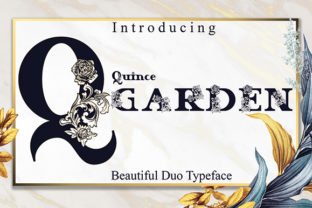
Quince Garden is a distinctive display font family inspired by the delicate beauty of quince blossoms native to France—and the timeless grace of roses. Designed for visual impact rather than extended reading, it belongs to the category of display typefaces: fonts crafted to captivate attention in headlines, logos, invitations, packaging, and digital banners. Unlike body text fonts such as Georgia or Inter—engineered for legibility at small sizes—Quince Garden shines when large, expressive, and intentional.
It offers two complementary styles: Quince Garden Regular and Quince Garden Outline. The Regular version features smooth, flowing curves with subtle floral flourishes—think petal-like terminals and gentle swashes that echo botanical symmetry. The Outline variant preserves the same elegant structure but renders each glyph as a clean, open silhouette—ideal for layering, embossing effects, or minimalist branding where negative space becomes part of the message.
Why “Quince” and “Garden”? The Inspiration Behind the Name
The name isn’t arbitrary. Quince refers to the flowering shrub Cydonia oblonga, historically cultivated across southern Europe—including the gardens of Provence and Normandy—where its pale pink, five-petaled blooms herald spring with quiet sophistication. Unlike showy peonies or bold tulips, quince flowers exude restrained charm: refined, balanced, and deeply rooted in tradition.
“Garden” evokes cultivation, harmony, and curated beauty—qualities reflected in the font’s meticulous spacing, consistent stroke contrast, and organic rhythm. Together, Quince Garden suggests not just aesthetics, but intentionality: a typeface grown—not generated—through thoughtful design principles.
How It Differs From Other Display Fonts
- Not script, not serif, not sans-serif: Quince Garden occupies a graceful middle ground. Its letterforms have structural clarity (like a refined serif) but avoid rigid geometry—instead favoring soft transitions and gentle tapering.
- No forced whimsy: Unlike many decorative fonts that lean into cartoonish exaggeration or retro clichés, Quince Garden maintains dignity. Its elegance feels earned, not applied.
- Two styles, one voice: While many display families offer bold, light, or italic variants, Quince Garden opts for duality—Regular and Outline—that speak the same visual language in different tonal registers.
Where Does Quince Garden Belong? Real-World Applications
Because it’s built for emphasis—not exposition—Quince Garden thrives where meaning meets mood. Here’s how designers, entrepreneurs, educators, and creators use it effectively:
Branding & Identity
A boutique bakery in Lyon might use Quince Garden Regular for its logo—evoking artisanal heritage and floral freshness—while applying the Outline version to window decals, letting natural light filter through the letterforms. Similarly, a sustainable skincare line could pair Quince Garden with a neutral sans-serif (like Lato or Manrope) for contrast: elegance above, clarity below.
Editorial & Publishing
In magazine covers or book jackets—especially for literary fiction, poetry collections, or nature writing—Quince Garden adds emotional resonance. Imagine a memoir titled The Garden We Carried: its title rendered in Quince Garden Regular, set against a watercolor background of blooming quince branches. The font doesn’t shout—it invites.
Digital Experiences
On websites and apps, Quince Garden works best in hero sections, call-to-action buttons (“Discover the Collection”), or animated loading screens. Thanks to modern web font loading techniques (like font-display: swap), it renders gracefully—even on mobile—without sacrificing performance. Just remember: never use it for paragraphs, navigation menus, or form labels. That’s not a limitation—it’s respect for function.
Common Misconceptions—Clarified
Let’s address assumptions that trip up new users:
- “It’s only for weddings.” While lovely for wedding stationery, Quince Garden’s versatility extends to tech startups launching wellness platforms, university art departments promoting exhibitions, or even eco-conscious fashion labels. Its strength lies in tone-setting, not narrow context.
- “Outline means ‘lightweight’ or ‘thin.’” Not quite. Outline refers to construction—not weight. You can fill the outline with color, gradient, or texture. It’s a design element, not a typographic weight.
- “I need special software to use it.” No. Quince Garden is available in standard OpenType (.otf) and web-friendly WOFF2 formats. It works in Adobe Creative Cloud, Figma, Canva (via upload), and CSS
@font-facedeclarations.
Typography Fundamentals Made Accessible
Understanding Quince Garden also deepens your grasp of typography itself. Consider these foundational ideas:
- Type Classification Matters: Knowing whether a font is serif, sans-serif, script, or display helps you predict how it’ll behave. Quince Garden is display—so prioritize size, spacing, and contrast over line length or x-height metrics.
- Pairing Is Strategic, Not Random: Great combinations create hierarchy and harmony. Try Quince Garden Regular + Inter (clean, highly readable) or Playfair Display (another elegant serif, but more traditional). Avoid pairing it with overly decorative fonts—that creates visual noise.
- Legibility ≠ Readability: Quince Garden is highly legible (individual letters are clear), but low readability (not ideal for long passages). That’s by design—and perfectly okay.
Why This Font Fits Modern Creative Needs
In an age saturated with algorithm-driven templates and AI-generated visuals, Quince Garden stands out by anchoring design in human observation and cultural resonance. Its French botanical roots reflect a growing appreciation for slow design: work that values craft, context, and continuity over speed and sameness.
For educators, it’s a teaching tool—demonstrating how typography carries narrative. For developers, it’s a reminder that web fonts aren’t just utility; they’re part of the user’s emotional journey. For small business owners, it’s affordable distinction: no need for custom logotype when a thoughtfully chosen font conveys authenticity and care.
Getting Started With Quince Garden
Ready to explore? Here’s how to begin responsibly:
- Preview first: Use font testing tools like FontDrop to upload and experiment with spacing, color, and scale.
- License appropriately: Check usage rights—some versions allow personal use only; commercial projects may require a license. Reputable foundries provide clear terms.
- Test across devices: View your design on iPhone, tablet, and desktop. Does the Outline style retain its delicacy at 24px? Does Regular hold weight at 80px? Adjust tracking (letter-spacing) if needed—it often improves impact.
- Respect hierarchy: Let Quince Garden introduce, then step aside. Body copy, captions, and data labels deserve fonts built for endurance—not flourish.
A Final Thought: Type With Intention
Fonts are never neutral. They carry history, geography, and emotion—often silently. Quince Garden does so with particular poise: honoring French horticultural tradition while serving contemporary creative needs. Whether you're naming a café, launching a podcast, designing a thesis cover, or refreshing a nonprofit’s visual identity, choosing Quince Garden signals something deeper than taste—it signals attention.
Attention to detail. To origin. To the quiet power of a flower that blooms before fruit, reminding us that beauty often precedes utility—and that some of the most meaningful designs grow slowly, thoughtfully, and with care.