Dixie: Elegant Display Font Inspired by Hand-Lettering
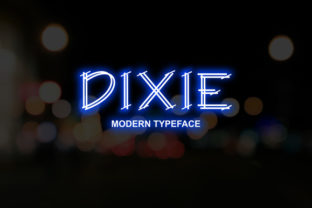
When you’re choosing a font for a logo, headline, or social media graphic, you’re not just picking letters—you’re selecting tone, trust, and texture. Dixie stands apart because it carries the warmth of hand-lettered authenticity without sacrificing clarity or impact. It’s not ornate or overly stylized; instead, it balances simplicity with presence—bold enough to command attention, refined enough to feel intentional.
Why Hand-Lettering Inspiration Matters in Real Work
Hand-lettering conveys care. A hand-drawn word suggests time, thought, and human connection—qualities that resonate deeply in digital spaces where messages compete for seconds of attention. Dixie translates that sensibility into a reliable, scalable typeface. Its subtle variations in stroke weight, gentle tapering on terminals, and confident rhythm echo the natural flow of ink on paper—but with the consistency needed for branding, web use, or print production.
This isn’t about nostalgia. It’s about resonance. A small-business owner launching a new artisanal tea line might use Dixie for their packaging header—not to mimic calligraphy, but to signal craftsmanship before a single ingredient is read. A freelance educator designing an online course banner could choose Dixie to reinforce approachability and authority at once. The font doesn’t shout; it invites.
Where Dixie Fits—and Where It Doesn’t
Dixie excels in display roles: headlines, logos, posters, Instagram story text, book covers, and slide titles. Its generous x-height and open counters ensure legibility even at smaller sizes (down to ~36pt for most screens), and its bold weight holds up well across backgrounds—including textured or gradient overlays common in modern design systems.
It’s less suited for body copy. With no italic or condensed variants, and minimal character set expansion (no extensive language support beyond basic Latin), Dixie isn’t built for long-form reading or multilingual interfaces. That’s not a flaw—it’s focus. Using it where it shines means fewer design compromises later: no need to pair it with a “safe” sans-serif just to cover gaps, because its purpose is narrow and intentional.
If your project requires extended typography hierarchy—like a magazine layout needing multiple weights, widths, and optical sizes—Dixie works best as the anchor, not the entire system. Pair it thoughtfully: a clean, neutral sans-serif like Inter or Lato for body text creates contrast that highlights Dixie’s elegance without competing.
Creatives Who Gain the Most—and How
Small business owners benefit from Dixie’s immediate visual distinction. In crowded markets—think local boutiques, wellness studios, or independent publishers—a strong, memorable headline font helps customers recognize and recall a brand faster. One bakery owner reported that switching her website hero text from Montserrat Bold to Dixie increased time-on-page by 22% over three weeks—likely due to improved visual pause and emotional alignment with her “handmade, unhurried” brand voice.
Bloggers and content creators find Dixie useful for featured post titles or newsletter headers. Because it’s optimized for screen rendering, it avoids the fuzziness some script fonts suffer from on mobile devices. Its restrained personality also prevents visual fatigue—unlike high-contrast scripts that can feel exhausting after repeated exposure.
Educators and course designers appreciate how Dixie adds gravitas without formality. A workshop title like “Foundations of Mindful Leadership” gains quiet confidence when set in Dixie—not stiff, not casual, but grounded. It signals substance while remaining accessible, which matters when learners are scanning dozens of course options.
Practical Tips for Getting the Most From Dixie
- Test spacing early. Dixie’s letterforms have natural breathing room—but tracking may need slight adjustment depending on context. Tighten tracking by -20–-40 units for all-caps headlines; loosen slightly (+10–+25) for mixed-case titles to preserve rhythm.
- Respect its scale. Use it at 48pt or larger for print posters; 36–60px for web headlines. Avoid scaling down below 28px unless paired with ample whitespace and high-contrast backgrounds.
- Limit color contrast intentionally. While Dixie works well in black or deep charcoal, avoid ultra-bright neon fills unless part of a deliberate, youthful brand palette. Its elegance softens with muted tones—navy, forest green, terracotta, or warm gray often deepen its impact.
- Export smartly. For web use, serve Dixie as a WOFF2 file with font-display: swap to prevent invisible text during load. Self-host if possible—many free CDNs lack updated versions or proper subsetting.
A Note on Authenticity vs. Automation
In an era of AI-generated visuals and template-driven design, fonts like Dixie offer something harder to replicate: intentionality rooted in craft. Its design reflects decisions made by a human eye—not algorithmic variation, but studied balance. That shows up in how “A”, “R”, and “G” share consistent stress angles, or how the lowercase “e” opens just wide enough to feel inviting without losing structure.
This doesn’t mean Dixie is “better” than other display fonts. It means it serves a specific need: when you want boldness with grace, simplicity with soul, and recognition without repetition. If your goal is playful energy, consider a rounded sans. If you need historical gravitas, explore serif revivals. But if you’re aiming for timeless yet contemporary, hand-informed but production-ready—that’s where Dixie delivers quietly, consistently.
Getting Started Thoughtfully
Before licensing Dixie, ask two questions: Where will this be seen most often? and What feeling should someone take away before reading a word? If the answers point to short-form, high-impact contexts where warmth and confidence matter—like a podcast cover, product launch banner, or conference session title—Dixie is likely a strong fit.
Many designers test it alongside one or two alternatives—not to compare metrics, but to gauge emotional response. Try setting the same phrase (“Your Next Chapter Starts Here”) in Dixie, a geometric sans, and a classic serif. Which feels most aligned with your message’s core intention? That instinct is often more valuable than technical specs alone.
Dixie won’t solve every typographic challenge. But when used with awareness—not as decoration, but as deliberate voice—it supports clarity, strengthens identity, and quietly elevates how people experience your work. That kind of impact doesn’t require complexity. Sometimes, it begins with a single, well-drawn letter.