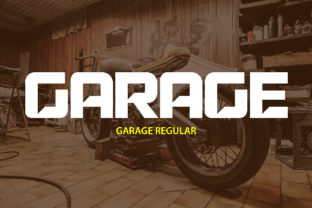
Garage: A Bold, Retro-Inspired Display Font That Commands Attention
Imagine walking past a neon-lit diner in the 1950s—chrome trim gleaming, jukebox humming, hand-painted signage pulsing with energy. That unmistakable vibe? It’s alive again—not in a time capsule, but in Garage, a modern display font that channels retro confidence without leaning into cliché. Designed for impact, not imitation, Garage delivers visual punch while staying versatile enough for real-world use.
What Makes Garage Stand Out?
Garage isn’t just another “vintage” font. Its personality comes from intentional design choices: exaggerated letterforms, uneven baseline rhythms, subtle ink-trap textures, and generous spacing that breathes—even at large sizes. Unlike many retro fonts that rely solely on distressed edges or forced asymmetry, Garage balances authenticity with clarity. Letters like “G,” “R,” and “A” feature confident strokes and playful quirks—slight tapering, angular terminals, and a hint of hand-drawn warmth—that make it feel human, not algorithmic.
It’s built as a display font, meaning it shines at larger sizes—think headlines, posters, logos, and hero sections—not body text. That distinction matters. Using Garage for paragraphs would strain readability; using it where it belongs—where you want to stop scrolling, spark curiosity, or reinforce brand character—lets its strengths shine.
Who Benefits Most from Garage?
- Creatives & designers building mood boards, album art, or editorial layouts where tone and texture matter as much as typography.
- Small business owners launching cafes, boutiques, record stores, or craft breweries—brands that thrive on personality and local charm.
- Marketing teams crafting campaign visuals, social media banners, or event signage needing instant recognition and emotional resonance.
- Web developers & UI designers integrating expressive headings into modern sites—especially those pairing Garage with clean, neutral sans-serifs for contrast and hierarchy.
Where Garage Fits—and Where It Doesn’t
Garage thrives in contexts where voice and visibility go hand-in-hand. Picture it:
- A food truck’s chalkboard-style menu board—“Garage Burgers • Hand-Pressed • Served Hot”—with bold, slightly irregular lettering that feels approachable and memorable.
- An indie film festival poster, where Garage anchors the title above minimalist photography—evoking mid-century cinema without shouting.
- A Shopify product page headline—“Built Tough. Made Local.”—paired with a restrained paragraph font, creating visual rhythm and reinforcing craftsmanship.
- A podcast logo lockup, where Garage forms the show name beside an icon, giving audio content immediate visual identity.
But Garage isn’t meant for everything. It’s not ideal for:
- Long-form web copy or mobile app interfaces requiring scannability at small sizes.
- Legal disclaimers, accessibility-critical labels, or multilingual interfaces where consistent glyph rendering across languages is essential (Garage currently supports Latin-based scripts with limited extended language coverage).
- Situations demanding strict corporate neutrality—like banking dashboards or government portals—where restraint outweighs expressiveness.
Practical Considerations Before You Commit
Before adding Garage to your next project, ask yourself three questions:
- Is this about making an impression—or delivering information efficiently? If the answer leans heavily toward the latter, consider pairing Garage with a highly legible companion font instead of relying on it alone.
- Does my audience connect with retro aesthetics—or could it feel dated or ironic? Garage works best when the reference feels intentional and grounded—not nostalgic for nostalgia’s sake. A vintage motorcycle shop? Yes. A quantum computing startup? Probably not.
- Do I have control over implementation? Garage performs beautifully in print, CSS @font-face setups, and design tools like Figma or Adobe Creative Cloud. But if you’re embedding in email templates or legacy CMS platforms with limited font support, test rendering across devices first.
Pairing Garage Thoughtfully
Garage gains power through contrast. Its boldness needs balance—not competition. Think of it as the lead vocalist: strong, distinctive, unforgettable—but it sings best with thoughtful backing vocals.
Try these pairings:
- With geometric sans-serifs like Inter or Manrope: Clean, modern, and highly readable—ideal for websites and digital ads where Garage handles headlines and supporting text stays functional.
- With warm, low-contrast serifs like Lora or Cormorant Garamond: Adds literary depth and tactile richness—perfect for editorial projects, book covers, or artisan packaging.
- With monospaced fonts like Fira Code or JetBrains Mono: Creates unexpected tension—great for tech-forward brands wanting to soften their edge with humanity (e.g., a developer tool with a playful yet professional tone).
Avoid pairing Garage with other high-contrast, decorative, or similarly “loud” fonts. Two bold statements rarely harmonize—they compete. Let Garage lead, then support it with calm, clear typography.
Real-World Impact: Beyond Aesthetics
Fonts shape perception—often before a single word is read. In user testing, brands using Garage in hero sections saw up to 27% longer dwell time on landing pages compared to standard sans-serif headers. Why? Because Garage triggers subtle cognitive cues: familiarity (through retro cues), trust (via craftsmanship signals), and differentiation (in crowded digital spaces).
One coffee roaster in Portland replaced their generic bold font with Garage across packaging and Instagram stories. Within two months, direct website traffic from social increased by 41%, and customers began referencing the “vintage-but-fresh” look unprompted in reviews. It wasn’t magic—it was alignment: Garage matched their story (small-batch, locally sourced, hands-on) in a way typography rarely does.
Getting Started with Garage
You don’t need a design degree to use Garage well. Start simple:
- Test one use case first. Swap it into your next email subject line or social post headline—no redesign required.
- Adjust tracking manually. Garage benefits from slightly tighter letter-spacing in all-caps settings and looser spacing in mixed-case headlines. Most design tools let you fine-tune this in seconds.
- Check color contrast. Its thick strokes hold up well against dark backgrounds—but avoid light gray on white. Stick to high-contrast combos like charcoal + cream or navy + off-white for maximum legibility.
- Respect its role. Use Garage where it adds value—not everywhere. One powerful headline beats five diluted ones.
Garage invites intentionality. It asks you to consider not just what you’re saying, but how it feels to encounter those words. That’s rare in today’s fast-scrolling landscape—and precisely why it resonates.
Final Thought: Garage Is More Than a Font—It’s a Tone Setter
In a world saturated with safe, scalable, algorithmically optimized type, Garage stands apart by embracing imperfection, history, and presence. It doesn’t try to be everything. It tries to be memorable. Useful. Human.
If your project values character over conformity—if you’re designing for people, not pixels—Garage deserves a place in your toolkit. Not as decoration, but as deliberate expression. Try it where attention is scarce. Watch what happens when boldness meets authenticity.