El Cabestor
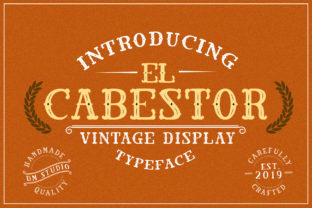
El Cabestor is a bold, retro-themed display font inspired by mid-20th-century Western and Americana visual culture. Its design features high-contrast letterforms, pronounced serifs, sharp angles, and deliberate irregularities that evoke vintage signage, rodeo posters, and classic Western film titles. It is not a text or body font — it is intended for short, impactful applications where strong thematic resonance matters more than extended readability.
Who Might Consider El Cabestor?
Designers working on branding, packaging, event promotion, or digital assets with a clear Western, rustic, frontier, or nostalgic American aesthetic may find El Cabestor relevant. This includes creators developing identities for craft breweries, barbecue restaurants, country music acts, outdoor apparel lines, or themed entertainment venues. It’s also used in editorial design for magazine covers or book jackets where tone and genre signaling are central to audience recognition.
Key Benefits of Using El Cabestor
- Strong thematic alignment: Its visual language communicates “Western” without relying on clichéd imagery like cacti or cowboy hats — the typeface itself carries the message.
- High visual impact: The bold weight and exaggerated proportions ensure legibility at large sizes, especially in print or environmental graphics such as banners, murals, or storefront signage.
- Retro authenticity: Unlike many generic “cowboy” fonts, El Cabestor avoids cartoonish exaggeration. Its construction reflects real historical sign-painting techniques, lending credibility to period-accurate or stylistically grounded projects.
- Distinctive voice: In saturated markets — such as food & beverage or lifestyle branding — using El Cabestor can help a project stand out through typographic personality rather than novelty alone.
Important Tradeoffs and Limitations
El Cabestor is intentionally narrow in scope. It lacks lowercase letters, numerals, and extensive punctuation — a common trait among display-only typefaces. Its character set is typically limited to uppercase Latin letters, meaning it cannot support full sentences, body copy, captions, or multilingual content. This isn’t a flaw, but a design constraint: El Cabestor assumes pairing with a neutral, highly legible companion font for supporting text.
Its stylistic intensity also means it performs poorly in contexts requiring subtlety, formality, or broad demographic appeal. For example, it would be unsuitable for healthcare communications, academic publishing, or corporate reports — not because it’s “bad,” but because its voice conflicts with audience expectations in those settings.
Additionally, licensing varies across vendors. Some versions include only desktop use; others add webfont or app embedding rights. Users should verify license terms before committing to a project, particularly if deployment spans multiple platforms or requires variable font functionality (which El Cabestor does not support).
When El Cabestor Is a Strong Fit
El Cabestor excels when the goal is immediate, unambiguous tone-setting. A brewery launching a new “Frontier Stout” benefits from El Cabestor on the label — it signals heritage, ruggedness, and regional identity before a single word is read. Similarly, a music festival poster using El Cabestor for the headliner name creates instant genre context, reinforcing the lineup’s stylistic cohesion.
It works well in static, high-visibility environments: physical signage, large-format prints, title sequences, or hero sections of websites where users scan rather than read deeply. In these cases, its strengths — memorability, mood, and visual authority — directly support communication goals.
When Alternatives May Be More Appropriate
If your project requires versatility across multiple touchpoints — such as a brand system needing logos, website headers, email campaigns, and product packaging — El Cabestor’s limitations become practical hurdles. A more flexible display font with extended language support, optical sizing variants, or OpenType features (like stylistic alternates or ligatures) may serve better long-term.
For projects emphasizing inclusivity or modern minimalism, El Cabestor’s strong stylistic bias may unintentionally exclude audiences or feel tonally misaligned. In those cases, fonts like Playfair Display (for serif-based elegance), Montserrat (for clean, adaptable sans-serif impact), or Reem Kufi (for bilingual or culturally nuanced contexts) offer broader utility without sacrificing presence.
Also consider alternatives if budget or technical constraints apply. Free or open-source fonts with similar Western undertones — such as Redressed or Old Standard TT — provide accessible starting points for early-stage exploration, though they often lack the refined detailing and intentional irregularity that distinguish El Cabestor.
Practical Decision-Making Guidance
Before selecting El Cabestor, ask three questions:
- Is the primary goal tone or function? If tone dominates — e.g., evoking a specific era, region, or cultural reference — El Cabestor is worth serious consideration. If functional needs like multilingual support, responsive typography, or accessibility compliance are central, prioritize fonts built for those requirements.
- What’s the usage scope? List every place the font will appear: logo, website banner, social media graphics, merchandise, printed menus, etc. If more than two of those require extended character sets or small-size legibility, El Cabestor likely won’t scale effectively without significant typographic layering — which adds complexity and cost.
- Does it complement, not compete with, other design elements? El Cabestor has strong visual gravity. Pair it with restrained color palettes, ample whitespace, and simple layouts. Overloading it with ornate illustrations or competing textures dilutes its impact and risks visual fatigue.
Final Considerations
El Cabestor is a purpose-built tool — not a universal solution. Its value lies in specificity: when Western themes are central to a project’s identity, and when visual shorthand matters more than typographic flexibility. Evaluating it shouldn’t revolve around whether it’s “good,” but whether its particular strengths match your concrete needs.
Test it early in context. Render El Cabestor alongside your intended body font at actual sizes and in real environments (e.g., mock up a business card or website header). Observe how it behaves across devices and under different lighting conditions. Compare it side-by-side with one or two alternatives using the same hierarchy and layout — not just as isolated letters, but as part of a complete communication system.
Ultimately, typography supports meaning. El Cabestor supports a very particular kind of meaning — one rooted in legacy, landscape, and cultural narrative. When that narrative is yours to tell, it’s a compelling choice. When it isn’t, choosing otherwise isn’t a compromise — it’s precision.