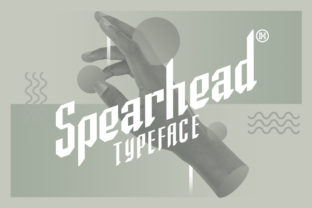
Spearhead: A Timeless Display Font
When a headline needs presence—not just readability, but resonance—Spearhead steps in. It’s not a workhorse font built for paragraphs or interfaces. It’s a display typeface: bold, confident, and deliberately crafted to command attention. Its clean geometry, balanced weight distribution, and subtle humanist touches give it both structure and warmth—making it feel classic without leaning into nostalgia.
Why “display” matters—and who notices
Display fonts like Spearhead serve a specific role: they’re designed for short bursts of high-impact text—logos, posters, book covers, hero banners, signage, or even engraved business cards. They’re not meant for body copy, and that’s by design. What makes Spearhead stand out isn’t novelty, but consistency: its letterforms hold up across sizes, from a 36pt magazine title to a 120pt mural, without losing clarity or character.
That reliability means different people notice different things—depending on what they’re trying to do, and what’s at stake.
For designers and branding professionals
Professionals often evaluate Spearhead through the lens of versatility and integration. Does it pair well with a clean sans-serif for supporting text? Can it anchor a brand identity without overwhelming it? Many use it for luxury goods, editorial features, or institutional campaigns—where authority and timelessness matter more than trendiness. One designer told us she chose Spearhead for a university’s 150th anniversary campaign because “it felt substantial, but not stiff—like tradition with room to breathe.”
For small business owners and entrepreneurs
If you’re launching a café, boutique, or creative studio, your logo and storefront signage are often the first impression—and sometimes the only one people get before walking past. Spearhead offers a strong, legible option that doesn’t require custom lettering or expensive licensing. It works well in both digital ads and vinyl decals. Because it’s widely supported in design tools and web platforms (via variable font files or standard OTF), there’s little technical friction—no need to hire a developer just to get it live on your site.
For educators and students
In classroom presentations, thesis titles, or academic posters, clarity and professionalism go hand-in-hand. Spearhead helps students elevate their work visually without relying on decorative fonts that distract or undermine credibility. Educators appreciate that it’s easy to teach as an example of rational, humanist-influenced design—its vertical stress and open counters make it ideal for discussing typographic anatomy or visual hierarchy.
For bloggers and content creators
A blog header or YouTube banner is prime real estate. Spearhead gives personality without sacrificing scannability. Unlike overly stylized fonts, it remains readable at smaller sizes on mobile—and its strong x-height ensures letters don’t vanish in thumbnail previews. One food blogger uses it for her recipe card headers because “it feels grounded, like the ingredients themselves—not flashy, but honest.”
What to consider before using Spearhead
Like any tool, Spearhead shines brightest when matched to the right job. Here’s how to check if it fits yours:
- Ease of use: It installs like any desktop font and works in Figma, Adobe Creative Cloud, Affinity apps, and modern CSS environments. No plugins or special setup needed.
- Flexibility: While it’s a display font—not intended for long text—it does come in multiple weights (Light to Bold) and supports Latin-based languages, including accented characters used in French, Spanish, and German.
- Commercial value: Licensing varies by vendor, but most reputable sources offer clear, one-time purchase options for personal and commercial use—including social media, merch, and client work. Always verify the license scope before deploying in a product or campaign.
- Creativity support: Its strong rhythm invites thoughtful pairing. Try it with a neutral, highly legible sans-serif (like Inter, Lato, or Source Sans) for contrast—or layer it subtly behind transparent text for texture.
A note on expectations
Spearhead won’t solve layout problems, fix weak hierarchy, or compensate for low-resolution images. It also won’t magically make a rushed design feel intentional. But when used thoughtfully—with space, contrast, and purpose—it amplifies intention. That’s why it endures: not because it’s loud, but because it’s sure.
Real-world moments where Spearhead fits naturally
- A freelance illustrator adds it to her portfolio site’s hero section—replacing a generic sans-serif. The shift signals craft, not just competence.
- A nonprofit launches a fundraising campaign with a single-word headline (“Resilience”) set in Spearhead Bold. Volunteers report it “feels like something worth showing up for.”
- A teacher creates printable science fair certificates. Students recognize the font as “the serious one”—and treat the award with more care.
- A podcast host uses it for episode cover art thumbnails. Listeners say the visuals “match the tone—clear, direct, no filler.”
Who might look elsewhere—and why
Spearhead isn’t built for every scenario. If your project demands extreme narrowness (for tight columns), ultra-light delicacy (for minimalist beauty brands), or expressive quirks (like hand-drawn flair), other fonts may suit better. Likewise, if you need extensive language support—Cyrillic, Arabic, or extended Vietnamese diacritics—you’ll want to confirm coverage before committing.
Beginners sometimes assume “iconic” means “universal.” But typography is contextual. A font that anchors a museum exhibition may feel too heavy for a children’s app. That’s not a flaw—it’s focus.
Making your own call
You don’t need a design degree to sense whether Spearhead fits. Ask yourself:
- Is this text meant to be seen quickly—and remembered?
- Does the project benefit from quiet confidence over playful energy?
- Will it appear in formats where clarity at scale matters (print, large screens, signage)?
- Do I have the time and tools to test it alongside my supporting type choices?
If three or more answers are yes, Spearhead is likely a strong candidate. And if you’re still unsure? Try it in a low-stakes place first—a slide title, a social post, or a mockup. See how it feels—not just how it looks.
Because great typography isn’t about perfection. It’s about alignment: between voice and vehicle, message and medium, intention and execution. Spearhead doesn’t shout. It stands ready—when the moment calls for something unmistakably, unapologetically present.