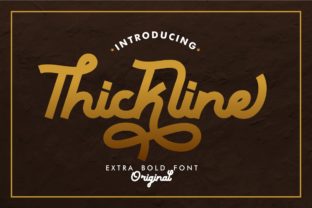
Thickline
What Makes Thickline Stand Out?
- Organic thickness: Not uniform or digital-perfect, but intentionally varied—thicker at stress points, softer at terminals—to mimic expressive hand-drawn energy.
- Playful yet powerful: Rounded corners and open counters keep it friendly, while its generous x-height and sturdy proportions ensure legibility and authority—even at smaller sizes.
- Display-first versatility: Designed for headlines, logos, posters, and social banners—but also surprisingly effective in short-form UI elements like buttons or app splash screens.
- Character-rich personality: Includes stylistic alternates, ligatures, and multilingual support (Latin-based languages), letting creators fine-tune tone without switching fonts.
Who Benefits Most from Using Thickline?
Small business owners love Thickline for branding that feels human and memorable. A local bakery might use it on chalkboard-style signage or Instagram Stories to signal freshness and craft. A boutique fitness studio could apply Thickline to class posters or app onboarding screens—communicating energy and confidence without shouting.
Creative professionals, from freelance designers to motion graphics artists, rely on Thickline when clients need “instant recognition.” Its strong silhouette works beautifully in animation, where bold shapes hold up during transitions and scaling. And because it pairs well with clean sans-serifs (like Inter or Poppins), it slots seamlessly into modern brand systems—not as an afterthought, but as the anchor.
Educators and nonprofit communicators find Thickline especially useful for outreach materials. Its clarity at large sizes helps draw attention to calls-to-action in community flyers or advocacy campaigns—while its friendliness softens formal messaging, making complex topics feel more accessible.
Where Thickline Shines (and Where It Doesn’t)
- Perfect for: Headlines, logos, packaging accents, social media visuals, presentation slides, merchandise, and short-form web banners.
- Less ideal for: Long paragraphs, body text, dense data tables, or interfaces requiring high-density information scanning.
- Important note: While Thickline includes lowercase letters and numerals, its true voice lives in uppercase and title-case settings—where its rhythm and spacing truly sing.
Real Projects, Real Impact
- A podcast about sustainable living uses Thickline for its logo and episode thumbnails—immediately conveying groundedness and vitality. Listeners associate the font with sincerity and action, not just aesthetics.
- An indie game studio selects Thickline for their title screen and achievement badges. Its tactile, almost “carved” quality reinforces the game’s handcrafted world-building—and players report feeling more immersed from the first frame.
- A university’s continuing education department adopts Thickline for workshop announcements. It stands out in crowded email inboxes and digital signage—without alienating adult learners who value both professionalism and warmth.
How to Evaluate If Thickline Fits Your Project
- What emotion do I want people to feel first? If the answer includes “energetic,” “confident,” “friendly,” or “authentic”—Thickline is likely aligned.
- Is this message meant to be seen quickly—or read slowly? Thickline rewards glances, not deep dives. If your audience will scan in under three seconds (think social feeds or event posters), it’s a strong candidate.
- Does my brand already have a “voice”? Thickline harmonizes best with brands that embrace humanity over perfection—those unafraid to show texture, variation, and joy in their communication.
Pairing Thickline Thoughtfully
Try pairing Thickline with:
- A warm, neutral sans-serif (e.g., Manrope or Commissioner) for balanced contrast and modern clarity.
- A relaxed serif (e.g., IBM Plex Serif or Cormorant Garamond) when aiming for editorial sophistication with a twist.
- Even another display font—if it’s quieter and more geometric—for dynamic, layered hierarchy (e.g., Thickline headlines over Space Grotesk subheads).