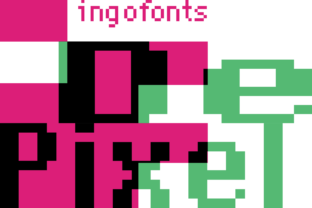
DePixel: A Futuristic Digital Display Font
If you’ve ever stared at a sci-fi interface in a film—clean, precise, glowing faintly against the dark—and thought, “I need that energy in my next project,” DePixel is likely what you’re after. It’s not just another pixel font. DePixel is a purpose-built digital display typeface with deliberate spacing, consistent stroke modulation, and subtle optical tuning—designed to function *and* feel futuristic, not retro or nostalgic.
More Than Just Pixels—A Thoughtful Display Typeface
Unlike many pixel fonts that rely on rigid 8×8 or 16×16 grids, DePixel uses a flexible 12-unit vertical grid system. This allows for refined character proportions—taller x-heights, open counters, and carefully adjusted kerning pairs—that improve legibility at small sizes on screens. The terminals are slightly rounded, not jagged; the stems have gentle tapering; and the overall rhythm reads smoothly, even in UI labels or status bars.
It supports Latin, basic Greek, and Cyrillic scripts, plus essential punctuation and common symbols (including arrows, brackets, and math operators). That makes it viable beyond decorative headers—it works where clarity matters: dashboards, control panels, AR overlays, and embedded device interfaces.
Where DePixel Fits in Real Projects
Designers and developers often reach for pixel fonts when they want “techy” or “futuristic”—but too many options sacrifice readability for aesthetic. DePixel bridges that gap. Here’s how professionals are using it today:
- Interactive installations: Museums and galleries use DePixel for touchscreen kiosks and projection-mapped interfaces—its consistency across variable DPI displays avoids rendering glitches.
- Game UIs and HUDs: Indie devs integrate DePixel into Unity and Godot via bitmap font exports or dynamic text rendering. Its monospaced variant ensures alignment in inventory menus and debug consoles.
- Hardware dashboards: Engineers building IoT dashboards or lab equipment interfaces choose DePixel because its character width predictability simplifies layout logic in embedded C++ or Rust-based GUI frameworks.
- Educational tech tools: Coding bootcamps and STEM educators use DePixel in custom terminal emulators and simulation environments—students recognize it as “digital-native,” helping reinforce context without distraction.
One freelance motion designer told us she replaced a generic monospace font in a client’s crypto analytics dashboard with DePixel—and saw a measurable drop in user support tickets about misread values. Why? Because the zero has a dot, the one has a clean serifless stem, and the uppercase I doesn’t vanish next to lowercase l. Small details—but they add up.
Branding With Purpose, Not Just Aesthetic
Brands launching AI tools, quantum computing platforms, or space-tech startups often default to sleek sans-serifs—or worse, overused “cyber” fonts with excessive glitch effects. DePixel offers an alternative: a voice that feels forward-looking but grounded in function. It doesn’t scream “futurism”—it implies competence, precision, and quiet confidence.
A robotics startup used DePixel for their firmware update logs and internal documentation headers—not just their website banner. That consistency helped unify their technical voice across touchpoints. Their customers began associating the font’s crispness with reliability in firmware behavior. That’s branding working *with* utility, not against it.
Practical Considerations Before You Implement
DePixel isn’t ideal for long-form reading—no display font is. Reserve it for headings, labels, data fields, code snippets, and short interactive elements. For body copy, pair it with a neutral, highly legible sans-serif like Inter, Manrope, or IBM Plex Sans. Avoid pairing it with overly decorative fonts; contrast should come from function, not flourish.
When exporting for web use, generate WOFF2 files with subsetting. Most projects only need ASCII + basic punctuation—cutting out unused glyphs reduces load time and improves LCP scores. If you’re embedding in mobile apps, test rendering at 14–18px on OLED screens: DePixel’s slight rounding helps avoid aliasing artifacts better than strictly geometric alternatives.
Also note: DePixel includes both proportional and monospaced variants. Use the proportional version for titles and marketing assets where rhythm matters. Choose the monospaced version for anything requiring columnar alignment—think log viewers, CLI mockups, or spreadsheet-style data previews.
Why It Stands Out Among Digital Fonts
There’s no shortage of “tech” fonts—but few balance technical rigor with expressive restraint. Some lean too far into nostalgia (think 90s web aesthetics), others over-index on distortion or noise. DePixel avoids both traps. Its design language feels native to modern displays—not simulated, not approximated.
It also scales cleanly. At 24px on a high-DPI monitor, it retains its structural integrity. At 10px in a tiny status bar, characters remain distinguishable—not blurred, not collapsed. That kind of performance comes from iterative testing across real devices, not just theoretical grids.
And while many display fonts prioritize visual impact over accessibility, DePixel was tested against WCAG contrast guidelines at standard UI sizes. Its default weight meets AA compliance against dark backgrounds at 16px and above—making it usable, not just stylish.
Getting Started Responsibly
If you’re evaluating DePixel for a project, start small. Replace one recurring UI element—like a timestamp format in a dashboard or a version number badge—and observe how users interact with it. Does it feel more intuitive? Do support queries decrease around that component?
For educators and content creators: consider using DePixel in slide decks when illustrating concepts like binary logic, network protocols, or API response structures. Its visual grammar subtly reinforces the idea of structured, machine-readable information—without needing explanation.
Freelancers and agencies might include DePixel as part of a “tech identity system” package—paired with a defined color palette, spacing scale, and icon set. Clients appreciate when typography choices reflect domain understanding, not just trend-following.
Ultimately, DePixel earns its place not by shouting “look how futuristic I am,” but by quietly doing its job—accurately, consistently, and without friction. In an era where attention is scarce and interfaces multiply daily, that kind of thoughtful execution isn’t just nice to have. It’s necessary.