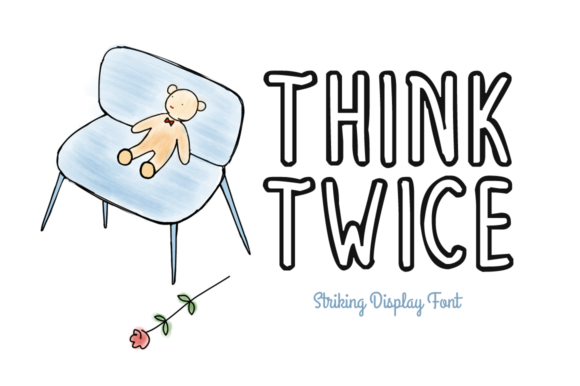
Think Twice: A Handwritten Display Font That Feels Human, Not Hectic
Think Twice isn’t just another script font—it’s the visual equivalent of a thoughtful pause before speaking. Designed with intentional lightness and natural flow, it captures the warmth and authenticity of real handwriting without sacrificing legibility or versatility. It’s not overly ornate, not aggressively casual, and never stiff. Instead, Think Twice lands in that sweet spot where personality meets practicality—ideal for designers, marketers, educators, small business owners, and creative professionals who want their work to feel approachable, genuine, and quietly confident.
Where Think Twice Fits Naturally (and Where It Doesn’t)
Think Twice shines brightest when you’re aiming for connection—not decoration. It’s built for moments where tone matters as much as message. You’ll find it working beautifully on:
- Local café menus and chalkboard-style signage—its airy weight and subtle bounce give food and drink listings a friendly, unhurried vibe. Unlike heavier scripts that can feel overwhelming at small sizes, Think Twice stays legible even at 24–36pt in print or on digital displays.
- Wedding stationery and boutique invitations—especially for couples leaning into relaxed elegance over formality. Pair it with a clean sans-serif for body text, and you get sophistication that breathes, not shouts.
- Educational handouts and classroom posters—teachers report students respond more warmly to materials using Think Twice for titles and headings. It subtly signals “this isn’t rigid—we’re learning together.”
- Small business branding elements—think handmade soap labels, ceramic studio logos, or indie bookshop banners. Its light contrast and open letterforms reflect craftsmanship and care, not mass production.
- Social media graphics and Instagram story highlights—where readability on mobile is non-negotiable. Think Twice scales well across devices, especially when used sparingly for headlines or quotes.
That said, Think Twice isn’t meant for long paragraphs, legal disclaimers, or technical documentation. Its handwritten rhythm slows reading pace—a strength in context, but a limitation in dense information settings. If your project needs rapid scanning or high-density text, pair it thoughtfully: use Think Twice for headers, callouts, or short quotes, then switch to a highly legible sans-serif or serif for body copy.
Who Benefits—and How
Freelance designers appreciate how Think Twice bridges client expectations. When a client says “make it feel personal but professional,” this font delivers without requiring custom illustration or complex kerning adjustments. It’s ready-to-use, yet feels bespoke—saving time without sacrificing voice.
Small business owners without design experience find Think Twice surprisingly forgiving. Because it’s light and balanced—not tightly spaced or excessively slanted—it resists looking “messy” even when used in basic tools like Canva or Google Slides. A single-word logo lockup (“Bloom,” “Haven,” “Trove”) often works better here than a full sentence.
Educators and nonprofit communicators use Think Twice to soften institutional messaging. A community health flyer titled “Let’s Talk About Sleep” in Think Twice feels like an invitation—not an edict. That subtle shift in perception helps information land more gently, especially around sensitive topics.
Content creators building brand consistency rely on Think Twice for recurring visual motifs: quote cards, podcast episode thumbnails, email newsletter headers. Its consistency across formats (web, print, video) builds recognition without monotony—especially when paired with a limited color palette and intentional spacing.
Practical Considerations Before You Apply It
Think Twice performs best when treated with intention—not sprinkled everywhere. Here’s what seasoned users watch for:
- Color contrast matters more than usual. Because of its light stroke weight, it needs strong background contrast to stay readable—especially on screens. Avoid pale gray text on off-white backgrounds, or thin black on dark navy. Deep charcoal on cream or true black on crisp white tends to hold up best.
- Size and spacing aren’t optional extras—they’re part of the design. At smaller sizes (under 20pt), increase letter-spacing slightly. At larger sizes (60pt+), reduce tracking to preserve rhythm. Test on both desktop and mobile before finalizing.
- It pairs exceptionally well with humanist sans-serifs—like Inter, Lato, or Poppins—but can clash with geometric or ultra-thin fonts. Avoid pairing with other scripts unless they’re dramatically different in weight and purpose (e.g., a bold brush script for emphasis alongside Think Twice’s gentle headline).
- Licensing is straightforward—but verify your use case. Most versions cover web, desktop, and app embedding, but check if you need extended rights for merchandise or large-scale print runs. Free trials are available, but commercial projects require a license.
What Makes Think Twice Stand Out in Practice
Unlike many handwritten fonts that lean into quirk or nostalgia, Think Twice feels contemporary and grounded. Its lowercase “a” and “g” are simple and open—not fussy. The ascenders and descenders have gentle curves, not sharp hooks. And crucially, it avoids the “too-perfect” trap: slight variations in stroke width and subtle irregularities keep it feeling hand-drawn, not algorithmically generated.
You’ll notice it most when it’s working quietly—like on a wellness coach’s workshop handout where the title “Breathe In, Begin Again” feels like encouragement, not instruction. Or on a local bookstore’s seasonal reading list, where “Summer Reads You’ll Actually Finish” gains warmth just from the font choice.
It also adapts gracefully across mediums. Print? It holds detail beautifully on matte paper. Web? Light font-weight renders cleanly with modern CSS font-display settings. Even embroidery digitizers report success converting Think Twice outlines for fabric applications—its simplicity translates well beyond pixels and ink.
A Few Quiet Limitations to Keep in Mind
Think Twice doesn’t include extensive language support—Latin-based languages only, no Cyrillic or extended diacritics. If your audience spans multiple scripts, plan for fallbacks early. Also, while it offers standard OpenType features (ligatures, stylistic alternates), it doesn’t include swashes or decorative flourishes—so if your project calls for dramatic embellishment, you’ll want to layer or complement, not rely solely on the font.
And because it’s light by design, it’s not ideal for low-resolution environments—think projected slides in bright rooms or low-DPI printed flyers. Always test in the actual environment where it will be seen.
Ultimately, Think Twice earns its place not by doing everything, but by doing one thing exceptionally well: helping your words feel like they came from a person—not a template. Whether you're naming a new product, designing a community event poster, or refreshing your portfolio, it’s the kind of font that makes viewers pause, soften their shoulders, and lean in—just a little. That’s not just design. That’s resonance.