Detached: A Display Font with Grungy Charm and Clear Design Intent
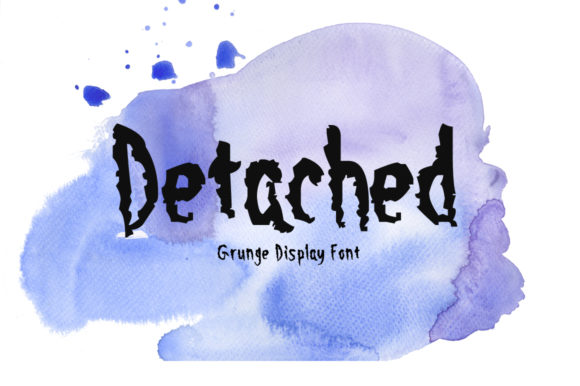
Detached stands apart as a display font that balances deliberate imperfection with strong visual identity. It’s not designed for body text or long-form reading—its purpose is bolder, more intentional. With uneven stroke weights, subtle irregularities in letterforms, and a slightly off-kilter rhythm, Detached conveys energy and attitude without veering into illegibility. It’s “cute” in the sense of having playful proportions and unexpected details—like a rounded ‘g’ or softened terminals—but “grungy” in its controlled roughness: ink bleeds implied, edges feel hand-drawn, and spacing carries a human pulse.
What Makes Detached Distinct from Other Display Fonts?
Many display fonts lean heavily into one trait: either polished minimalism, high-contrast elegance, or chaotic distortion. Detached occupies a narrower middle ground—one where personality emerges from restraint. Unlike ultra-thin geometric sans-serifs or aggressively distressed typefaces, Detached uses texture sparingly. Its grunge isn’t simulated distress (cracks, scratches, or noise overlays), but built into the letter construction: slight asymmetry in curves, variable baseline alignment, and intentional inconsistencies in terminal shapes.
This approach gives Detached a different kind of versatility. It reads clearly at medium sizes (36–72pt) on screen and in print, yet still carries enough character to avoid blending into background noise. That balance matters when evaluating alternatives: some fonts gain attention through sheer loudness, while others fade because they’re too neutral. Detached earns notice without shouting—and holds it through nuance.
Fitting Detached Into Real Projects
Detached works best where tone and identity matter more than neutrality. Think album artwork for indie rock or lo-fi electronic acts, editorial headlines for culture-focused magazines, packaging for small-batch skincare or craft beverage brands, or digital banners for creative workshops and art collectives. In each case, the font supports—not overrides—the message. A coffee roaster using Detached on a bag label signals approachability and authenticity; the same font on a corporate annual report would feel misaligned.
It also performs well in motion graphics and social media visuals, where its distinct letterforms scale cleanly and retain legibility even in fast-cut sequences. Because its quirks are structural rather than decorative, Detached avoids the pixelation or blurring issues that sometimes plague highly textured or low-resolution display fonts at smaller sizes.
Comparing Strengths and Practical Tradeoffs
One of Detached’s quiet advantages is its limited but thoughtful character set. It includes standard Latin uppercase and lowercase letters, numerals, and basic punctuation—enough for most short-form applications, but not extended language support or OpenType features like stylistic alternates or ligatures. That’s not a flaw; it’s a design decision aligned with its role. If your project requires multilingual typesetting, complex typographic hierarchy, or fine-grained control over letterfitting, Detached won’t serve as a system font. It’s a spotlight typeface—not a stagehand.
Contrast this with more expansive display families that ship with multiple weights, optical sizes, or companion text faces. Those offer flexibility across contexts but often sacrifice distinctiveness in exchange for utility. Detached trades breadth for voice: you get one strong, cohesive style, not a toolkit. That makes it easier to implement consistently—and harder to misuse through overcomplication.
Another tradeoff lies in pairing. Because Detached has such clear personality, it pairs most effectively with understated, highly legible sans-serifs or low-contrast serifs. A clean, neutral typeface—like a modest humanist sans—creates useful contrast without competing. Pairing it with another high-character display font often results in visual tension rather than harmony. That doesn’t mean Detached is hard to use—it means it asks for thoughtful context, not default application.
When Detached Is the Right Choice
Consider Detached if your goal is to signal creative confidence without resorting to cliché. It fits naturally in projects where audience expectations include warmth, honesty, and a touch of irreverence—especially when those values are already present in imagery, writing tone, or brand behavior. For example, a nonprofit focused on youth arts education might use Detached in campaign posters to reflect the raw, evolving nature of student work—while relying on a simple sans-serif for body copy and logistical details.
It also suits time-bound or experimental initiatives: limited-run zines, event branding for pop-up galleries, or prototype interfaces where visual distinction helps users orient quickly. In those cases, Detached’s uniqueness becomes functional—not just aesthetic. Its recognizability supports memory and recall, especially when used consistently across touchpoints.
When Another Option May Serve Better
Detached isn’t ideal for interfaces requiring rapid scanning or high information density. Navigation menus, data dashboards, or instructional materials benefit from predictability and uniformity—qualities Detached intentionally sets aside. Similarly, if your brand voice leans toward tradition, authority, or precision (e.g., legal services, financial reporting, academic publishing), Detached’s informality may dilute credibility rather than reinforce it.
Projects needing scalability across many formats—such as global brand guidelines with strict typography rules—may find Detached too singular. You can’t build a full typographic system around it alone. And if your workflow depends heavily on variable font interpolation, advanced kerning controls, or extensive language coverage, Detached’s focused scope will likely fall short.
Making an Informed Decision
Choosing a display font isn’t about finding the “best” one—it’s about matching expressive intent with functional needs. Detached excels when you want typography that feels intentional, human-scaled, and quietly confident. It rewards restraint: using it once per layout, at the right size and weight, with breathing room around it. Overuse flattens its impact; underuse misses its potential.
Before committing, test Detached in your actual environment—not just in a font menu. Render it at intended sizes on target devices. Check contrast against your background colors. Read it aloud to gauge rhythm. Compare how it behaves next to your chosen text font in real combinations, not isolated specimens. Does it elevate the message—or distract from it?
You’ll also want to consider licensing and technical fit. Detached is typically available as a desktop and web font with straightforward licensing terms, but verify usage rights for your specific context—especially for embedded applications or SaaS platforms. Some versions include only basic Latin characters, so confirm coverage if diacritics or extended punctuation are needed.
A Final Note on Intentional Typography
Detached reminds us that typography isn’t just about communication—it’s about resonance. Its appeal lies not in universality, but in specificity. It doesn’t try to be everything to everyone. Instead, it offers a clear point of view: friendly but unpolished, structured but spontaneous, familiar but distinctive.
That clarity makes Detached easier to evaluate honestly. If your project benefits from that kind of focused expression—if your audience responds to authenticity over polish, and personality over perfection—then Detached deserves serious consideration. If not, that’s equally valuable insight. The strongest typographic choices emerge not from trend-following, but from alignment between form, function, and intention.