Brave: The Vintage Display Font That Gives Western Designs Instant Character and Charm
If you're designing a poster for a local rodeo, branding a craft brewery with desert roots, or launching a retro-inspired apparel line, you know how hard it is to find a typeface that feels authentic—not gimmicky—while still standing out in a crowded visual landscape. That’s where Brave steps in: a stunning, fun, and deeply intentional vintage display font with a cool, confident Western spirit. It’s not just another “cowboy” font slapped with serifs and spur motifs. Brave balances nostalgic texture with modern legibility and expressive energy—making it a practical tool for designers who value both personality and precision.
Many creatives face the same quiet challenge: how to evoke a sense of place, heritage, or attitude without leaning on clichés. A poorly chosen Western font can unintentionally signal “costume,” “theme park,” or “low-effort novelty.” Worse, it may fail at basic functional needs—like scaling cleanly on a mobile banner or holding visual weight in a large-format print. Users often cycle through options only to land back at generic slab serifs or overused woodtype revivals. What’s missing isn’t more choices—it’s a font that *understands the assignment*: embody rugged individualism, warmth, and timelessness—all while performing reliably across real-world applications.
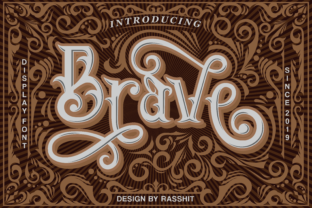
Brave answers that need by grounding its design in thoughtful vintage references—not imitation. Its letterforms nod to mid-century American signage, hand-painted diner menus, and regional advertising from the 1940s–60s, but with refined spacing, consistent stroke contrast, and open counters that ensure readability even at smaller sizes. The lowercase ‘a’ and ‘g’ carry subtle quirks; the uppercase ‘R’ has a confident, slightly flared leg; and the overall rhythm feels lively but never chaotic. That balance means Brave doesn’t shout—it commands attention with intention.
Practically speaking, Brave shines brightest where impact meets authenticity. Consider these everyday scenarios:
- Small business branding: A Sonoran taco truck named “Lone Cactus” uses Brave for its logo and menu board—immediately communicating regional pride and approachable boldness without needing illustrations or extra graphic elements.
- Festival and event identity: A boutique music festival in West Texas selects Brave for stage banners and lineup posters. Its strong verticals and warm curves hold up beautifully in sunlight and at distance, while still feeling human-scaled and inviting.
- Packaging design: A small-batch whiskey brand opts for Brave on its front label. The font’s tactile texture complements embossed foil and kraft paper stock—adding perceived craftsmanship and story before the bottle is even opened.
- Digital use (with care): When used sparingly—as a hero headline in a responsive email campaign or as a featured title in a Shopify store banner—Brave adds memorable character without compromising load time or accessibility, especially when paired with a clean, neutral sans-serif for body text.
It’s worth noting that Brave is designed as a display font—not a workhorse text face. That’s a feature, not a limitation. Smart implementation means using it where it can breathe: headlines, logos, short quotes, signage, and packaging fronts. Avoid setting full paragraphs or fine-print legal disclaimers in Brave. Instead, pair it intentionally: try it with a sturdy, low-contrast sans like Inter or Manrope for digital interfaces, or a warm, organic serif like Cormorant Garamond for editorial layouts. These combinations let Brave lead with personality while supporting content with clarity.
Different users will approach Brave differently—and that’s part of its strength. A solo designer building a client’s entire brand system might use Brave as the cornerstone of a custom typographic hierarchy, adjusting letter-spacing manually for each application to fine-tune rhythm. A marketer managing social assets week-to-week may rely on pre-built Canva templates that embed Brave in optimized headline styles—saving time without sacrificing cohesion. A print shop owner selecting fonts for in-house promotional materials might choose Brave specifically because its robust outlines render crisply on vinyl cutters and screen-printed textiles. In each case, the font serves a functional goal first—distinctiveness second.
One often-overlooked consideration is licensing and technical compatibility. Brave is available in standard OpenType format with full Latin character support, including accented characters commonly needed for bilingual Western U.S. markets (think Spanish-language signage in Arizona or New Mexico). It includes ligatures and alternate glyphs—subtle extras that add polish when enabled in design software like Adobe Illustrator or Affinity Designer. For web use, it’s best deployed via self-hosted @font-face declarations or trusted font services that support variable-weight delivery—ensuring fast loading and consistent rendering across devices.
Another practical tip: test Brave in context early and often. Because its charm lives in contrast—between its vintage soul and contemporary settings—seeing it alongside your actual imagery, color palette, and layout structure reveals whether it enhances or competes. Try it at three key sizes: large (for billboards or hero sections), medium (for product cards or event titles), and small (for secondary labels or captions). If it loses legibility or feels cramped at the smallest size, scale back usage—don’t force it. Let Brave do what it does best: anchor moments of visual emphasis with warmth and wit.
Ultimately, Brave succeeds not because it looks “old,” but because it feels *true*. It avoids caricature by honoring the craft behind vintage American typography—the slight imperfections, the hand-guided confidence, the pride in making something that lasts. That authenticity translates directly into trust: customers subconsciously read brands using Brave as grounded, intentional, and human-centered. Whether you’re refreshing a decades-old family business identity or launching something entirely new, Brave gives your project a voice that’s both distinctive and dependable.
So if your next Western-themed design feels flat, generic, or overly literal—pause before reaching for the next trending font. Ask instead: *What would make this feel lived-in, memorable, and unmistakably itself?* Chances are, the answer has a name—and it’s Brave.