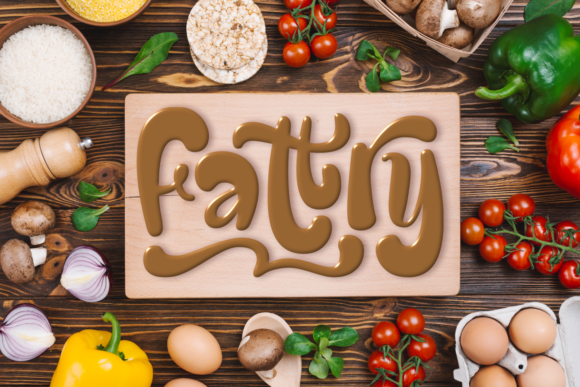
Fattry: Where Playful Typography Meets Purposeful Design
Typography is rarely just about legibility—it’s about voice, intention, and emotional resonance. In a digital landscape saturated with minimalist sans-serifs and overused variable fonts, designers increasingly seek typefaces that don’t just communicate information but invite engagement. Enter Fattry: a display font that balances bold personality with thoughtful structure, offering creators a rare blend of whimsy and reliability. Unlike decorative fonts that sacrifice function for flair, Fattry delivers character without compromising clarity—making it especially valuable for projects where tone and authenticity matter as much as readability.
What Makes Fattry Distinctive—Beyond the Surface
Fattry stands apart not because it’s “cute” or “quirky,” but because its design decisions are intentional and layered. Its letterforms feature gently exaggerated terminals, subtle ink-trap-inspired notches, and a rhythmic contrast between thick vertical strokes and soft, rounded counters. The uppercase ‘A’, for example, doesn’t simply taper—it leans forward slightly, evoking motion; the lowercase ‘g’ includes a looping, almost handwritten tail that feels familiar rather than forced. These aren’t arbitrary flourishes—they’re calibrated to support visual hierarchy and reinforce brand warmth without tipping into childishness.
Crucially, Fattry avoids the pitfalls common to playful display fonts: inconsistent x-heights, erratic spacing, or unpredictable kerning pairs. Its OpenType features include contextual alternates and stylistic sets that respond intelligently to adjacent characters—so “OO” doesn’t collapse into an indistinct blob, and “AV” maintains generous, readable spacing. This technical rigor means Fattry performs well across environments: from high-resolution print brochures to responsive web banners—even at 36px on mobile viewports, its proportions remain legible and expressive.
Real-World Applications Across Diverse Contexts
Fattry thrives where identity and approachability intersect. Consider how educators use it in classroom posters: a science unit titled “Wild Weather Wonders” gains immediate visual energy with Fattry in headline size, while body text remains in a neutral, accessible sans-serif. The font signals curiosity and openness—not authority-by-intimidation—making complex topics feel more inviting to learners of all ages.
In product packaging, Fattry helps small-batch brands differentiate themselves on crowded shelves. A locally roasted coffee label using Fattry for its origin story (“Guatemala Antigua, Sun-Ripened & Slow-Roasted”) conveys craft and care more effectively than a generic slab serif. Consumers subconsciously associate its rounded geometry with warmth and human touch—aligning perception with values like sustainability and community sourcing.
For digital interfaces, Fattry excels in controlled, high-impact moments—not as UI text, but as strategic accent typography. A fintech app might deploy Fattry only in its onboarding welcome screen (“Your Money, Made Human”), then switch to a functional system font for navigation. That single, purposeful use builds emotional connection before users even enter core functionality. Similarly, nonprofit campaigns leverage Fattry in campaign slogans (“Grow Hope. Not Just Crops.”) to soften institutional messaging and emphasize shared humanity over bureaucratic language.
Where Fattry Fits—and Where It Doesn’t
Understanding Fattry’s scope prevents misuse. It’s not designed for long-form reading, data tables, or legal disclaimers. Its strength lies in short, resonant bursts: headlines, callouts, logos, social media graphics, exhibition signage, and interactive microcopy. When used outside this range—say, as paragraph text in a blog post—the very qualities that make it engaging begin to fatigue the eye.
This isn’t a limitation—it’s a design constraint that encourages intentionality. Fattry invites creators to ask: What do I want this reader to feel first? What idea deserves emphasis? Where does personality serve the message, rather than distract from it? That discipline benefits all audiences, whether a researcher designing a conference poster or a small business owner updating their Instagram highlights.
Practical Integration: From Selection to Implementation
Selecting Fattry begins with alignment—not aesthetics alone. Before licensing, ask: Does our brand voice lean toward warmth, curiosity, or gentle irreverence? Does our audience respond better to polished precision or approachable authenticity? A university’s continuing education division may find Fattry ideal for promoting creative writing workshops, while its engineering department might reserve it for student innovation challenge branding—not course catalogs.
Implementation requires attention to pairing and scale. Fattry harmonizes best with humanist sans-serifs (e.g., Inter, Manrope) or low-contrast serifs (e.g., PT Serif). Avoid pairing it with geometric sans-serifs like Helvetica or ultra-thin fonts—clashing contrasts can undermine cohesion. For web use, serve Fattry via modern font-loading strategies: preload critical instances, apply font-display: swap for graceful fallbacks, and define explicit font-weight and font-style descriptors to prevent layout shifts.
Color application matters too. Fattry’s generous counters and open apertures handle light-on-dark treatments exceptionally well—unlike many display fonts that appear visually heavy or muddy in reverse. A dark-themed portfolio site using Fattry in white for section headers achieves strong contrast without glare, while maintaining the font’s inherent friendliness.
Accessibility Considerations You Can’t Overlook
Playful doesn’t mean inaccessible. Fattry meets WCAG 2.1 AA contrast standards at 24px and above when paired with appropriate background colors (e.g., #2D3748 text on #F7FAFC). Its letterforms avoid problematic ambiguities: the lowercase ‘l’, ‘1’, and ‘I’ are distinctly differentiated; the ‘O’ and ‘0’ differ in width and terminal shape. However, designers must still test real-world usage—especially in dynamic contexts like user-generated content overlays or translated interfaces where character sets expand beyond Latin glyphs.
Screen reader compatibility remains unaffected, as Fattry is purely presentational. Best practice dictates using semantic HTML: wrap Fattry-styled headings in The rise of Fattry reflects broader shifts in how we relate to digital and physical spaces. After years of interface austerity—glass-morphism, ultra-thin weights, and monochrome palettes—users increasingly crave human-scale cues: texture, variation, implied handcraft. Fattry answers that need without nostalgia or gimmickry. It doesn’t mimic handwriting or retro signage; instead, it abstracts organic rhythm into something contemporary and scalable. Its versatility also mirrors evolving work patterns. A freelance illustrator might use Fattry to title a Patreon newsletter (“Sketchbook Dispatches”), then reuse the same font family in client presentations for a children’s book publisher—maintaining consistency across touchpoints without repetition fatigue. Meanwhile, a museum curator selects Fattry for an exhibition’s immersive audio guide interface, where its friendly weight reassures visitors navigating unfamiliar concepts. Importantly, Fattry scales ethically. Its licensing model supports independent foundries, and its technical efficiency (modest file size, no reliance on JavaScript rendering) reduces environmental impact per page view—a quiet but meaningful advantage as sustainability becomes a non-negotiable design criterion. These patterns aren’t about Fattry “selling more”—they’re evidence of typography functioning as silent advocacy: shaping perception, lowering cognitive barriers, and honoring the humanity of both creator and audience. That’s the quiet power of a well-designed display font—not to shout, but to resonate. As generative tools accelerate font creation, Fattry’s enduring relevance lies in its refusal to be merely algorithmic. Every curve was refined through physical sketching, every spacing decision stress-tested against real content. It reminds us that great typography emerges from dialogue—not just between designer and tool, but between intention and impact, playfulness and purpose, individual expression and collective understanding. Whether you’re prototyping a startup’s first landing page, designing inclusive learning materials, or crafting a community garden’s seasonal newsletter, Fattry offers more than visual appeal. It offers permission—to be warm without being vague, distinctive without being alienating, joyful without being superficial. And in a world hungry for authenticity, that balance isn’t just aesthetic. It’s essential. or elements, not Why Fattry Resonates in Today’s Design Landscape
Observations from Practitioners Across Fields
Looking Ahead: Fattry as a Catalyst, Not a Crutch
🔗 You Might Also Like