Quartro: Where Modernist Clarity Meets Timeless Design
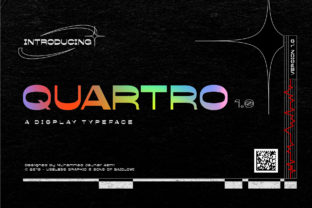
Typography isn’t just about letters—it’s about voice, intention, and first impressions. When you choose Quartro, you’re selecting more than a font: you’re choosing a quiet confidence rooted in modernist tradition yet fully at home in today’s digital landscape. Designed with precision and restraint, Quartro is a classic modernist display font that balances geometric structure with subtle human warmth—making it ideal for projects where intelligence, clarity, and distinction matter.
What Makes Quartro Stand Out?
At its core, Quartro reflects the best of mid-century modernist ideals: clean lines, balanced proportions, and purposeful simplicity. But unlike rigid, purely functional typefaces, Quartro introduces thoughtful refinements—slight variations in stroke contrast, carefully tuned terminals, and open apertures—that enhance legibility without sacrificing character.
Its smart feel emerges not from ornamentation, but from consistency and control. Each uppercase letter carries architectural presence; lowercase forms remain approachable and readable even at smaller sizes. The font family typically includes multiple weights (Light to Bold) and true italics—not slanted copies—giving designers real flexibility for hierarchy and emphasis.
Key Characteristics, Explained Simply
- Geometric foundation, humanized execution: Circles and squares anchor the design, but curves are subtly softened to avoid coldness.
- High x-height with generous spacing: Improves readability in headlines and short-form text—even on screens.
- Distinctive letterforms: The lowercase a and g feature single-story shapes; the capital R has a confident, angled leg; the ampersand is elegantly integrated, not tacked on.
- Neutral but never bland: It avoids trend-driven quirks, so it ages gracefully—and feels intentional, not generic.
Who Benefits Most From Using Quartro?
Quartro isn’t a one-size-fits-all solution—but it *is* a highly effective tool for specific needs. Its strengths shine brightest when used intentionally. Here’s who finds real value in Quartro:
- Brand designers building identities for consultancies, architecture studios, publishing houses, or tech-adjacent startups—where credibility and clarity are non-negotiable.
- Web and UI designers crafting hero sections, feature headers, or editorial titles that need to command attention without overwhelming users.
- Print professionals laying out premium brochures, exhibition signage, or book covers where typographic presence supports storytelling.
- Small business owners refreshing their visual identity—especially those in design, education, wellness, or creative services—who want sophistication without complexity.
- Content creators producing newsletters, presentations, or social assets where tone matters as much as message.
Real-World Uses: Beyond the Specimen Sheet
Seeing Quartro in action helps clarify its role. Consider these everyday scenarios:
- A boutique design agency uses Quartro Bold for its logo and Quartro Light for body copy in client proposals—creating instant visual cohesion and signaling thoughtful craftsmanship.
- An independent bookstore applies Quartro Medium to window signage and event posters. Its clean geometry reads clearly from the sidewalk, while its warmth invites curiosity—not intimidation.
- A SaaS dashboard deploys Quartro SemiBold for section headings and status labels. Users scan faster because letterforms are distinct and spacing is generous—even on mobile.
- A university department selects Quartro for its annual report cover and chapter openers. It conveys academic rigor while feeling accessible—no sterile sans-serif sterility, no distracting serifs.
- A podcast brand builds its entire visual language around Quartro: episode thumbnails, website headers, and merch tags all share the same typographic DNA—building recognition through consistency, not repetition.
Strengths You Can Rely On
When evaluating any font, practical performance matters most. Quartro delivers reliably across several key areas:
- Legibility at scale: Works exceptionally well from large-format signage down to ~24px web headings—unlike many display fonts that lose clarity below 36px.
- Cross-platform compatibility: Well-hinted and optimized for both desktop and web use (via WOFF2), with consistent rendering on macOS, Windows, and iOS.
- Accessibility-aware spacing: Default letter-spacing and line-height recommendations support WCAG contrast and reading flow—especially important for users relying on screen magnifiers.
- License flexibility: Available in web, desktop, and app licenses—with clear usage terms—so there’s no guesswork for freelancers or small teams.
Things to Keep in Mind
No font excels in every context—and being honest about limitations helps you use Quartro more effectively:
- Not a text face: While highly legible in short bursts, Quartro isn’t designed for long-form paragraphs. Pair it with a complementary serif or neutral sans (like Lora, Inter, or Source Sans) for body text.
- Display-first mindset: Its personality shines in headlines, logos, and callouts—not footnotes or data tables. Using it everywhere dilutes its impact.
- Subtlety requires intention: Because Quartro avoids loud features, it can blend in if surrounded by overly decorative elements. Let it breathe—use ample white space and restrained color palettes.
- Language support varies: Standard releases cover Latin-based languages thoroughly; check documentation if you need extended Cyrillic, Greek, or Vietnamese characters.
How to Decide If Quartro Fits Your Project
Ask yourself these three questions before committing:
- Is this about making an impression—or delivering dense information? If your goal is memorability, authority, or elegance in a headline, logo, or title, Quartro is likely a strong fit. If you're typesetting a 50-page manual, look elsewhere for body text.
- Does your brand voice lean toward thoughtful, precise, or quietly confident? Quartro supports tones like “expert but approachable,” “innovative but grounded,” or “minimalist but meaningful.” It won’t suit playful, rebellious, or ultra-casual brands.
- Do you have room for typographic hierarchy? Quartro works best when paired deliberately—not layered over competing fonts. If your layout already uses three type families, adding Quartro may create visual noise instead of focus.
Try this quick test: Set your project’s main headline in Quartro Bold alongside your current font. Does it feel sharper? Calmer? More intentional? If yes—you’ve found a match. If it feels too quiet or too stark, consider adjusting weight, size, or surrounding whitespace before ruling it out.
Final Thought: Typography With Quiet Confidence
In a world saturated with flashy fonts and algorithm-driven trends, Quartro offers something increasingly rare: typographic integrity. It doesn’t shout. It doesn’t chase attention. Instead, it earns it—through balance, intelligence, and unwavering clarity. Whether you’re launching a new brand, redesigning a portfolio site, or refining a presentation deck, Quartro gives your work a foundation that feels both timeless and unmistakably now.
It’s not just a font choice. It’s a statement—one that says you value meaning over noise, craft over convenience, and resonance over reaction.