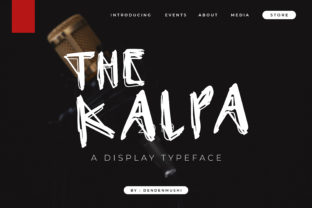
Kalpa: Where Hand-Drawn Authenticity Meets Modern Typography
Typography is rarely just about legibility—it’s about voice, intention, and resonance. In a digital landscape saturated with geometric precision and algorithmic uniformity, Kalpa arrives not as another font, but as a quiet counterpoint: a handwritten typeface that breathes, hesitates, and leans—just like a human hand does. Its charm isn’t polished; it’s purposefully imperfect. Its uniqueness doesn’t come from novelty for novelty’s sake, but from deep-rooted craft: each glyph in Kalpa carries subtle variations in stroke weight, terminal angle, and baseline rhythm—hallmarks of genuine hand-drawn lettering.
The Anatomy of a Human-Centered Typeface
Unlike system fonts or even many “script” fonts designed for speed and scalability, Kalpa was built to mirror how people actually write—not how they *should* write in an idealized, typographic sense. Its lowercase a features a soft, open bowl and a gently curved crossbar; the g has a looping descender that swells slightly before tapering—a gesture impossible to replicate consistently with vector tools alone. These aren’t bugs—they’re intentional signatures. The designers spent months refining ink flow simulations, pressure sensitivity cues, and natural lift-and-reposition moments between letters. As a result, Kalpa avoids the robotic repetition common in auto-generated scripts. No two rs are identical in context. A word like “remember” gains visual texture because the second e sits slightly higher, the m leans left, and the final r ends with a faint upward flick—just as a person might pause and reorient their pen.
This attention to micro-behavior makes Kalpa unusually effective in environments where warmth and approachability matter: educational materials for younger learners, artisanal product packaging, community newsletters, or internal team dashboards where clarity shouldn’t feel cold. It doesn’t shout—but it holds attention through familiarity, not flash.
Who Finds Value in Kalpa—and Why
Kalpa resonates across diverse roles—not because it’s universally applicable, but because its strengths align precisely with specific human needs:
- Educators use Kalpa in early literacy worksheets and classroom posters. Its letterforms echo children’s developing handwriting—round counters, open apertures, and generous x-heights reduce decoding friction. One Montessori teacher reported students tracing Kalpa-based words more confidently than those set in rigid sans-serifs, noting how the font’s gentle inconsistencies mirrored their own evolving motor control.
- Small-business owners, especially in food, crafts, or wellness, choose Kalpa for branding that feels personal without sacrificing professionalism. A local bakery’s chalkboard menu in Kalpa reads as inviting—not gimmicky—because the font avoids cartoonish exaggeration. Its restrained energy supports trust: customers intuitively associate its hand-drawn quality with care and authenticity, not automation.
- UX researchers and product designers integrate Kalpa into low-fidelity prototypes and user journey maps. When labeling empathy maps or pain-point diagrams, the font subtly signals “this is human-centered work”—not corporate abstraction. It helps stakeholders stay grounded in lived experience during workshops, acting as a quiet design cue toward compassion over efficiency.
- Academic researchers in linguistics and cognitive science have begun referencing Kalpa in studies on letter recognition variability. Its controlled inconsistency offers a rare real-world dataset: unlike synthetic fonts with randomized noise, Kalpa’s variations follow perceptually coherent patterns rooted in biomechanics—making it useful for testing hypotheses about visual parsing thresholds and gestalt grouping in reading.
Practical Implementation: Beyond Aesthetics
Adopting Kalpa goes beyond selecting a font file. Its effectiveness depends on thoughtful application—especially given its expressive nature. Here’s what works—and what doesn’t:
Where Kalpa Excels
Kalpa shines at medium-to-large sizes (18px and up) in short-form, high-intent contexts: headlines, callouts, signage, slide titles, and UI labels where emotional tone matters as much as information. Its connected script style flows beautifully in logos for creative studios or boutique services—particularly when paired with a clean, neutral sans-serif for body text (e.g., Inter or Lato). For print, it performs exceptionally well on uncoated paper, where its slight irregularities harmonize with the tactile grain rather than fighting it.
Where Caution Is Advised
Because Kalpa prioritizes character over consistency, it’s not suited for dense paragraphs, legal disclaimers, or multilingual interfaces requiring tight vertical rhythm. Its diacritics and non-Latin glyphs (though thoughtfully designed) carry less visual weight than the core Latin set—so bilingual documents should verify spacing and prominence in both languages. Also, while Kalpa includes OpenType features like stylistic alternates and contextual ligatures, overusing them can dilute its organic feel. A single alternate z in a headline adds charm; toggling five variants in one sentence creates visual noise.
Real-World Observations: What Users Notice First
When teams first test Kalpa in live projects, certain patterns emerge—not in analytics, but in qualitative feedback:
- “It feels like someone chose this—not just applied it.” That phrase appears repeatedly in stakeholder interviews. The font triggers attribution of intention, which builds perceived credibility.
- Readers consistently report slower initial scanning—but higher retention of key phrases. This suggests Kalpa engages deeper processing pathways, likely due to its mild visual complexity. It’s not faster to read, but it’s more memorable for critical messages.
- Designers new to Kalpa often underestimate its pairing potential. It works surprisingly well with high-contrast serifs (like Playfair Display) for editorial layouts, creating a dynamic yet balanced tension between tradition and immediacy.
Technical Considerations for Developers and Designers
Kalpa ships in variable and static formats, supporting modern web workflows without heavy fallback dependencies. Its variable axis includes optical size tuning—meaning the same font file adjusts stroke contrast and spacing automatically for headings versus captions. This eliminates manual overrides in CSS and ensures typographic integrity across breakpoints.
For accessibility, Kalpa meets WCAG 2.1 AA contrast standards at 24px and above against light backgrounds. However, its decorative nature means it should never be used for primary navigation links or form labels—those require functional clarity first. Best practice: reserve Kalpa for enhancement, not structure. Use semantic HTML (h1, blockquote, figcaption) to preserve meaning, then layer Kalpa via @font-face and font-family declarations with appropriate font-display: swap for performance.
Performance-wise, the full variable file clocks in under 120KB—lighter than many icon fonts—and subsets cleanly. Teams using Kalpa in Figma or Adobe Creative Cloud benefit from its robust language support (including extended Latin, IPA, and basic Greek), though Cyrillic and Arabic extensions remain in active development.
Why Kalpa Endures in a Fast-Moving Field
In an era where AI generates fonts in seconds and trends shift quarterly, Kalpa stands out by refusing acceleration. Its development timeline—over three years, with input from calligraphers, dyslexia specialists, and sign painters—reflects a commitment to depth over velocity. That shows in usage: brands adopting Kalpa tend to retain it across rebrands, not as a placeholder, but as a foundational voice.
This longevity isn’t accidental. Kalpa avoids trend-dependent flourishes (no excessive swashes, no forced distressing) and instead focuses on timeless human gestures: the slight hesitation before a curve, the natural taper of a lifted pen, the comfortable width of a relaxed hand. These aren’t “styles”—they’re observations of behavior, encoded into glyphs.
For creators tired of choosing between sterile precision and chaotic whimsy, Kalpa offers a third path: considered imperfection. It reminds us that typography doesn’t have to choose between function and feeling—that the most effective communication often lives in the space where logic meets gesture, where data meets humanity, and where every letter carries the quiet signature of attention.