Jirogi: A Playful Display Font with Real Personality
If you've ever scrolled past a website, social post, or printed flyer and felt an instant lift—a smile tugging at the corner of your mouth—you’ve likely encountered the quiet magic of a well-chosen display font. Jirogi is one of those rare typefaces that doesn’t just sit on the page—it leans in, winks, and invites attention without shouting. Designed for charm over conformity, it’s not a workhorse sans-serif or a stately serif—but something more intentional: a joyful, hand-crafted voice for moments that deserve to feel human.
What Makes Jirogi Stand Out (Without Trying Too Hard)
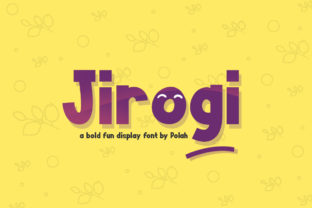
Jirogi isn’t built for body text or spreadsheets. It’s made for impact—small bursts of personality where tone matters as much as message. Its letterforms balance irregularity and rhythm: slightly uneven baselines, gentle curves that mimic natural pen strokes, and generous spacing that breathes rather than crowds. There’s no forced symmetry, no sterile uniformity—and that’s the point. Each character carries subtle variation, giving headlines, logos, and short quotes a tactile, almost animated quality.
Unlike many whimsical fonts that tip into cartoonish or dated territory, Jirogi stays grounded. Its proportions are legible at scale, its contrast moderate, and its x-height generous enough to hold up on screens—even on mobile. That means it works where many display fonts falter: in responsive web headers, email subject lines, Instagram story overlays, and even small-format print like stickers or packaging labels.
Why Pairing It With Go Cloud Just Feels Right
Jirogi ships with Go Cloud—a clean, friendly, highly legible sans-serif designed to complement, not compete. Think of them as creative partners: Jirogi takes the spotlight for titles and calls-to-action; Go Cloud steps in for supporting text, captions, navigation, or anything requiring clarity and neutrality. The pairing avoids visual whiplash. Their shared warmth, similar stroke weights, and thoughtful vertical metrics mean they coexist seamlessly—not just in design software, but in real-world layouts.
You’ll notice it immediately when setting a headline in Jirogi above a paragraph in Go Cloud: no awkward sizing gymnastics, no mismatched optical weight, no need to nudge tracking or line height into submission. That harmony saves time—especially if you're iterating fast across mockups, client revisions, or A/B test variants.
Where Jirogi Earns Its Keep—Beyond “Cute”
Let’s be clear: whimsy has professional value. In crowded digital spaces, distinctiveness drives recognition. Jirogi helps creators and brands signal approachability, creativity, or lighthearted confidence—without sacrificing polish.
- Bloggers & content creators use Jirogi for newsletter banners, course module headers, or quote graphics—adding visual punctuation that reinforces voice and builds familiarity over time.
- Educators and trainers apply it selectively in slide decks or handouts to highlight key concepts or learning milestones—making abstract ideas feel more tangible and memorable.
- Small business owners integrate it into Shopify banners, product tags, or local event posters—differentiating their presence from corporate templates while keeping messaging warm and inclusive.
- Freelancers and agencies leverage Jirogi in pitch decks and case study visuals—not as filler, but as deliberate tonal framing that aligns design with client values (e.g., “innovative but human-centered” or “thoughtful, not stiff”).
It’s also surprisingly effective in accessibility-conscious contexts—if used intentionally. Because Jirogi maintains strong character distinction (no ambiguous O/0, I/l, or B/8 pairs), and because its open counters and spacing support quick scanning, it performs well for short-form emphasis—even for readers with mild dyslexia or visual processing preferences. Just avoid using it for long paragraphs, fine print, or low-contrast backgrounds.
Real-World Considerations Before You Type “Hello World”
Jirogi shines brightest when treated like a seasoning—not the main ingredient. Overuse dilutes its effect and can undermine credibility in formal or data-heavy contexts. Ask yourself: does this element benefit from emotional resonance? Is legibility at this size and medium guaranteed? Does it align with the audience’s expectations—not just yours?
Test early and often. Try Jirogi in your actual CMS or email builder—not just Figma. Some platforms render variable fonts or OpenType features inconsistently. Jirogi includes standard OpenType ligatures and stylistic alternates, but only enable those if they serve clarity (e.g., a custom ampersand in a logo lockup) rather than novelty.
Also consider loading performance. As a display font, Jirogi is lean—but if you’re already serving multiple web fonts, weigh whether it’s pulling measurable weight in engagement or conversion. Sometimes, one well-placed Jirogi headline paired with system fonts elsewhere delivers more impact—and faster load times—than three font families fighting for attention.
A Few Practical Tips From the Trenches
- Start small: Swap out just one recurring header—like your blog’s “Featured Post” label—to gauge audience reaction before overhauling your entire UI.
- Respect hierarchy: Use Jirogi only at sizes 32px and up on desktop, and 24px+ on mobile—never for body copy or form labels.
- Match tone, not trend: If your brand voice is dry, witty, or technical, Jirogi may clash. But if you celebrate curiosity, craft, or everyday joy, it’ll feel like a natural extension.
- Leverage Go Cloud intentionally: Don’t default to it—choose it. Its even rhythm and neutral warmth make it ideal for testimonials, pricing tables, or step-by-step instructions alongside Jirogi’s expressive energy.
Finally, remember that typography isn’t about perfection—it’s about resonance. Jirogi won’t fix weak messaging or inconsistent branding. But in the right context, with thoughtful execution, it adds a layer of authenticity that’s increasingly rare: the sense that a real person, not a template, made this. And in a world saturated with algorithmically optimized sameness, that kind of intentionality isn’t just charming—it’s strategic.
So go ahead—try Jirogi where you’d normally reach for something safe. Then step back. Does it feel like *you*? Does it make the message land differently? If yes, you’ve already found its most valuable use case.