Liqouring: A Playful Display Font with Whimsy
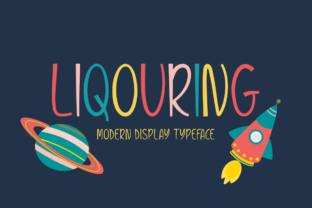
If you’ve ever seen a font that makes you smile before you even read the words—Liqouring does exactly that. It’s not a workhorse sans serif built for spreadsheets or a stately serif meant for legal disclaimers. Liqouring is a premium display font with a distinct personality: bouncy, slightly off-kilter, and full of quiet mischief. Letters tilt just enough to feel alive. Serifs curl like ribbon ends. Some characters have subtle ink blots or uneven strokes—not flaws, but intentional quirks that give it warmth and humanity.
Visually, Liqouring sits at an interesting intersection: it reads as a serif font at first glance, but its rhythm and proportions borrow from modern typography and even hint at playful script fonts. It’s not handwritten—but it feels hand-touched. The contrast between thick and thin strokes is gentle, never dramatic, which helps it avoid looking overly decorative or dated. That balance is why designers reach for Liqouring when they want charm without sacrificing clarity.
Where Liqouring Shines (and Where It Doesn’t)
Liqouring isn’t meant for body text. You won’t use it for a 3,000-word blog post or a product manual—and that’s by design. As a display font, its strength lies in moments of emphasis: headlines, logos, packaging accents, social media graphics, book covers, and event posters. Think of it as the visual equivalent of a well-placed laugh in conversation—it lands because it’s deliberate and brief.
We’ve seen Liqouring elevate small-batch coffee labels where the font’s organic irregularity mirrors artisanal roasting. It works beautifully on greeting cards, especially for birthdays or baby announcements—its whimsy feels personal, not generic. In editorial design, it’s been used sparingly for section headers in indie magazines focused on craft, sustainability, or slow living. One children’s publisher used it for chapter titles in a middle-grade novel about backyard inventors—the font’s joyful energy matched the tone without overwhelming young readers.
It’s less effective in contexts demanding neutrality or authority: financial reports, medical brochures, or corporate governance documents. Its personality is too present for those spaces. And while it holds up well at 36–72pt sizes in print, scaling it below 24pt on screen can soften its character—some of the subtler details blur, and readability dips. So always test at your intended size and medium.
How It Shapes Perception—Without Saying a Word
Typography silently influences how people interpret your message. Liqouring signals approachability, creativity, and lightness. When used thoughtfully in logo design or brand identity, it tells your audience, “We don’t take ourselves too seriously—but we care deeply about what we do.” That nuance matters. A bakery using Liqouring for its signage feels more inviting than one using a rigid geometric sans serif. A stationery brand choosing Liqouring over a trendy script font conveys craftsmanship over trend-chasing.
Consistency matters, too. Because Liqouring has strong visual presence, pairing it with quieter supporting fonts becomes essential. We often pair it with a clean, low-contrast sans serif—something like Poppins, Inter, or even a well-hinted version of Helvetica Neue—for body copy or captions. The contrast creates hierarchy naturally: Liqouring draws the eye; the companion font supports understanding. Avoid pairing it with other high-personality fonts—two whimsical typefaces competing for attention will dilute both.
Practical Tips Before You Use It
First, check what styles are included. Most Liqouring licenses include Regular and Bold weights—but no italics or condensed variants. That’s fine for display use, but it means you’ll need fallbacks if you require stylistic variation within a single layout. Also verify licensing: Liqouring is a commercial font, so personal-use-only licenses won’t cover client work, e-commerce banners, or printed product packaging. If you’re a marketer or small business owner commissioning design work, ask your designer whether the license covers your intended use—including web embedding via @font-face or SVG exports for digital ads.
Test early and often. Drop Liqouring into your actual layout—not just a mockup. Try it against your brand colors. Does it hold up on dark mode? Does it render cleanly on iOS Safari and older Android browsers? We once saw a food blogger switch from Liqouring to a lighter-weight alternative after noticing subtle kerning issues in Instagram Stories text overlays—small context, big impact.
Also consider accessibility. While Liqouring itself isn’t WCAG-compliant for body text (no display font is), it’s perfectly appropriate for large-format headings when paired with sufficient color contrast and clear supporting type. Just don’t rely on it alone to convey critical information.
Real Pairings That Work
- For print packaging: Liqouring (Bold) + Lora (Regular) — the gentle serif contrast keeps things cohesive without competing.
- For social media graphics: Liqouring (Regular) + Inter (SemiBold) — clean, readable, and platform-friendly.
- For editorial section headers: Liqouring (Regular) + Source Sans Pro (Light) — gives breathing room and modern flow.
- For craft business branding: Liqouring (Bold) + DM Sans (Medium) — warm yet professional, scalable across stickers, tags, and websites.
One final note: Liqouring rewards restraint. Its joy comes from contrast—from being the spark, not the whole flame. Use it where you want someone to pause, smile, and lean in—even just for a second. That’s real engagement. Not flashy, not forced—just human.