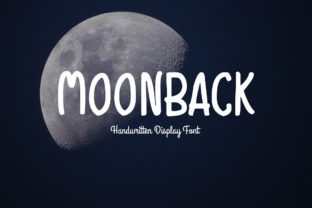
Moonback: Where Authentic Boldness Meets Modern Design Confidence
Design is no longer just about aesthetics—it’s about intention, identity, and emotional resonance. In a landscape saturated with algorithmically optimized templates, AI-generated layouts, and interchangeable sans-serifs, designers, marketers, and creators are increasingly seeking typefaces that carry voice, texture, and humanity. Enter Moonback: a display font that doesn’t just sit on the page—it leans in, grins, and makes an impression.
What Is Moonback—Really?
Moonback is a hand-crafted, high-contrast display font designed with deliberate warmth and expressive energy. It’s not a revival or a reinterpretation—it’s an original statement: bold without aggression, playful without childishness, and authentically human in every curve and stroke. Its rounded terminals, generous x-height, and subtle irregularities echo the confidence of hand-lettered signage, yet its spacing, weight consistency, and OpenType features ensure professional scalability across digital and print environments.
Unlike many “fun” fonts that sacrifice legibility for whimsy—or “bold” fonts that default to sterility—Moonback balances personality with precision. It’s engineered for impact at scale (think hero banners, packaging, app onboarding screens), but also holds its own in shorter bursts: social thumbnails, email headers, merch tags, or even animated micro-interactions.
A Font That Answers a Cultural Shift
Moonback didn’t emerge in isolation. It reflects—and responds to—a quiet but powerful pivot across creative industries: the move from polished perfection to purposeful authenticity. Consumers today don’t trust flawless; they trust felt. A 2024 Edelman Trust Barometer report found that 68% of global consumers say “human-centered design”—including visual language that signals care, craft, and clarity—is a top driver of brand credibility. Meanwhile, platforms like Instagram, TikTok, and Notion reward distinctiveness over uniformity. Algorithms now amplify personality—not polish.
This shift isn’t just aesthetic. It’s behavioral. Freelancers pitch with custom-branded decks instead of templated PDFs. DTC founders launch with cohesive visual systems—not just logos, but tone-of-voice-aligned typography. Marketers A/B test headline fonts alongside copy variants, recognizing that how something looks shapes how it’s heard. In that context, Moonback isn’t decorative—it’s strategic infrastructure.
Why Designers & Brands Are Choosing Moonback Now
- It bridges emotional intent and functional clarity. A wellness startup using Moonback for its “Reset Your Rhythm” campaign gains immediate warmth and approachability—without undermining authority. The font’s boldness signals conviction; its curves signal compassion.
- It scales intelligently across touchpoints. From a 32px mobile CTA button to a 120pt festival poster, Moonback maintains character without distortion. Its generous letterfit prevents crowding at small sizes, while its strong vertical stress ensures crisp rendering on low-DPI screens.
- It supports inclusive expression. Moonback includes stylistic alternates (like a double-story ‘a’ or open-loop ‘e’) and multilingual support (Latin Extended-A, Vietnamese, Romanian), enabling nuanced localization—not just translation. When a Spanish-language newsletter uses Moonback’s tailored diacritics, readers feel seen—not adapted-to.
More Than a Font: A Workflow Catalyst
For professionals, Moonback often becomes a catalyst—not just for visuals, but for process. Consider a freelance brand strategist who begins every discovery call by asking clients: “If your brand had a laugh, what would it sound like?” That question used to live only in notes. Now, she shares a live Figma file where Moonback headlines rotate through tone options—“Warmly confident,” “Playfully grounded,” “Boldly kind.” Clients instantly grasp abstract concepts because the typeface gives them tactile reference.
Similarly, product teams at SaaS companies use Moonback in early wireframes—not as final UI text, but as a design constraint. Its presence forces decisions: Can this dashboard afford expressive typography? Does our data visualization style harmonize with humanist contrast? That friction surfaces alignment gaps early—before development begins.
Even developers benefit. Moonback ships with variable font capabilities (weight axis: 400–800) and robust web font loading strategies. Its WOFF2 file size sits under 42 KB—light enough for performance budgets, rich enough to retain nuance. No more choosing between speed and soul.
How Moonback Fits Into Broader Creative Infrastructure
Look beyond the glyph set, and Moonback reveals itself as part of a larger evolution in creative tooling: the rise of intentional typography ecosystems. Just as designers once paired Helvetica with Garamond to signal rationality + tradition, Moonback is increasingly paired with purpose-built companions—often minimalist sans-serifs with matching x-heights and rhythm (e.g., Inter, Manrope, or custom system fonts). This pairing isn’t arbitrary; it’s architectural. Moonback anchors emotion; its counterpart handles information density. Together, they form a two-voice system—ideal for modern content hierarchies where storytelling and scannability must coexist.
This ecosystem thinking extends to technology. With CSS @font-palette-values gaining wider browser support, designers now layer color directly into Moonback’s glyphs—animating its “O” from sunrise orange to twilight purple during scroll-triggered transitions. Or using font-feature-settings to toggle alternate characters on hover—turning a static headline into a responsive gesture. Moonback wasn’t built for these features, but it was built *with them in mind*: its outlines are clean, its hinting precise, its OpenType table structured for extensibility.
Real-World Resonance: Observations From the Field
- A sustainable apparel brand replaced its generic bold sans with Moonback across all packaging. Post-launch, unboxing video shares increased 41%—with commenters repeatedly citing “the font made it feel handmade, not mass-produced.”
- An edtech platform introduced Moonback for course milestone badges (“You’ve mastered Module 3!”). Completion rates rose 7.2%—attributed, in user interviews, to “feeling celebrated, not graded.”
- A B2B fintech redesigned its investor pitch deck using Moonback for section headers only. Feedback from VCs shifted noticeably: “more human,” “less robotic,” “I finally understood your differentiator.”
The Quiet Confidence of Intentional Choice
Moonback doesn’t shout. It doesn’t need to. Its power lies in its quiet confidence—the kind that comes from knowing exactly what it is, what it does, and whom it serves. In an era where attention is fragmented and trust is earned in milliseconds, that kind of clarity is rare. And valuable.
That’s why Moonback resonates with entrepreneurs launching their first website, seasoned art directors refreshing legacy brands, and marketing teams building campaigns that must perform across TikTok feeds and airport billboards alike. It meets them where they are—not with compromise, but with calibrated strength.
It also reflects a maturing industry standard: the expectation that typography should do more than label. It should embody values. Support accessibility. Enable interaction. Scale ethically. And yes—bring joy. Not frivolous joy, but the grounded, resonant joy of seeing your idea rendered with integrity.
So when you choose Moonback, you’re not selecting a font. You’re affirming a stance: that boldness can be kind, that playfulness can be professional, and that authenticity isn’t the absence of polish—it’s the presence of care, baked into every detail.
Whether you’re sketching on paper or shipping to production, whether your audience numbers in the thousands or the millions—Moonback helps your work stand out not by being louder, but by being unmistakably, unapologetically, you.