Hello Freeday: A Playful Display Font That Delivers
Imagine a font that smiles at you—not in a forced, stock-photo way, but with genuine warmth and quiet confidence. That’s Hello Freeday. It’s not a workhorse sans serif built for spreadsheets or a delicate script reserved for wedding invites. It’s a display font—designed to be seen, felt, and remembered—with a whimsical twist that lands just right: friendly without being childish, energetic without feeling chaotic, distinctive without sacrificing clarity.
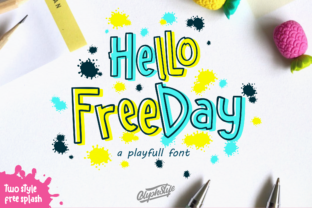
Visually, Hello Freeday balances rounded, open letterforms with subtle irregularities—slight variations in stroke weight, gentle asymmetry in curves, and soft, almost hand-guided terminals. The lowercase “a” and “g” carry a relaxed, single-story shape; the “y” dips with a playful tail; the “t” has a slight upward flick. These aren’t flaws—they’re intentional cues that signal approachability and human intention. It’s not a handwritten font, but it carries the warmth of one. And while it’s technically a sans serif font, its personality leans more toward modern typography with character than minimalist austerity.
Where Hello Freeday Earns Its Keep
This isn’t a font for body text in a 30-page annual report—and it shouldn’t be. Hello Freeday shines where attention, tone, and identity matter most. Think of it as your go-to creative font for moments when you want people to pause, connect, and feel something before they even read the words.
It works beautifully in logo design for small businesses with personality—think independent bakeries, boutique studios, children’s book publishers, or wellness coaches who lead with empathy. In editorial design, it anchors magazine covers, chapter headers, or pull quotes that need emotional resonance. For packaging design, it adds charm to jar labels, greeting cards, or subscription box inserts—especially when paired with a clean, neutral secondary typeface.
Digital use is equally strong. Social media graphics—Instagram story highlights, Pinterest pins, or TikTok thumbnails—gain instant visual distinction with Hello Freeday. It holds up well on screen at larger sizes, and its generous x-height improves legibility even on mobile. Bloggers and content creators use it for featured headlines or section dividers to break up long-form posts without resorting to generic fonts. Crafters and hobbyists apply it to digital patterns, printable planners, or SVG files for Cricut and Silhouette machines—its clean outlines render crisply at any scale.
What It Does for Your Brand (Beyond Looking Nice)
Typography isn’t decoration—it’s silent communication. Hello Freeday subtly tells your audience: We’re thoughtful, we’re human, and we don’t take ourselves too seriously—but we do care about craft. That shapes brand perception in ways color or imagery alone can’t replicate.
In practice, this means better audience engagement: readers linger longer on a headline set in Hello Freeday because it feels inviting, not intimidating. It supports visual hierarchy by creating natural focal points—your tagline stands out, your call-to-action feels lighter and more personal, your brand name becomes more memorable. When used consistently across touchpoints (a website banner, a business card, an email header), it strengthens brand recognition and consistency—not through rigidity, but through a recognizable emotional signature.
That said, professionalism isn’t compromised. Hello Freeday doesn’t look “amateurish” because it’s whimsical—it looks intentional. Its spacing, kerning, and character set reflect careful typeface development. Used with restraint and paired thoughtfully, it reads as confident, not careless.
Practical Tips Before You Type
Before downloading or licensing Hello Freeday, ask yourself three things:
- Is this the first impression I want? If your project leads with trust, authority, or technical precision (e.g., legal services, enterprise SaaS dashboards), Hello Freeday may soften your message more than intended.
- What’s my pairing strategy? Hello Freeday thrives alongside neutral, highly legible companions—a sturdy serif font like Merriweather for contrast, or a warm, geometric sans serif font like Inter or Poppins for balance. Avoid pairing it with other display or script fonts; that creates visual noise, not harmony.
- Which styles do I actually need? Most premium font releases include weights (Light, Regular, Bold) and sometimes italics. Hello Freeday typically ships with Regular and Bold—sufficient for most display applications. Check whether the package includes OpenType features like stylistic alternates or ligatures; these add nuance but aren’t essential for basic use.
Test readability early. Set a headline at 48px on white background, then at 24px on a light pastel. Does it still feel clear and friendly—or does it start to blur or compete? Also, preview how it renders on actual devices—not just desktop browsers. Some display fonts lose subtlety on lower-resolution screens.
Licensing, Legitimacy, and Long-Term Use
Hello Freeday is a commercial font, meaning it requires a license for professional projects—even if you’re a solo blogger monetizing via ads or a crafter selling digital downloads. Free versions found on unofficial sites often lack full character sets, have inconsistent spacing, or embed hidden tracking. Worse, they risk copyright claims down the line.
Always source Hello Freeday from reputable platforms like Creative Market, MyFonts, or the designer’s official site. Licenses vary: a standard desktop license covers print and static digital use (PDFs, social graphics); webfont licenses are separate and usually priced per domain or monthly pageview tier. If you’re building a client website, confirm whether your license permits embedding—or whether the client needs their own.
Finally, treat it as a design asset, not a trend. Fonts like Hello Freeday gain power through consistent, considered application—not novelty. Use it where it amplifies your message, not where it distracts from it. That’s how it becomes part of your brand identity, not just a decorative flourish.