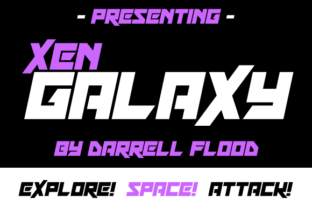
Xen Galaxy: A Futuristic Font for Space-Themed Projects
Xen Galaxy isn’t just another sci-fi font—it’s a carefully engineered, robot-like typeface built for clarity, impact, and forward-looking expression. With its sleek, geometric letterforms, subtle angular precision, and balanced negative space, Xen Galaxy delivers a distinct futuristic tone without sacrificing readability. It’s not overly ornate or cartoonish; instead, it feels like something you’d see on a spacecraft interface, a high-end tech brand identity, or an immersive indie game UI—functional, intentional, and quietly confident.
What makes Xen Galaxy especially useful is how it bridges aesthetic appeal with practical versatility. Its design avoids visual noise while maintaining strong character presence—ideal when you need typography that commands attention but doesn’t overwhelm your layout. Whether you're designing a poster for an astronomy lecture series or branding a podcast about exoplanets, Xen Galaxy grounds your work in a cohesive, space-conscious visual language.
Where Xen Galaxy Fits Naturally
This font thrives in contexts where theme, tone, and audience alignment matter most. It’s not meant for body text in long-form articles—but it shines in headlines, logos, app interfaces, presentation slides, merch designs, and interactive installations. Think of it as your go-to typographic anchor for any project rooted in exploration, innovation, or speculative futures.
- Designers use Xen Galaxy to unify visual systems—pairing it with clean sans-serifs (like Inter or IBM Plex Sans) for contrast and hierarchy.
- Educators incorporate it into classroom materials about astrophysics or robotics to reinforce conceptual themes visually—not as decoration, but as cognitive scaffolding.
- Bloggers and content creators apply it selectively in featured headers or quote graphics to signal a shift in tone—say, when pivoting from analysis to imaginative speculation.
- Small business owners building niche brands (e.g., a custom LED lighting studio or a VR training platform) find Xen Galaxy helps communicate technical sophistication without coldness.
Creative Applications That Go Beyond the Obvious
Don’t limit Xen Galaxy to star charts and rocket silhouettes. Its strength lies in reinterpretation. Try these grounded, tested approaches:
Layered Typography for Depth
Use Xen Galaxy at varying weights and opacities to create subtle dimensional effects—light weight for distant background text, bold for foreground impact. This works exceptionally well in digital banners or exhibition signage where spatial perception enhances engagement.
Animated Micro-Interactions
In web or app design, animate Xen Galaxy characters with staggered entrance timing or gentle scaling. Because of its rigid geometry, even small motion cues feel precise and intentional—not playful, but purposeful. Ideal for loading states, navigation highlights, or data visualization labels.
Hybrid Brand Systems
Pair Xen Galaxy with a warm, humanist serif (like Cormorant Garamond or PT Serif) to soften its edge—especially effective for science communication projects aiming to balance authority with approachability. The contrast tells a story: rigor meets curiosity.
Practical Tips for Consistent, Audience-Friendly Use
Like any strong design tool, Xen Galaxy rewards intentionality. Here’s how to keep results clear and effective:
- Reserve it for moments of emphasis. Overuse dilutes impact—and risks making your layout feel like a theme park rather than a thoughtful experience.
- Test legibility across devices. Its tight spacing and sharp terminals look crisp on retina screens but may tighten further on smaller mobile viewports. Adjust tracking by +20–40 units in responsive CSS if needed.
- Match color with context. Cool metallics (slate blue, gunmetal gray) enhance its tech feel; deep indigo or charcoal adds gravitas for educational or documentary uses. Avoid neon unless irony or parody is part of your strategy.
- Consider licensing early. Xen Galaxy is available in both free and premium variants—verify usage rights for commercial prints, SaaS dashboards, or merchandise before finalizing layouts.
Real Projects, Real Results
A freelance UX designer used Xen Galaxy as the primary display font for a climate modeling dashboard aimed at urban planners. By applying it only to module headers and key metric labels—and pairing it with a highly legible monospace for data rows—they created immediate visual distinction without sacrificing scanability. Users reported faster orientation and stronger recall of section purposes.
An independent publisher launched a quarterly zine exploring speculative futures in African tech ecosystems. They set all cover titles and chapter openers in Xen Galaxy, then used hand-drawn line art and muted earth tones throughout interior spreads. The juxtaposition gave the publication both authority and warmth—readers described it as “grounded futurism.”
A university’s outreach team redesigned their annual astronomy night branding around Xen Galaxy—applied to signage, digital invites, and telescope-viewing station labels. They kept supporting text in a neutral sans-serif and added tactile elements (embossed stars, matte black finishes) to extend the theme beyond screen. Attendance rose 32% year-over-year, with feedback highlighting how the visuals “felt like stepping into the observatory before you even arrived.”
Adapting Xen Galaxy Across Platforms
How you use Xen Galaxy changes depending on medium—and that’s where smart adaptation pays off:
- Web & Apps: Load it as a variable font if supported, or use WOFF2 with fallbacks. Prioritize font-display: swap so performance doesn’t compromise tone.
- Print: For large-format posters or vinyl decals, increase stroke contrast slightly in vector editing to prevent ink spread—especially on textured or dark substrates.
- Social Media: Apply Xen Galaxy to static assets only (not video text overlays), and always test visibility against common platform backgrounds (e.g., Instagram’s white feed vs. TikTok’s dark UI).
- Presentation Tools: In PowerPoint or Keynote, embed the font or convert to outlines before sharing externally—prevents substitution glitches during live delivery.
Xen Galaxy doesn’t promise magic. It offers focus. When your message is about discovery, precision, or what lies ahead, choosing this font signals that you’ve considered not just what you’re saying—but how it lands, where it lives, and who it serves. That kind of intention separates memorable work from forgettable noise.
Start small: pick one upcoming project—a workshop title slide, a product launch banner, a chapter header in your next report—and let Xen Galaxy define its tone. Then step back. Does it feel like a natural extension of your idea? If yes, you’re using it right.