Histeria: A Twisted Display Font for Horror Projects
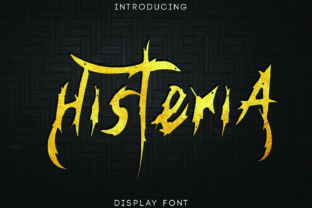
When your project needs to unsettle, intrigue, or thrill—before a single word is read—the right typeface becomes more than decoration. It’s atmosphere. It’s tone. It’s the first whisper of dread. Histeria isn’t just another display font. It’s a deliberately unbalanced, high-energy typographic character—full of jagged curves, uneven spacing, and unpredictable distortions. Designed to feel alive—and slightly unhinged—it thrives where conventional fonts retreat.
Why Histeria Stands Apart in the Display Font Landscape
Most display fonts aim for clarity, elegance, or bold simplicity. Histeria rejects those goals. Its irregular baseline, warped letterforms, and inconsistent stroke weights aren’t flaws—they’re features. Each glyph seems to writhe just enough to suggest instability: a flickering lightbulb, a creaking floorboard, a breath catching mid-sentence. That “weird” quality isn’t arbitrary; it’s calibrated to resonate with psychological tension. Unlike decorative fonts that rely on gothic serifs or dripping effects, Histeria generates unease through rhythm and asymmetry—not cliché.
This makes it especially valuable when you’re working beyond surface-level spookiness. Think indie horror game UIs where menu text shouldn’t feel polished or safe. Or limited-edition vinyl sleeves for experimental noise artists who want typography that mirrors sonic distortion. Or even academic posters analyzing liminality in 20th-century Gothic fiction—where visual dissonance reinforces conceptual ambiguity.
Real-World Uses That Benefit from Histeria’s Energy
Histeria shines brightest in short-form, high-impact contexts. It’s not built for body text, captions, or interfaces requiring rapid scanning. But within its niche, it delivers tangible advantages:
- Time saved in mood alignment: Designers often spend hours layering textures, adjusting contrast, or adding glitch effects to evoke unease. With Histeria, much of that emotional groundwork is embedded in the letterforms themselves. A headline set in Histeria over a muted photo of fog-draped trees may need no additional treatment—saving 20–40 minutes per asset in iterative refinement.
- Stronger audience recall for niche brands: Small publishers launching a new line of surreal horror chapbooks report higher pre-order retention when Histeria appears consistently on covers and promo banners. Readers associate the font’s distinct rhythm with the publisher’s aesthetic voice—building cohesion without repetitive imagery.
- Improved creative confidence in experimental work: Educators using Histeria in student film festival branding noticed participants felt freer to explore non-linear narratives. The font subtly signals that “rules are bent here,” lowering hesitation around unconventional storytelling techniques.
Who Gains the Most—and When to Pause
Histeria serves creators who prioritize expressive precision over universal legibility. Freelance motion designers crafting title sequences for paranormal podcasts find it invaluable—its kinetic energy translates seamlessly into subtle animation. Indie game developers building atmospheric walking simulators use it sparingly for diegetic notes (e.g., journal entries found in-game), where distorted readability enhances immersion rather than hinders it.
That said, Histeria isn’t universally appropriate. It’s unsuitable for accessibility-critical contexts like warning labels, medical signage, or public service announcements—even in horror-themed campaigns. Its irregular forms challenge screen readers and reduce legibility at small sizes or low contrast. Likewise, brands targeting broad demographics (e.g., family-friendly Halloween events) may find its intensity alienating rather than engaging.
If your goal is playful eeriness—not terror—consider pairing Histeria with a clean, neutral sans-serif for supporting text. This contrast lets the font breathe while maintaining readability. One designer working on a retro-futuristic haunted theme park website used Histeria only for attraction names (“The Fracture Maze”, “Static Hollow”) and paired it with Inter for navigation and descriptions. The result felt cohesive, intentional, and easy to navigate—without diluting the unsettling hook.
Practical Tips for Using Histeria Effectively
Start small. Test Histeria at three sizes: 36pt, 48pt, and 72pt—on both light and dark backgrounds. Notice how spacing shifts visually at each size. You’ll likely find that tracking (letter-spacing) adjustments are essential: too tight, and letters merge into illegible tangles; too loose, and the rhythm collapses. Most users achieve best results with +40 to +80 tracking units in design software, depending on weight and context.
Avoid stacking multiple distorted fonts. Histeria’s strength lies in its singularity—not competition. If your layout includes soundwave graphics or hand-drawn elements, let Histeria coexist with them instead of mimicking their chaos. Its role is to anchor the unease, not replicate every detail.
Also consider licensing fit. Histeria is typically offered as a desktop + web license. If you’re embedding it in a mobile app or SaaS dashboard, verify whether the license covers those uses—or if a custom agreement is needed. One small business owner discovered mid-launch that their web license didn’t extend to animated email headers, causing rendering inconsistencies. Checking usage scope early prevents rework.
When to Look Beyond Histeria
Histeria excels at psychological tension—but not all horror communicates the same way. If your project leans into vintage camp (think 1950s B-movie posters), fonts like Blood & Glory or Chiller might better match that nostalgic palette. For cosmic horror evoking vast indifference, ultra-thin, fragile-looking typefaces like Obsidian or Void Serif can convey scale and silence more effectively than Histeria’s frenetic energy.
And if your audience includes people with vestibular sensitivities or reading disorders, even brief use of Histeria warrants caution. In those cases, consider alternatives with strong personality but higher structural consistency—like Shatter (which distorts selectively) or Windsong (which implies movement without sacrificing baseline stability).
A Final Thought on Intentional Typography
Choosing Histeria isn’t about chasing trendiness—it’s about recognizing that some ideas resist tidy presentation. Its “twisted charm” works because it refuses neutrality. That makes it powerful, yes—but also demanding. It asks you to commit to a specific emotional register and hold it with consistency across touchpoints.
Used thoughtfully, Histeria doesn’t just decorate a horror-themed project. It deepens narrative subtext, sharpens audience focus, and quietly signals that what follows won’t play by expected rules. That’s rare. And in an era of algorithmically homogenized design, rare has real value.