Funky Gurls: The Playful Display Font That Brings Comic Energy to Real-World Projects
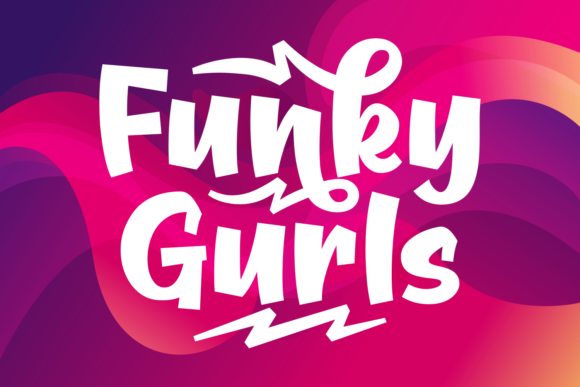
If you're designing a comic-themed product—or even something that just needs a burst of personality—Funky Gurls is more than a font choice. It’s a strategic tool for communicating fun, approachability, and creative confidence without saying a word. Designed with a slightly whimsical, kooky charm and bold, expressive letterforms, Funky Gurls stands out in a sea of predictable sans-serifs and overused script fonts. It’s not meant for body text or formal reports—but where it shines is unmistakable: in headlines, logos, merch, social graphics, and any context where tone matters as much as content.
Adults working on creative projects often face a quiet but persistent challenge: how to balance professionalism with authenticity. You might be launching an indie comic series, branding a pop-culture podcast, designing merch for a convention booth, or refreshing the visual identity of a playful small business. In each case, your goal isn’t just visibility—it’s resonance. You want people to pause, smile, and feel invited in—not intimidated or bored. That’s where many default to safe, generic fonts—and unintentionally mute their message.
Funky Gurls helps solve this by doing one thing exceptionally well: signaling joy with intention. Its uneven baseline, exaggerated curves, and hand-drawn imperfections aren’t flaws—they’re deliberate cues that say, “This is human-made, full of character, and unafraid to stand out.” Unlike overly polished display fonts that can feel sterile or dated, Funky Gurls lands with warmth and energy. It’s friendly without being childish, bold without being aggressive, and nostalgic without leaning too hard into retro clichés.
Practical application starts with alignment—not aesthetics alone. Before reaching for Funky Gurls, ask: What emotion do I want users to feel before they read a single word? If the answer includes “playful,” “irreverent,” “confidently quirky,” or “unapologetically fun,” then Funky Gurls is a strong candidate. For example:
- A local comic shop uses Funky Gurls for its weekly newsletter banner—pairing it with clean, readable sans-serif body text. The result? Higher open rates and more social shares, because the header feels like an inside joke shared with fans.
- An illustrator launching a limited-edition enamel pin line sets the product name in Funky Gurls on packaging. Customers consistently mention the “vibe” in reviews—calling it “instantly recognizable” and “so them.”
- A teacher creating classroom posters for a graphic novel unit swaps out standard title fonts for Funky Gurls. Students report feeling more engaged during discussions—proof that typography influences perception and participation.
Of course, effectiveness depends on thoughtful implementation. Funky Gurls works best when it has room to breathe. Avoid cramming it into narrow columns or pairing it with other highly decorative fonts. Instead, combine it with simple, high-contrast typefaces—like Montserrat, Inter, or even Georgia—for balance. Use it at larger sizes (36pt and up for print; 48px+ for web headers) to let its personality fully emerge. And always test legibility across devices: while its charm is undeniable, its stylized ‘g’, ‘y’, and ‘a’ may need extra spacing or kerning adjustments in certain layouts.
Different users will approach Funky Gurls differently—and that’s part of its strength. A freelance designer might use it as a signature accent across multiple client projects, applying consistent spacing rules and color palettes to maintain brand cohesion. A DIY creator selling stickers on Etsy may treat it as a mood-setting element—applying it only to titles and taglines, keeping descriptions in neutral type to avoid overwhelming shoppers. Meanwhile, a marketing manager at a youth-focused nonprofit might deploy Funky Gurls selectively in campaign banners and event signage—using it as a visual shorthand for inclusivity, creativity, and joyful expression.
One common misconception is that playful fonts like Funky Gurls lack versatility. In reality, its flexibility lies in context—not coverage. It won’t replace your system font, and it shouldn’t. But it *can* transform how your audience interprets your intent. Think of it like adding a perfectly timed laugh in conversation: it doesn’t change the facts—but it changes how those facts land.
When evaluating whether Funky Gurls fits your project, consider three practical checkpoints:
- Tone match: Does your brand voice lean toward wit, warmth, or wonder? If yes, Funky Gurls supports rather than contradicts that direction.
- Usage scope: Are you using it for short, high-impact text (logos, buttons, cover titles)? That’s ideal. If you’re considering it for long paragraphs or data tables, step back—it’s not built for that role.
- Accessibility awareness: While Funky Gurls passes basic contrast checks, always pair it with sufficient color contrast and provide alt text for images containing the font. Never rely solely on its styling to convey meaning.
Importantly, choosing Funky Gurls isn’t about chasing trends—it’s about selecting a tool that aligns with your communication goals. In a digital landscape saturated with algorithm-driven sameness, intentional typography becomes a subtle act of differentiation. It tells your audience: We paid attention—not just to what we’re saying, but to how it feels to receive it.
For creators who value both craft and clarity, Funky Gurls offers a rare blend: expressive enough to spark delight, structured enough to hold attention, and distinctive enough to become memorable. It won’t fix weak messaging—but paired with strong ideas and smart design decisions, it amplifies them. Whether you’re sketching storyboards, drafting email subject lines, or finalizing a Kickstarter campaign page, Funky Gurls invites you to lead with personality—without sacrificing professionalism.
So if your next project calls for a little more spark, a dash of mischief, or simply the kind of visual warmth that makes people lean in—that’s where Funky Gurls earns its place. Not as decoration. Not as afterthought. But as purpose-built typography, ready to help your voice stand out—playfully, confidently, and unmistakably.