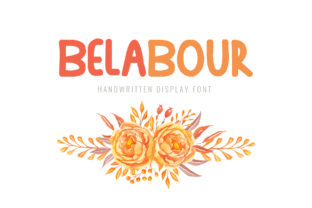
Belabour: A Whimsical Display Font for Expressive, Playful Typography
Belabour is a display font designed to bring warmth, charm, and gentle personality to visual communication. It’s not built for long paragraphs or dense interfaces — instead, it excels where tone, mood, and intention matter most: headlines, logos, invitations, packaging, social media graphics, and short-form brand messaging. Its defining traits are soft curves, subtle irregularities, and a hand-crafted rhythm that avoids mechanical uniformity without sacrificing legibility.
What sets Belabour apart isn’t just its aesthetic — it’s the consistency of its voice. Many playful fonts lean heavily into exaggeration: oversized swashes, dramatic contrast, or cartoonish proportions. Belabour stays grounded. Its lowercase ‘a’ has a friendly, open bowl; its ‘g’ features a looping tail that feels intentional, not forced; its capitals carry quiet confidence rather than shouting. That restraint makes it more versatile than it first appears — especially for brands that want approachability without sacrificing polish.
How Belabour Fits Within the Display Font Landscape
Display fonts fall broadly into categories: geometric, serif-based, handwritten, brush-style, and decorative. Belabour sits comfortably at the intersection of handwritten and decorative — but with clear design discipline. Unlike fully script fonts (which often require careful kerning and may struggle at small sizes), Belabour maintains even spacing and balanced weight distribution across characters. It also avoids the rigid geometry of fonts like Montserrat Bold or Playfair Display, which prioritize structure over expressiveness.
This middle ground gives Belabour functional advantages in specific contexts. For example, a wedding invitation set in Belabour reads as personal and considered — not generic or overly formal. A children’s book cover benefits from its gentle asymmetry, suggesting imagination without visual noise. Even a boutique coffee shop’s chalkboard-style menu gains authenticity when Belabour replaces a more literal handwriting font — because it feels *designed*, not traced.
Strengths: Where Belabour Shines
- Emotional resonance: Its slight imperfections evoke human touch — ideal for brands emphasizing care, craft, or community.
- Legibility at medium sizes: Works reliably from 24pt to 72pt in print and digital, especially against clean backgrounds.
- Pairing flexibility: Complements neutral sans-serifs (Inter, Lato, Open Sans) without competing. Its warmth offsets clinical typefaces without clashing.
- Distinct yet accessible: Recognizable on first glance, but not so idiosyncratic that it alienates broader audiences.
One practical strength is its language support. Belabour includes extended Latin characters, basic diacritics, and standard punctuation — enough for English, French, Spanish, German, and Dutch use without falling back on fallback fonts. It doesn’t cover Cyrillic or extended Asian character sets, so multilingual projects beyond Western Europe require evaluation.
Tradeoffs and Practical Limits
No display font is universally suitable — and Belabour’s strengths come with natural boundaries. Its primary limitation is text density. At sizes below 18pt, letterforms begin to lose clarity, particularly in low-resolution environments like email clients or older mobile displays. It’s not intended for body copy, captions, interface labels, or data-heavy layouts. Using it there risks reduced readability and inconsistent rendering across devices.
Another consideration is tone alignment. Because Belabour carries such clear personality, mismatched application can undermine messaging. A fintech dashboard using Belabour for dashboard headings may unintentionally signal informality where users expect precision and stability. Similarly, legal disclaimers or technical documentation benefit from neutrality — not whimsy.
Weight options are also limited. Belabour is typically offered in a single weight with optional italics. That’s sufficient for many branding applications, but less flexible than families with multiple weights (light, regular, bold, black) or variable axes. Designers needing fine-grained typographic hierarchy — say, distinguishing subheadings from callouts within the same visual system — may need to supplement with a secondary font.
When Belabour Is the Right Choice
Belabour fits best when the goal is to communicate warmth, creativity, or gentle distinction — especially in contexts where users engage emotionally rather than transactionally. Consider it for:
- Branding for lifestyle, wellness, education, or artisanal businesses — e.g., a yoga studio’s logo, a ceramicist’s website headline, or a Montessori school’s newsletter banner.
- Print collateral where texture and tactility matter: greeting cards, recipe cards, boutique product tags, or event posters.
- Digital touchpoints with controlled environments: hero sections on modern websites, Instagram story templates, or email headers where background and layout support its character.
- Projects requiring a “handmade but professional” impression — think handmade soap labels, indie podcast cover art, or illustrated children’s app onboarding screens.
In each case, Belabour works because it supports intent rather than dominates it. It enhances meaning without obscuring message.
When Another Option May Serve Better
Belabour isn’t the answer if your priority is scalability across complex systems. Large-scale applications — enterprise dashboards, government websites, multi-language publishing platforms — demand fonts built for rigor, consistency, and broad linguistic coverage. In those cases, robust sans-serif families with extensive weights, OpenType features, and thorough international support remain more appropriate.
Similarly, if your brand voice leans toward authority, innovation, or minimalism, Belabour’s inherent softness may dilute impact. A tech startup launching an AI analytics tool might find greater alignment with a crisp, high-contrast sans-serif that signals clarity and forward motion — not nostalgic charm.
And while Belabour handles short bursts beautifully, it shouldn’t be expected to carry long-form narrative. If your project includes editorial content — blog posts, whitepapers, or product documentation — plan for a dedicated text font. Belabour can introduce the piece; another typeface should sustain it.
Making the Decision: Fit Over Fashion
Choosing a display font isn’t about finding the most visually striking option — it’s about identifying the one that reinforces your communication goals without introducing friction. Belabour earns attention not through novelty alone, but through thoughtful execution: every curve serves balance, every irregularity feels deliberate, and its personality remains consistent across use cases.
To evaluate fit, ask three questions:
- What emotion or impression do users need to feel before engaging further? If “welcoming,” “thoughtful,” or “playfully sincere” aligns with your goal, Belabour is worth testing.
- Where will this type appear — and under what constraints? Review real layouts, not mockups. Test Belabour in your actual CMS, email platform, or print workflow. Does it render cleanly? Does it scale predictably?
- Does it coexist well with your existing type system? Try pairing it with your current body font at various sizes and weights. Does hierarchy emerge naturally? Or does one overpower the other?
Finally, remember that typography is cumulative. A single font choice won’t define your brand — but repeated, intentional use of a well-matched typeface like Belabour contributes meaningfully to recognition, trust, and coherence over time.
It’s not flashy. It doesn’t try to be everything. But for the right context — and the right voice — Belabour offers something increasingly rare in digital typography: quiet confidence with a smile.