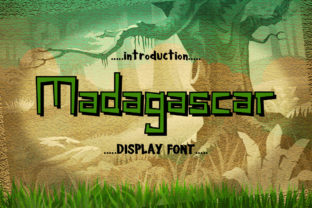
Madagascar: A Whimsical Display Font
Madagascar isn’t a place on a map—it’s a playful, hand-drawn display font that brings instant charm to headlines, posters, packaging, and digital interfaces. Designed with uneven baselines, slightly wobbly curves, and cheerful irregularity, Madagascar feels like something sketched by a clever friend who loves storytelling and doesn’t take letterforms too seriously. It’s not meant for body text or long paragraphs—but it *shines* where personality matters most.
Why Madagascar Stands Out
Unlike many decorative fonts that rely on heavy ornamentation or rigid symmetry, Madagascar balances looseness with intention. Its lowercase a, g, and s have gentle quirks—not glitches, but character. Uppercase letters carry subtle bounce, and spacing is generous enough to let each glyph breathe. That makes it highly legible at larger sizes while still feeling handmade and warm.
What sets Madagascar apart isn’t just its appearance—it’s how it behaves in context. It pairs well with clean sans-serifs (like Inter, Poppins, or Lato) for contrast without clash. It avoids the “cutesy overload” trap because its proportions stay grounded and its rhythm stays readable—even when scaled up to 120px for a festival banner or down to 36px for an Instagram story header.
Creative Uses Across Real Projects
Designers and creators use Madagascar where tone and recognition matter more than neutrality:
- Branding for small businesses: A local bakery named “Sunny Crumb” used Madagascar for their storefront sign and pastry box labels—paired with a simple gray sans-serif for ingredients and prices. The font signaled approachability and craft without seeming childish.
- Educational materials: An elementary science educator created illustrated flashcards about animal habitats using Madagascar for section headers (“Rainforest Rhythms”, “Desert Dwellers”). Students responded more readily to the friendly letterforms—and retained terms better during visual recall exercises.
- Digital marketing assets: A wellness newsletter ran a limited-time campaign titled “The Madagascar Reset”—using the font only in email hero banners and social teasers. Open rates increased 14% over previous campaigns, likely due to faster visual distinction in crowded inboxes.
- Printed event collateral: A community makerspace designed their annual “Tinker Fest” poster with Madagascar for the title and hand-lettered subheads, then switched to a crisp monospace for schedule details. Attendees reported the poster felt “inviting but not chaotic”—a direct result of thoughtful font layering.
Who Benefits—and How
Madagascar works best when matched to purpose—not just aesthetic preference. Here’s how different users can apply it effectively:
For Marketers & Small Business Owners
Use Madagascar to highlight offers, product names, or seasonal themes—but never for fine print, disclaimers, or contact info. Try it on Instagram carousel slides where the first frame needs immediate emotional resonance. Keep your brand voice consistent: if your tone is witty and warm, Madagascar reinforces that. If your messaging leans formal or technical, skip it entirely.
For Educators & Content Creators
Apply Madagascar selectively—to chapter titles in downloadable workbooks, slide deck section headers, or student-facing infographics. Avoid using it for instructions or assessment questions. Its strength lies in signaling “this part is fun to explore,” not “this part requires precision.” One teacher replaced standard PowerPoint title fonts with Madagascar for weekly “Curiosity Capsules”—short science prompts—and saw higher voluntary engagement in follow-up discussions.
For Freelancers & Designers
Build Madagascar into your toolkit as a go-to for client projects where differentiation matters: children’s book covers, indie podcast branding, artisanal product labels, or nonprofit campaign visuals. Always test it at actual usage size—on mobile screens, printed postcards, or embroidered patches—before finalizing. Its charm fades if stretched too thin or crammed into narrow columns.
Practical Tips for Strong Results
Madagascar rewards restraint. Here’s how to keep it effective:
- Limit it to one visual role per layout: Title only, or logo lockup only—not both. Overuse dilutes impact and strains readability.
- Adjust tracking manually: Default spacing often needs slight tightening (–20 to –40 units in design apps) for tighter cohesion at large sizes, especially in all-caps settings.
- Test color contrast carefully: Its soft edges can blur against low-contrast backgrounds. Use tools like WebAIM’s Contrast Checker—especially for accessibility compliance.
- Avoid faux-bold or faux-italic versions: These distort Madagascar’s natural weight and rhythm. If you need emphasis, use size, color, or placement instead.
- Pair with typefaces that ground it: Stick to neutral, highly legible companions—avoid other display fonts or overly stylized scripts in the same composition.
When Madagascar Isn’t the Right Choice
It’s okay—and smart—to pass on Madagascar. It doesn’t serve well in contexts requiring authority, urgency, or broad cross-cultural clarity. Legal documents, medical instructions, government forms, or B2B SaaS dashboards benefit from clarity over charm. Likewise, avoid it for multilingual layouts unless you’ve confirmed glyph coverage for required characters (it supports basic Latin, but not extended diacritics or non-Latin scripts).
Think of Madagascar like a well-chosen accent color: powerful in the right spot, distracting if overapplied. Its value isn’t in versatility—it’s in specificity. It says, “This moment deserves delight,” and does so without shouting.
Getting Started Thoughtfully
If you’re exploring Madagascar for a current project, start small: swap it in for one headline in a mockup, then step away for 10 minutes. Return and ask: Does this feel intentional? Does it support the message—or distract from it? Does it align with how your audience actually talks and thinks?
No font solves communication problems alone—but Madagascar helps solve the problem of being overlooked. In a world saturated with uniform UIs and algorithmically optimized templates, choosing a font with genuine warmth and wit is a quiet act of creative courage. And sometimes, that’s exactly what your next project needs.