Katrin Sketch: A Whimsical Display Font for Light, Playful Design
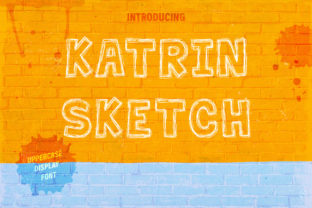
Katrin Sketch is a hand-drawn display font designed with a light, airy stroke and irregular, sketch-like contours. It features rounded terminals, subtle inconsistencies in line weight, and gentle variations in letterform height—characteristics that evoke the spontaneity of pencil or fine-tip marker work. Unlike monoline or geometric display fonts, Katrin Sketch intentionally avoids precision, prioritizing charm and approachability over uniformity. It is not intended for body text or long-form reading; rather, it serves best in contexts where visual personality and lighthearted tone are central to communication.
Why Designers Consider Katrin Sketch
Designers often seek fonts that reinforce brand voice without requiring extensive custom illustration. Katrin Sketch appeals to those working on projects where warmth, informality, or childlike wonder supports the message—such as packaging for organic snacks, invitations for baby showers, or websites for creative workshops. Its sketch aesthetic signals authenticity and human touch, which can help differentiate a design from more polished, corporate alternatives. It also functions well in digital environments where soft contrast and open spacing support legibility at larger sizes, especially against clean or muted backgrounds.
Key Benefits and Practical Strengths
Katrin Sketch offers several functional advantages for specific use cases:
- Strong visual identity: Its distinctive rhythm and irregular baseline create immediate recognition, helping headlines or logos stand out in crowded visual spaces.
- Light visual weight: The thin, delicate strokes avoid overwhelming layouts, making it suitable for pairing with heavier sans-serif or serif typefaces in typographic hierarchies.
- Low cognitive load for short phrases: When used sparingly—on titles, labels, or callouts—the font’s simplicity and consistent lowercase dominance support quick comprehension.
- Cross-platform compatibility: As a standard OpenType font, it embeds reliably in web projects (via @font-face), print workflows, and common design tools like Figma, Adobe Illustrator, and Canva.
Tradeoffs and Realistic Expectations
Like any display font, Katrin Sketch comes with inherent limitations. Its sketch-style construction reduces legibility at small sizes or low resolutions. Characters such as “a”, “e”, and “g” rely on open counters and loose proportions—features that blur when scaled below 36px on screen or printed at under 14pt. It also lacks extended language support; most versions include only basic Latin characters, with limited or no diacritics, making it unsuitable for multilingual interfaces or publications requiring accented characters.
Another consideration is tonal consistency. Because Katrin Sketch leans heavily into playfulness, it may unintentionally undermine seriousness in contexts like financial reports, legal disclaimers, or healthcare communications. Its informal nature doesn’t convey authority or stability—qualities that some audiences expect from typography in certain domains.
When Katrin Sketch Is a Strong Fit
Katrin Sketch performs best when three conditions align: the text is short, the context is visually permissive, and the audience expects lightness or creativity. Examples include:
- Event branding for festivals, craft fairs, or educational camps targeting children or families.
- Product labels for artisanal goods—think handmade soaps, small-batch teas, or illustrated stationery—where handmade aesthetics reinforce perceived quality and care.
- Digital banners or social media graphics where headline text appears alongside ample whitespace and simple imagery.
- Internal design systems for teams building playful brand extensions (e.g., a children’s book publisher launching a companion app).
In each case, Katrin Sketch contributes meaning—not just decoration. Its presence signals intention: that the content values imagination, accessibility, and emotional resonance over formality or technical rigor.
When Alternatives May Be More Appropriate
If your project requires broader linguistic coverage, tighter spacing control, or adaptability across multiple weights and widths, other display fonts may better serve long-term needs. For instance:
- For multilingual support: Fonts like Quicksand or Nunito offer similar lightness and rounded forms but include extended Latin, Cyrillic, and Greek character sets.
- For greater typographic flexibility: A family like Poppins provides variable weight options, optical sizing variants, and robust hinting for screen rendering—making it easier to maintain hierarchy across devices.
- For higher legibility at smaller sizes: Fonts such as Comic Neue retain a casual feel while improving character distinction and x-height proportion, supporting readability down to 16–18px.
Additionally, if your workflow relies heavily on dynamic text generation—such as user-generated content or CMS-driven headlines—Katrin Sketch’s stylistic quirks may introduce unpredictability. In those cases, a more neutral yet friendly alternative helps preserve consistency without sacrificing approachability.
Making an Informed Choice
Selecting Katrin Sketch shouldn’t hinge solely on visual preference. Start by reviewing your content structure: how many words will appear in the font? Will it appear on mobile screens, printed materials, or both? What emotions or associations should the typography reinforce—and do those align with the font’s inherent qualities?
Test early and in context. Render sample headlines using real copy—not placeholder text—and evaluate them against your actual background colors, image treatments, and layout constraints. Check contrast ratios for accessibility compliance, especially if the font appears over photographs or gradients. If possible, gather feedback from representative users: does the typeface support—or distract from—the message?
Finally, consider maintenance. If you anticipate needing bold variants, italic styles, or alternate glyphs (such as swashes or ligatures), verify whether the version of Katrin Sketch you’re licensing includes those features—or whether you’ll need to supplement with manual adjustments or fallbacks.
Katrin Sketch is a purpose-built tool—not a universal solution. Its value lies in its specificity: when matched thoughtfully to audience, medium, and intent, it adds nuance and warmth that more generic fonts cannot replicate. But that same specificity means it requires deliberate integration. Evaluating it alongside functional requirements—not just aesthetic appeal—helps ensure it enhances, rather than complicates, your design goals.