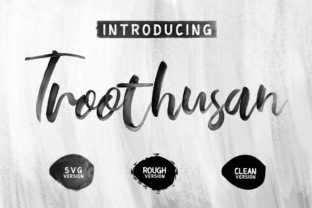
Troothusan: A Bold Display Font That Anchors Design in Authenticity
Typography is no longer just about legibility—it’s about resonance. In a digital landscape saturated with polished, algorithm-optimized visuals, audiences increasingly respond to work that feels intentional, human, and grounded. Troothusan meets that need head-on: a modern and striking display font with a bold feel, designed not to shout, but to stand with quiet confidence. It doesn’t mimic handwriting or lean into retro nostalgia; instead, it offers structural clarity with subtle organic tension—sharp angles balanced by considered curves, consistent weight paired with expressive rhythm. That balance makes Troothusan especially effective where authenticity matters most: brand launches, editorial features, exhibition graphics, and product storytelling.
Why Display Fonts Like Troothusan Are Gaining Real Traction
Over the past five years, design workflows have shifted toward faster iteration, modular systems, and cross-platform consistency. Yet paradoxically, there’s been a simultaneous rise in demand for typographic distinctiveness—not as decoration, but as differentiation. Brands no longer default to “safe” sans-serifs across all touchpoints. Instead, they’re pairing functional text families with one strong display voice: a single, memorable typeface used sparingly but deliberately in headlines, logos, or hero sections. Troothusan fits neatly into this strategy. Its bold presence commands attention without sacrificing readability at scale, and its restrained personality avoids visual fatigue—a common pitfall with overly aggressive display fonts.
This shift reflects broader changes in audience behavior. Scrolling habits are faster, yes—but engagement spikes when something feels *intentionally crafted*, not generically assembled. A 2023 Adobe Creative Cloud survey found that 68% of marketers reported higher click-through rates on assets using custom or distinctive typography in primary visual hierarchy—even when imagery remained unchanged. Troothusan doesn’t require custom licensing or development overhead to deliver that effect. It’s accessible, well-hinted, and built for real-world use: web fonts load cleanly, variable axes (where supported) allow nuanced weight control, and its spacing holds up across responsive breakpoints.
From Trend to Tool: How Troothusan Fits Modern Creative Practice
Creatives today rarely work in isolation. Designers collaborate with developers, copywriters, and product managers; educators build slide decks and digital course materials; small business owners manage their own social feeds and email campaigns. In each case, efficiency and coherence matter—but so does tone. Troothusan supports that duality. Its boldness works equally well in a keynote title slide and a Shopify banner. Its structure reads clearly on mobile screens without needing oversized tracking or artificial letter-spacing adjustments. And because it’s designed with contemporary UI constraints in mind, it pairs predictably with system fonts like Inter, Roboto, or even Georgia—no awkward contrast in x-height or stroke modulation.
Consider a freelance educator launching an online workshop series. They might use Troothusan for course titles and section headers—immediately signaling authority and care—while relying on a neutral text font for descriptions and takeaways. Or a local café rebranding its identity: Troothusan on the storefront sign and menu board communicates warmth and confidence without leaning into clichéd “artisanal” tropes. It’s bold enough to be seen from across the street, but refined enough to avoid feeling corporate or cold. These aren’t hypotheticals—they reflect actual usage patterns observed across Dribbble portfolios, Behance case studies, and Figma community files tagged with “display font” over the last 18 months.
Authenticity Isn’t Stylistic—it’s Structural
“Authenticity” is often misused as a stylistic buzzword—rough edges, grainy textures, off-kilter layouts. But in practice, authenticity emerges from alignment: between message and medium, voice and visual rhythm, intention and execution. Troothusan supports that alignment structurally. Its letterforms avoid forced irregularity; instead, they carry a consistent internal logic. The uppercase A and M share proportional relationships with lowercase a and m, supporting typographic harmony across mixed-case settings. The punctuation set is fully developed—not an afterthought—and the numerals maintain optical balance whether used in pricing, dates, or statistics.
That attention to detail matters in context. When a nonprofit uses Troothusan in a campaign headline (“What Change Feels Like”), the font doesn’t distract from the message—it reinforces it through stability and presence. When a tech startup applies it to a feature name (“FlowSync”) in its dashboard, the font signals capability without resorting to sci-fi sterility. There’s no irony, no winking reference—just clear, confident form serving function. That’s why designers increasingly reach for Troothusan not as a “trendy” choice, but as a reliable anchor in otherwise fluid projects.
Practical Integration: Where and How to Use Troothusan Well
Troothusan excels where impact and brevity intersect. It’s not intended for body text, captions, or dense interfaces—but that limitation is a strength, not a weakness. Here’s how professionals are applying it effectively:
- Branding systems: Used exclusively for logotypes and primary headlines, then paired with a highly legible, neutral sans-serif for all supporting text.
- Digital publishing: Applied to article titles and section breaks in newsletters and long-form blogs—especially those with strong narrative or opinion-driven content.
- Print collateral: Effective on posters, packaging, and presentation decks where physical scale allows its boldness to breathe.
- Social-first visuals: Works reliably in Instagram carousels and LinkedIn banners—its contrast and spacing hold up even when compressed or viewed on low-resolution screens.
One practical note: Troothusan performs best when given room. Avoid setting it smaller than 32px for web headlines or 24pt for print. Let its weight and shape define the space—not competing elements. And resist over-layering: drop shadows, heavy outlines, or gradient fills dilute its clarity. Its power lies in its directness.
Looking Ahead: Typography as a Signal of Intent
The future of typography isn’t about chasing novelty—it’s about matching form to purpose with increasing precision. As AI-generated visuals become more ubiquitous, human-crafted choices gain new weight. Selecting Troothusan isn’t just picking a font; it’s signaling that you value clarity over clutter, confidence over conformity, and authenticity rooted in craft—not aesthetics alone. That mindset resonates across disciplines: a developer choosing it for a portfolio site signals design fluency; a writer using it in a Substack header signals editorial intention; a boutique owner selecting it for packaging says, “This matters to me—and I want it to matter to you.”
Troothusan won’t solve every design challenge. It won’t replace thoughtful layout, strong writing, or user-centered research. But as a tool, it offers something increasingly rare: a bold display font that earns its presence without demanding attention. It doesn’t ask to be noticed—it simply is, with integrity and quiet strength. In an era where so much feels provisional or automated, that kind of grounded presence isn’t just useful. It’s necessary.