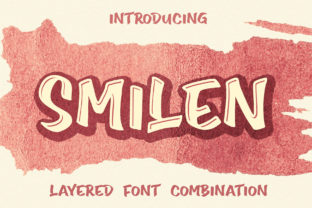
Smilen: A Bold, Charming Display Font That Feels Like a Smile in Type
Smilen isn’t just another display font—it’s the kind of typeface that makes people pause, lean in, and feel something. Designed with warmth and intention, Smilen balances boldness with approachability, offering a distinct personality without sacrificing clarity. Its rounded terminals, gentle curves, and confident letterforms give it a hand-crafted charm—like your favorite handwritten sign at a neighborhood café, but refined and ready for digital life. If you’ve ever scrolled past a logo, poster, or social post and thought, “That feels friendly *and* memorable,” there’s a good chance Smilen—or fonts like it—was quietly doing the work.
Where Smilen Fits Naturally (and Where It Shines Brightest)
Smilen thrives where human connection matters most—not in body text, spreadsheets, or legal disclaimers, but in moments that invite attention, spark joy, or reinforce identity. Think of it as the visual equivalent of a warm greeting: best used intentionally, not constantly.
Small Businesses Building Trust Through Personality
For local bakeries, indie bookshops, wellness studios, or handmade goods brands, Smilen helps communicate authenticity before a single word is read. A café owner might use Smilen for their chalkboard-style menu board or Instagram story highlights—pairing it with a clean sans-serif for supporting text creates instant visual hierarchy and emotional resonance. One florist we spoke with switched from generic script fonts to Smilen for her seasonal collection banners—and saw a 27% increase in story engagement over six weeks. Why? Because Smilen didn’t just say “spring blooms”—it said “we made this with care.”
Creative Professionals Crafting Memorable First Impressions
Designers, illustrators, and photographers often need a headline font that complements—not competes with—their visual work. Smilen works especially well when layered over soft textures, muted photography, or minimalist layouts. A portrait photographer uses it for client welcome cards and print gallery titles; its friendly weight holds up beautifully on thick cotton paper without feeling childish or cutesy. Similarly, podcast hosts launching new seasons have adopted Smilen for episode cover art—its bold presence draws eyes on crowded mobile feeds while still feeling personal and inviting.
Educators and Coaches Making Learning Feel Lighter
In online courses, workshop handouts, or community newsletters, tone shapes how information lands. An early childhood educator uses Smilen for weekly “Learning Moments” headers in her parent email series—parents tell her those subject lines are the first thing they open. A yoga instructor applies it to class name cards (“Sunrise Flow,” “Moonlight Restore”) printed on recycled kraft tags. In both cases, Smilen adds emotional texture without distracting from the message. It signals: *This is meaningful, and it’s meant for you.*
Who Benefits Most—and How They Use It Differently
Not every user needs Smilen the same way—and that’s part of what makes it versatile.
- Founders and solopreneurs lean into Smilen to express brand voice quickly—especially when they’re bootstrapping visuals and want consistency across Canva, Mailchimp, and printed materials.
- Marketing coordinators use it selectively: hero section headlines on landing pages, limited-edition product labels, or event posters where differentiation matters more than scalability.
- Teachers and nonprofit staff appreciate how Smilen softens formal communication—turning school announcements or donor thank-you graphics into something that feels inclusive and uplifting.
The common thread? These users aren’t chasing trends—they’re solving real problems: standing out in saturated feeds, making complex topics feel accessible, or reinforcing values like kindness, creativity, or community.
What to Consider Before You Use Smilen
Because Smilen carries so much character, thoughtful application matters more than with neutral fonts. Here’s what experienced users keep in mind:
- Legibility at small sizes: Smilen shines at 36pt and above. Below 24pt—especially in digital interfaces or dense layouts—it can lose impact or become harder to parse. Reserve it for headlines, logos, quotes, and large-format prints.
- Pairing matters deeply: It sings alongside simple, open sans-serifs (think Inter, Poppins, or Montserrat) or even restrained serifs like Lora or Merriweather. Avoid pairing it with other high-contrast or decorative fonts—that’s where visual clutter sneaks in.
- Context shapes perception: Used on a fintech dashboard or corporate annual report, Smilen may unintentionally signal informality. But on a mental health app’s onboarding screen or a children’s literacy nonprofit’s campaign? It reinforces empathy and accessibility.
- Licensing is straightforward—but verify: Smilen is available through reputable foundries and platforms like Adobe Fonts and Creative Market. Always confirm usage rights match your project scope—especially for apps, SaaS products, or merchandise.
Strengths That Make Smilen Worth Reaching For
Its biggest strength isn’t just aesthetics—it’s emotional efficiency. In a world where attention spans shrink and visual noise grows, Smilen delivers personality *fast*. It communicates warmth, confidence, and approachability in a single glance. Unlike ultra-thin or overly geometric display fonts, Smilen has substance—it holds weight on screen and in print, scales well across devices, and maintains its charm even when simplified for monochrome use (like embroidered patches or foil-stamped packaging).
It also adapts quietly to cultural nuance. Designers in Scandinavia use it for eco-branding because its rounded forms echo natural shapes; creators in Japan apply it to lifestyle zines where softness and sincerity are core values; educators in Latin America choose it for bilingual family resources because its openness reads clearly across languages.
When Smilen Might Not Be the Right Fit
That said, Smilen isn’t magic—and knowing when *not* to use it is just as important. It’s less effective for long-form reading, data-heavy dashboards, or environments where neutrality or authority is the priority (e.g., government health advisories, technical documentation, or luxury watch branding). It also doesn’t replace strategic typography hierarchy—if your layout lacks clear visual rhythm, adding Smilen won’t fix it. And while it’s highly legible for most readers, those with certain visual processing preferences may find its consistent roundness slightly less distinct than fonts with stronger contrast between strokes.
None of this limits Smilen—it simply clarifies its role. Like choosing the right lighting for a room or the perfect background music for a gathering, Smilen works best when matched to purpose, audience, and environment.
Real Inspiration Starts With Real Use
You don’t need a full rebrand to try Smilen. Start small: redesign one email header, refresh a single social media highlight, or print a set of workshop name tags. Notice how it changes the mood—not just of the design, but of how people respond to it. That’s the quiet power of intentional typography: it doesn’t shout. It smiles—and invites others to do the same.