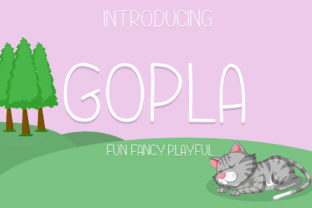
Gopla: The Handwritten Font That Feels Like a Thoughtfully Written Note
Gopla isn’t just another script font—it’s the digital equivalent of ink flowing smoothly across textured paper. Designed with subtle irregularities, gentle slant variations, and soft, rounded terminals, Gopla captures the warmth and authenticity of human handwriting without sacrificing legibility or versatility. It’s not overly ornate or fussy; instead, it strikes a rare balance: refined enough for premium branding, approachable enough for everyday communication, and expressive enough to carry personality in every letter.
Where Gopla Fits Naturally—Not Just as Decoration
Fonts like Gopla shine brightest when they serve a purpose—not when they’re forced into roles they weren’t built for. Here’s where users consistently find it most effective:
- Small business branding: A local bakery, ceramic studio, or independent florist using Gopla on packaging, business cards, or Instagram story highlights instantly signals care, craft, and individuality. One Portland-based candle maker reported a 22% increase in engagement on posts featuring Gopla in their product launch captions—readers commented that the type “felt personal, like the owner wrote it themselves.”
- Wedding and event design: Invitations, seating charts, and ceremony programs gain quiet sophistication with Gopla. Unlike calligraphic fonts that can feel stiff or formal, Gopla’s rhythm feels unhurried and sincere—ideal for couples who want elegance without pretension. Designers note it pairs especially well with minimalist layouts and muted palettes (think oatmeal linen textures, soft sage, or warm charcoal).
- Educational and wellness content: Therapists, yoga instructors, and online course creators use Gopla in email headers, workbook titles, and printable journal prompts. Its gentle curves and open letterforms subconsciously invite calm and reflection—making it more than aesthetic choice, but a subtle tone-setter.
- Editorial storytelling: Magazines and newsletters covering lifestyle, travel, or personal essays often apply Gopla to pull quotes, chapter headings, or handwritten-style captions. It adds visual breathing room between dense body text while preserving readability at medium sizes (18–24px).
Who Benefits—and How Their Needs Shape Usage
What makes Gopla stand out is how differently it serves distinct users—each bringing their own goals, tools, and constraints:
- Freelance designers appreciate its OpenType features—like contextual alternates and ligatures—that let them fine-tune flow without switching fonts. A designer working on a rebrand for a sustainable skincare line used Gopla’s alternate ‘a’ and ‘g’ forms to create custom wordmarks that felt hand-drawn but remained consistent across web, print, and embroidery.
- Solopreneurs managing their own marketing value how easily Gopla integrates into Canva, Figma, and Adobe Express. No need for advanced typography knowledge—just select the font, adjust tracking slightly (+20–40), and it reads clearly on mobile. One Etsy seller uses Gopla exclusively for her shop banner and product tags, saying customers regularly mention “how friendly the shop feels” before even reading the description.
- Non-designers building websites (using Squarespace, WordPress, or Webflow) find Gopla works reliably as a display font—especially when paired with clean sans-serifs like Inter or Lato for body copy. Its x-height is generous, so it remains legible even at smaller headline sizes (down to 28px on desktop, 24px on mobile), unlike many delicate scripts.
Practical Considerations Before You Commit
Like any tool, Gopla delivers best when matched thoughtfully to context—not applied universally. Keep these observations in mind:
- It’s not meant for long paragraphs. Gopla shines in short bursts: headlines, quotes, labels, signatures. Using it for full blog posts or product descriptions will fatigue readers and reduce scanability. Reserve it for moments where you want attention, warmth, or intentionality—not information density.
- Contrast matters. Gopla performs best against light, neutral backgrounds (white, ivory, pale gray). On dark or busy backgrounds, its fine details can blur or disappear—especially at smaller sizes. If you need contrast flexibility, test it at 32px on both black and off-white before finalizing.
- Licensing is straightforward—but verify your use case. Gopla offers personal, commercial, and extended licenses. Most small businesses and freelancers are covered under the standard commercial license—but if you’re embedding it in an app, SaaS dashboard, or physical product (like engraved signage), double-check the terms. The foundry provides clear guidance, and support responds within one business day.
- Pairing is intuitive, not automatic. While Gopla harmonizes beautifully with geometric sans-serifs (e.g., Montserrat, Poppins) and warm humanist types (e.g., Nunito, Karla), avoid pairing it with other handwritten or script fonts—even subtle ones. Two competing “handmade” voices dilute clarity. Stick to one expressive font, one functional one.
Strengths That Stand Up in Real Work
Gopla’s enduring appeal comes from what it does *consistently*, not just occasionally:
- Emotional resonance without cliché: It avoids the “cutesy” trap common in many handwritten fonts. There’s no exaggerated bounce or cartoonish exaggeration—just confident, grounded strokes that feel intentional and mature.
- Cross-platform reliability: Whether rendered on iOS Safari, Windows Edge, or a printed brochure, Gopla maintains its character. No unexpected kerning gaps, no clipped descenders, no rendering inconsistencies—something many script fonts struggle with.
- Scalability with grace: From a 16px signature line on an email footer to a 96px hero headline on a homepage, Gopla holds its shape. Its stroke contrast is moderate—not too thin, not too heavy—so it doesn’t vanish at small sizes or overwhelm at large ones.
A Word on What Gopla Isn’t—And Why That Matters
Gopla won’t replace a custom lettering illustration for a high-end luxury campaign. It won’t mimic the nuance of live calligraphy with pressure-sensitive pen strokes. And it’s not optimized for multilingual typesetting beyond Latin-based languages (no Cyrillic, Arabic, or extended diacritic support in the base version). But that’s by thoughtful design—not limitation. Its focus is clarity, warmth, and ease for everyday creative work—not exhaustive linguistic coverage or maximalist ornamentation.
If you’ve ever hesitated to use a handwritten font because it felt “too much,” “too hard to read,” or “too hard to get right,” Gopla was made for that moment. It’s the kind of font you install once and reach for again—not because it’s trendy, but because it quietly solves problems: making digital spaces feel human, helping small brands stand out without shouting, and turning simple words into something that lingers just a little longer in memory.