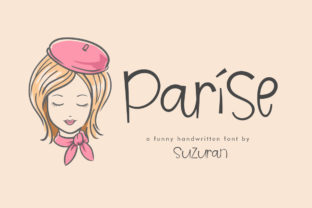
Parise: A Light, Expressive Display Font for Creative Projects
Parise is a display font designed to balance elegance with approachability. It’s not built for body text or long-form reading — instead, Parise thrives where personality and visual impact matter most: headlines, logos, invitations, editorial features, and short-form digital graphics. Its defining traits are lightness, subtle contrast, and a hand-informed rhythm that avoids mechanical uniformity. Each glyph carries gentle variations in stroke weight and terminal shape, lending Parise a quiet warmth without sacrificing clarity.
What Makes Parise Distinct Among Display Fonts
Many display fonts fall into one of two camps: highly stylized (with strong decorative elements) or minimalist (stripped down to near-neutrality). Parise occupies a thoughtful middle ground. It’s light in weight — not thin to the point of fragility, but airy enough to feel modern and uncluttered. Its letterforms feature soft curves, open counters, and modest x-height, which together support legibility at larger sizes while preserving charm.
Unlike monoline sans-serifs or tightly spaced geometric fonts, Parise uses organic spacing and intentional irregularities — for example, the lowercase a has a slightly tilted bowl, and the g includes a looping descender that feels deliberate, not arbitrary. These details aren’t gimmicks; they’re cues that invite attention without demanding it. That subtlety makes Parise versatile across contexts where tone matters: a boutique brand might use it to signal craftsmanship, while an independent magazine could deploy it to suggest editorial warmth and intentionality.
Fitness for Purpose: Where Parise Excels
Parise performs best when used intentionally and sparingly. It shines in situations where hierarchy is clear and the viewer has time to absorb visual nuance — such as:
- Editorial mastheads and section headers in print or web publications
- Branding elements for lifestyle, wellness, or creative services
- Wedding stationery, event posters, or artisan product packaging
- Short digital banners or hero text where screen real estate is limited but impact is essential
In each case, Parise contributes voice without overwhelming content. Because it’s light and relatively low-contrast, it pairs well with robust, highly legible text fonts — think a sturdy serif or neutral sans-serif for body copy. That contrast in tone and function helps guide the reader naturally from headline to detail.
Tradeoffs and Practical Considerations
Parise isn’t suited for every application — and recognizing its boundaries is key to using it effectively. Its light weight means it can fade on low-resolution screens or in environments with poor lighting. At small sizes — below 24px on screen or under 14pt in print — some characters lose distinction, particularly in condensed settings or with tight tracking. It also lacks extensive language support in many releases, so multilingual projects may require fallbacks or complementary typefaces.
Another consideration is tone alignment. While Parise’s charm is genuine, it leans toward the refined and understated. It won’t convey urgency, authority, or technical precision the way a high-contrast serif or structured sans-serif might. If your project demands gravitas, immediacy, or broad accessibility (such as public signage or government communications), Parise may sit too far from those goals.
How Parise Compares With Other Light Display Options
When evaluating Parise alongside other light display fonts, differences emerge in rhythm, structure, and implied context. Some alternatives prioritize geometric precision — clean lines, uniform terminals, consistent spacing — which gives them a more contemporary or tech-adjacent feel. Parise, by contrast, embraces slight asymmetry and variation, evoking human touch rather than algorithmic perfection.
Other light fonts rely heavily on extreme thinness or dramatic contrast to stand out. Parise avoids that strategy. Its lightness comes from balanced proportions and open forms, not minimal stroke weight alone. That makes it more durable across backgrounds — it holds up better over textured photography or soft gradients than ultra-thin fonts that risk disappearing.
Compared to script or handwritten display fonts, Parise offers greater neutrality and scalability. It doesn’t carry the informality or exclusivity that some scripts imply, nor does it sacrifice readability for flourish. That positions it well for brands seeking distinction without theatricality.
When to Choose Parise — and When to Look Elsewhere
Parise is a strong candidate if your project values:
- Distinctiveness without distraction — you want typography that supports, not competes with, imagery or messaging
- Tone consistency — your brand voice is calm, considered, and quietly confident
- Print and digital flexibility — you’ll use the font across both mediums, often at larger sizes
- Design cohesion — you have control over layout, color, and supporting type choices
It’s less ideal if you need:
- High legibility at small sizes or on variable devices (e.g., mobile app interfaces or data dashboards)
- Broad character coverage for non-Latin scripts or extended diacritics
- A bold or commanding presence — Parise doesn’t scale upward in weight, so it won’t serve as a full typographic system on its own
- Rapid scanning or functional clarity — like navigation labels, warning text, or instructional copy
Real-world examples help illustrate fit. A ceramics studio launching a new collection might use Parise for the product name on packaging, paired with a warm, low-contrast serif for care instructions. That pairing reinforces craft and care without shouting. Meanwhile, a fintech startup building a dashboard would likely benefit more from a highly legible, multi-weight sans-serif — one that scales cleanly from button labels to chart annotations.
Making the Choice: Context Over Catalog
Selecting a display font like Parise isn’t about finding the “best” option — it’s about matching typographic behavior to communicative intent. Ask yourself: What role does this text play? Who will see it, and under what conditions? How much visual breathing room does the layout allow? Does the font complement or complicate the message?
Parise works because it respects those questions. It doesn’t try to be everything — it’s not a text font, a branding system, or a UI toolkit. But within its scope, it delivers consistency, character, and quiet confidence. That focus makes it easier to evaluate alongside alternatives: compare how each handles spacing, contrast, and expressive range in your actual layouts — not just in specimen sheets.
Testing matters. Try Parise in your real environment: set a headline against your intended background, view it on multiple devices, and read it aloud. Notice whether it feels like part of the story — or a separate layer competing for attention. That kind of grounded evaluation, not abstract preference, leads to stronger typographic decisions.
Ultimately, Parise invites restraint and intention. It rewards thoughtful pairing, careful sizing, and awareness of context. Used well, it adds personality without pretense — a light touch that lingers.