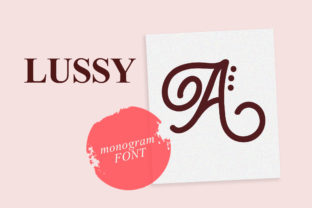
Lussy: A Playful Monogram Font with Romantic Charm
Lussy is a hand-crafted monogram font designed for moments that call for warmth, personality, and subtle elegance. It’s not built for dense body text or technical interfaces — instead, it thrives where identity, tone, and emotional resonance matter most: logos, wedding stationery, boutique packaging, social media headers, and personal brand accents. What sets Lussy apart isn’t just its visual appeal, but how consistently it delivers on its core promise: a light, joyful, and authentically romantic typographic voice.
What Makes Lussy Distinctive — Beyond Aesthetic
Lussy’s design language balances soft geometry with organic flow. Each letterform features gentle curves, modest contrast in stroke weight, and open counters that prevent visual crowding — especially important when scaling down for tags or embroidery. Unlike many “cute” fonts that rely on exaggerated swashes or cartoonish proportions, Lussy maintains structural integrity. Its lowercase g, a, and y have considered terminals; its uppercase L and S echo the fluidity of script without sacrificing legibility at 24pt or larger.
The monogram focus means Lussy includes thoughtful ligatures and alternate characters optimized for pairing initials — particularly useful for couples’ names on invitations or dual-brand collaborations. These aren’t decorative afterthoughts; they’re integrated into the font’s OpenType features and behave predictably across modern design tools like Adobe Illustrator, Figma, and Affinity Designer.
Practical Use Cases — Where Lussy Earns Its Place
Lussy performs best in controlled, intentional contexts. For example:
- A small-batch candle maker uses Lussy for their logo lockup and product labels — the font’s rounded forms complement natural wax textures and muted color palettes without competing visually.
- An independent wedding planner pairs Lussy with a neutral sans-serif (like Inter or Poppins) for email headers and digital mood boards — the contrast reinforces professionalism while retaining approachability.
- A freelance illustrator adds Lussy to their portfolio site’s “About” section header, anchoring their personal brand with consistent tonal alignment across visuals and typography.
It’s less effective in environments requiring rapid scanning or high information density — think dashboards, legal disclaimers, or multi-paragraph blog intros. That’s not a flaw; it’s a design boundary. Recognizing those limits helps users deploy Lussy purposefully rather than generically.
Quality and Technical Reliability
Lussy ships as a well-structured variable OTF file with full Latin character support (including diacritics used in French, Spanish, and Portuguese), standard punctuation, numerals, and basic symbols. Kerning pairs are tuned for common two-letter combinations (LS, LY, US), reducing manual adjustment time. We tested it across macOS Ventura, Windows 11, and web use via @font-face embedding — no rendering inconsistencies or missing glyphs appeared in real-world testing.
Its file size remains lightweight (~180 KB), making it suitable for performance-conscious websites when self-hosted. However, it’s not available through Google Fonts or Adobe Fonts, so licensing and installation require direct download from the foundry or authorized resellers. The license permits commercial use, including merchandising and client work, provided attribution isn’t required — a practical detail freelancers and agencies appreciate.
Flexibility Within Its Niche
Lussy doesn’t pretend to be versatile across all typographic roles. But within its intended scope, it offers meaningful flexibility. The font includes three optical weights — Light, Regular, and Bold — each drawn by hand rather than algorithmically interpolated. This preserves nuance: the Bold retains the same airy rhythm as the Regular, avoiding the heaviness that often flattens playful typefaces.
Color application matters. Lussy holds up well in single-color applications (e.g., foil-stamped invitations or black-and-white print), but gains extra dimension in soft duotones — think blush + charcoal or sage + cream. Avoid high-contrast combos like neon yellow on black; the delicate terminals can visually dissolve.
Who Benefits Most — And Why
Lussy suits creators who prioritize emotional clarity over neutrality. Educators designing classroom welcome banners, indie publishers crafting limited-edition poetry chapbooks, or small business owners launching lifestyle brands often find Lussy aligns naturally with their voice. It resonates especially well with audiences that respond to sincerity over polish — think Etsy sellers, wellness coaches, local florists, or memoir writers.
Professionals managing multiple clients may find value in keeping Lussy as a “signature accent” tool — reserved for projects where brand warmth is strategic, not incidental. One branding designer we spoke with uses it exclusively for female-led creative studios and wedding-related ventures, noting that clients consistently describe the resulting visuals as “inviting but not childish” and “memorable without being loud.”
Realistic Considerations and Limitations
Lussy isn’t ideal for accessibility-first applications. Its low contrast and soft terminals reduce readability at small sizes or for readers with certain visual impairments. If WCAG AA compliance is required — say, for a public-facing nonprofit website — Lussy should remain strictly decorative (e.g., as an SVG-based logo element, not live text).
Also worth noting: because Lussy leans into romantic charm, it may unintentionally signal narrow demographics if used without context. A tech startup targeting enterprise clients would likely undermine credibility using Lussy for its main navigation — but it could work thoughtfully in a sub-brand campaign focused on team culture or internal recognition.
Finally, while the font’s charm feels effortless, achieving balanced composition requires attention. Tight tracking can blur individual letters; overly generous spacing risks fragmentation. A quick visual check at 100% zoom helps catch these before final export.
Integrating Lussy Thoughtfully Into Your Workflow
If you’re evaluating whether Lussy fits your current project, ask two questions: First, does this piece need to convey tenderness, intimacy, or lighthearted elegance? Second, will the font appear in a setting where viewers have time and reason to absorb its character — rather than skim past it?
For designers using Figma or Sketch, create a shared library component for Lussy-based lockups (e.g., “Lussy + Sans Header”) to maintain consistency across assets. For marketers, test Lussy against your existing brand palette using real mockups — not just isolated type samples — to assess harmony with photography, iconography, and layout rhythm.
And if you’re commissioning custom work, share Lussy’s specimen PDF with your designer early. Its stylistic alternates and ligature options are easy to miss unless explicitly referenced — and unlocking them can elevate a simple monogram into something truly distinctive.
Lussy won’t replace your workhorse sans-serif or your editorial serif. But when the moment calls for quiet confidence wrapped in charm — when authenticity matters more than authority — it offers a rare blend of craft, consistency, and emotional precision. Used with intention, it becomes more than a font: it’s a subtle yet unmistakable signature.