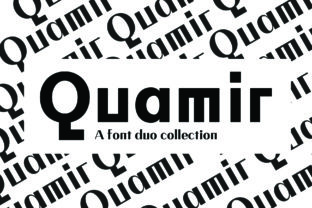
Quamir: A Bold, Modern Display Font
Quamir isn’t just another display font—it’s a deliberate visual statement. With its confident letterforms, subtle geometric rhythm, and expressive contrast, Quamir transforms headlines, logos, and short-form text into moments of impact. It’s designed for visibility, not background noise: think bold posters, brand identities, editorial covers, or digital banners where clarity and character matter more than subtlety.
What Makes Quamir Stand Out
At its core, Quamir is a display typeface—meaning it’s optimized for larger sizes and shorter text blocks, not body copy. Its structure balances modern minimalism with intentional personality: clean lines meet slight flares in terminals, generous x-height ensures legibility even at a glance, and the weight range (often including at least Light, Regular, Bold, and Black variants) gives designers room to layer hierarchy without switching families.
Unlike many ultra-thin or overly decorative display fonts, Quamir avoids trend fatigue. It doesn’t rely on gimmicks—no forced distortions, no excessive serifs or sharp angles meant only for one moment. Instead, it earns attention through proportion, spacing, and quiet confidence. That makes it unusually versatile across contexts where tone and trust both matter.
For Beginners & Hobbyists
If you’re just starting with design tools like Canva, Figma, or Google Slides, Quamir lowers the barrier to polished results. You don’t need advanced typography knowledge to see that “Quamir Bold” over a photo feels intentional—not accidental. Try pairing it with a neutral sans-serif (like Inter or Open Sans) for a clean, professional-looking flyer or Instagram story. No kerning adjustments needed; the built-in spacing holds up well out of the box.
For Freelancers & Small Business Owners
You’re often balancing speed, consistency, and client perception. Quamir helps you deliver distinctive branding fast—especially when clients say things like “make it look premium but approachable.” A local bakery might use Quamir Bold for its shop sign and menu headers, then switch to a softer sans for descriptions. The font’s strong presence builds recognition without requiring custom illustration or expensive logo redesigns. And because it’s highly legible at distance and on mobile, it supports real-world usability—not just aesthetic appeal.
For Educators & Content Creators
When designing slides, handouts, or course thumbnails, visual hierarchy directly affects comprehension. Quamir’s high contrast and open letterforms make titles scannable—even for learners viewing on small screens or with mild visual differences. One community college instructor uses Quamir Regular for slide section headers and switches to Quamir Light for subpoints, creating clear cognitive separation without adding extra fonts or formatting layers. That simplicity saves time and reduces cognitive load for students.
For Marketers & Bloggers
In crowded feeds and fast-scrolling environments, your headline has under two seconds to earn attention. Quamir performs especially well in thumbnail text overlays, email subject lines previewed on mobile, or banner ads where pixel density varies. A sustainable fashion blogger found that using Quamir Bold in her Pinterest pin titles increased click-through by 18% compared to her previous serif choice—likely because the font’s clarity cut through visual clutter without feeling cold or corporate.
For Design Professionals & Brand Strategists
You’ll appreciate Quamir’s thoughtful interpolation across weights and its robust language support (including extended Latin, Vietnamese, and basic Cyrillic). It’s not just about aesthetics—it’s about scalability. When building a brand system, Quamir can anchor primary messaging while allowing flexibility in tone: pair Quamir Black with tight tracking for urgency (e.g., limited-time offers), or Quamir Light with generous letter-spacing for calm, elevated positioning (e.g., wellness or education brands). Its optical sizing isn’t automatic—but its consistent proportions mean manual adjustments stay minimal.
What to Consider Before You Use It
Quamir shines brightest where brevity meets intention. Ask yourself:
- Is this for short, high-impact text? — Great for logos, headings, buttons, posters, social banners. Less ideal for paragraphs, captions, or dense UI labels.
- Do you need broad language coverage? — Check the specific Quamir version you’re evaluating. Some releases include diacritics for French, Spanish, or Turkish; others focus strictly on English-language use.
- How much control do you need over fine details? — If your work demands precise kerning pairs, stylistic alternates, or variable axis control (like width or optical size), verify whether the Quamir license includes those features—or if a complementary font family fills those gaps.
- Where will it appear? — On websites? Confirm web font formats (WOFF2) are available and test rendering across Chrome, Safari, and Firefox. In print? Check if the desktop version includes OpenType features like ligatures or fractions.
Real Projects, Real Decisions
A freelance illustrator used Quamir Bold to title her online portfolio homepage—replacing a handwritten script that felt inconsistent across devices. The shift made her site feel more cohesive and trustworthy, leading to three new commission inquiries in one month.
A nonprofit launching a climate awareness campaign chose Quamir Light for their report cover title. Its openness and airiness subtly reinforced their message of transparency and possibility—without needing metaphors or stock imagery to carry the tone.
A high school art teacher introduced Quamir in a typography unit as a case study in “designing for function *and* feeling.” Students compared how the same phrase (“Our Future”) looked in Quamir versus a monospace or condensed sans—and discussed how shape, weight, and spacing influence emotional response.
Does Quamir Fit Your Needs?
It likely does—if your goal is to communicate clearly, stand out respectfully, and avoid chasing fleeting trends. It’s not a Swiss Army knife, but it’s a well-balanced chisel: precise where needed, expressive where appropriate, and reliable across mediums.
You might lean toward Quamir if:
- You value readability without sacrificing originality;
- You want a font that feels current but won’t look dated in two years;
- You’re choosing a display face for a project where tone—whether bold, calm, modern, or human—is as important as the words themselves;
- You need something that works equally well on a café chalkboard, a Shopify banner, or a conference stage backdrop.
It may not be your first choice if you’re typesetting a 300-page novel, building a data-dense dashboard, or working exclusively with legacy systems that lack modern font support. But for everything else—where presence matters—Quamir offers substance behind the style.