Tenro: A Display Font Built for Clarity, Confidence, and Contemporary Design
When a headline needs to land—not just be seen, but felt—designers reach for something bolder than neutrality. Something that carries weight without shouting, modernity without coldness, and distinction without distraction. That’s where Tenro enters the picture: a display font engineered for impact, grounded in typographic craft, and shaped by how people actually read, scroll, and decide in today’s visual landscape.
What Tenro Is—and Why It Fits Right Now
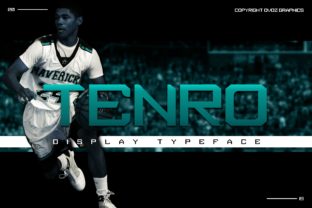
Tenro is a powerful display font with a contemporary feel. This bold font will turn any design idea into an eye catcher—not through novelty alone, but through considered contrast, generous spacing, and confident letterforms. It’s not designed for body text or fine print; it’s built for moments of emphasis: hero sections, presentation slides, packaging front panels, social media banners, and brand signage where first impressions are non-negotiable.
Unlike many “bold” fonts that sacrifice legibility at scale or lean too heavily into geometric austerity, Tenro balances structural integrity with subtle human rhythm. Its uppercase letters have strong verticals and open counters, while its lowercase forms retain warmth in their curves and terminals. The result? A typeface that reads clearly even at smaller display sizes (like on mobile thumbnails) and commands attention without sacrificing sophistication.
Why Attention to Display Typography Is Growing—Not Just Trending
Attention isn’t scarce because people are distracted—it’s scarce because expectations have risen. Users scroll faster, skim deeper, and filter harder. A headline that blends in is functionally invisible. That shift isn’t just about behavior—it’s about trust. When a brand uses thoughtful typography, it signals intentionality: that someone considered how the message would be received, not just what it says.
This matters across contexts. A freelance educator launching an online course needs a landing page that conveys authority and approachability—Tenro’s balanced weight helps bridge that gap. A local café redesigning its menu board wants something memorable but not gimmicky—Tenro offers presence without pretension. A SaaS startup building a new dashboard header needs clarity at a glance—its open letterforms and consistent stroke contrast support rapid recognition.
What’s changed isn’t just screen resolution or device diversity—it’s the growing expectation that visual language should align with voice and values. Tenro supports that alignment because it’s versatile enough to adapt (pairing well with clean sans-serifs like Inter or modest serifs like Literata), yet distinct enough to anchor a visual identity.
From Print-First to Context-Aware: How Tenro Reflects Modern Workflow Realities
Design workflows used to be linear: sketch → mockup → print or web export. Today, they’re iterative, cross-platform, and often collaborative. A single headline might appear as a static Instagram post, an animated banner in a Figma prototype, a dynamic SVG in a React component, and later as vinyl lettering on a storefront window. Each context demands different technical considerations—file size, rendering consistency, hinting, variable axis support.
Tenro was developed with those realities in mind. Its outlines are optimized for crisp rendering across devices and browsers, and its spacing is tuned for both digital screens and physical output. Designers using it in Figma or Adobe XD report fewer adjustments needed for optical balance. Developers appreciate its predictable metrics when embedded via @font-face or Google Fonts (if hosted there). And because it’s built as a display font—not stretched or distorted from a text face—it avoids the fuzzy edges or uneven weights common in poorly adapted bold variants.
Practical Implications: Where Tenro Adds Quiet Value
Using Tenro isn’t about swapping one font for another—it’s about rethinking where emphasis lives in your communication. Here’s how that plays out in real work:
- For marketers: A/B test headlines set in Tenro versus a generic bold sans. You’ll likely see improved dwell time—not because Tenro “converts better,” but because it reduces cognitive load in the first 0.8 seconds of viewing. Less decoding means more room for message absorption.
- For educators and presenters: Slides benefit from typographic hierarchy that doesn’t rely solely on size. Tenro’s inherent presence allows you to use smaller point sizes while retaining impact—keeping content focused and reducing clutter.
- For small business owners: Branding consistency starts with restraint. Using Tenro for logos, signage, and key marketing assets—paired with one neutral text font—creates cohesion without requiring a full design system budget.
- For developers and product teams: Font loading performance matters. Tenro’s streamlined character set (focused on Latin, with careful diacritic support) keeps file sizes lean—critical when every kilobyte affects Core Web Vitals.
Not a Panacea—But a Purposeful Tool
Tenro won’t fix weak messaging. It won’t compensate for poor color contrast or misaligned layouts. What it does offer is reliability in service of intent. In an era where AI-generated visuals flood feeds and templated designs dominate tools, deliberate typographic choices stand out precisely because they’re human-made and meaning-driven.
That’s why Tenro resonates with creators who care about craft—not as decoration, but as infrastructure. It’s the kind of font you choose when you want your audience to pause, not because it’s loud, but because it feels earned.
Getting Started—Thoughtfully
If you’re exploring Tenro, start small. Try it in one high-impact place: the title of your next blog post, the headline on a lead magnet, or the main tagline in a pitch deck. Notice how it changes the breathing room around your content—and whether it invites closer reading or quicker scanning. Then ask: does this serve the goal?
Avoid overuse. Tenro earns its strength by contrast—so pair it with typefaces that recede gracefully. For body copy, consider moderately weighted sans-serifs with open apertures (like Inter or Manrope). For accent text, a restrained serif like Literata can add quiet contrast without competing.
Also consider licensing. Tenro is typically distributed under clear, commercial-friendly terms—but always verify usage rights for your specific project scope, especially if embedding in apps or distributing branded templates.
Looking Ahead—Without Overpromising
Typography evolves alongside how we live, work, and connect. As interfaces become more ambient (think voice UIs, AR overlays, or glanceable wearables), the role of display type may shift toward micro-moments of recognition—where shape, rhythm, and silhouette matter more than fine detail. Tenro’s strong geometry and uncluttered structure position it well for those transitions, not because it’s “future-proof,” but because its foundations prioritize function over fashion.
That’s the quiet strength of Tenro: it doesn’t chase trends. It supports them—by giving designers and communicators a dependable, expressive tool that works where it’s needed most: at the threshold of attention.