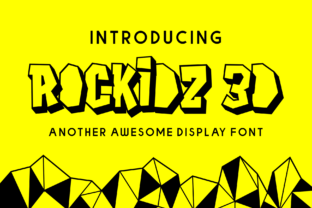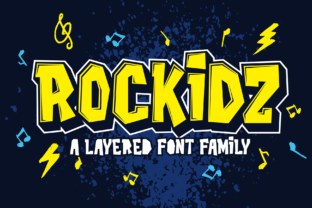
Rockidz: A Whimsical Handwritten Font with Bold Energy
Rockidz isn’t just another handwritten font—it’s a spark of personality in digital form. With its confident, slightly uneven strokes, lively baseline variation, and expressive contrast between thick and thin lines, Rockidz feels authentically human—like it was drawn by someone who knows when to lean in, pause, or add a playful flick at the end of a letter. It’s whimsical enough to charm, yet bold enough to command attention without shouting. That rare balance makes it especially useful for creators who want warmth and energy—not just decoration.
Why Rockidz Stands Out in Real Projects
Unlike many script fonts that prioritize elegance over readability—or chaos over character—Rockidz maintains strong legibility at medium sizes (16–24px) while keeping its hand-drawn soul intact. Its lowercase “a”, “g”, and “y” have distinctive shapes that avoid ambiguity; uppercase letters retain presence without overwhelming layout. That practicality means it works where many decorative fonts fail: on product labels, social media graphics, email headers, workshop slides, or even short-form video text overlays.
It also scales well across devices. On mobile, Rockidz holds up in hero banners or CTA buttons when paired with a clean sans-serif for body copy. On print, it adds tactile charm to business cards, event posters, or packaging—especially when used selectively: a headline, a tagline, or a single word you want to resonate.
Creative Uses Across Audiences and Goals
How you use Rockidz depends less on what it *is*, and more on what you want your audience to *feel*. Here’s how different users apply it intentionally:
- Small business owners use Rockidz for storefront signage or Instagram story highlights—pairing it with a neutral typeface like Inter or Lato to keep contact info and hours clear while letting their brand voice shine in slogans like “Hand-Poured • Small Batch • Made Here.”
- Educators and workshop facilitators choose Rockidz for slide titles or printable worksheets—adding visual warmth to learning materials without sacrificing clarity. A title like “Let’s Build Your First Website” gains approachability, encouraging participation over intimidation.
- Bloggers and content creators drop Rockidz into newsletter headers or Pinterest pin titles (“Your Weekly Dose of Calm”)—creating instant recognition across platforms while staying on-brand for lifestyle, wellness, or creative topics.
- Freelance designers treat Rockidz as a stylistic anchor: using it consistently across a client’s logo lockup, social bios, and presentation decks—then stepping back to let supporting type handle detail work. One font, multiple touchpoints, unified tone.
Smart Pairings Keep Rockidz Effective
Rockidz thrives in contrast. Its expressive nature needs grounding—so pair it with a simple, highly readable sans-serif (e.g., Open Sans, Montserrat, or even system fonts like Helvetica Neue). Avoid pairing it with other decorative or script fonts; that invites visual noise. Instead, let Rockidz carry emotion while your secondary type handles information.
For accessibility and hierarchy, reserve Rockidz for display use only: headlines, quotes, callouts, or short labels. Never use it for long paragraphs, captions under 14px, or forms requiring input clarity. And always test contrast—especially over textured or colored backgrounds. A dark charcoal Rockidz on soft cream reads beautifully; the same color on light gray may fade.
Ideas You Can Try This Week
You don’t need a full rebrand to explore Rockidz. Start small, stay intentional:
- Refresh one recurring asset: Swap your standard email subject line font for Rockidz in your next campaign—just for the main hook (“You’re Invited!” or “New Tools Just Dropped”). Keep sender name and preview text in your default font.
- Add motion to static content: In Canva or Figma, animate a Rockidz headline with a subtle “write-on” effect for an explainer video intro—then cut to clean body text. The contrast reinforces message priority.
- Design a printable resource: Create a one-page checklist or reflection prompt for your audience—using Rockidz for section headers (“Pause”, “Plan”, “Play”) and a neutral font for instructions. Print it, share it, see how people respond.
- Test tone shifts: Write the same phrase three ways—“Join Our Community”—in Rockidz at three weights (if available), or with slight spacing adjustments. Notice how tighter tracking feels urgent, looser spacing feels inviting, and medium spacing feels balanced.
Staying Original Without Overcomplicating
Using Rockidz doesn’t mean copying trends—it means making deliberate choices about voice and visibility. Originality comes from context, not novelty: a local bakery using Rockidz on chalkboard-style delivery notes feels authentic; the same font slapped onto a corporate annual report likely won’t.
To keep results consistent, define simple usage rules upfront: “Rockidz = headlines only,” “Rockidz appears in brand blue (#2A5C8D) or black,” “Never stretch or skew the letters.” These constraints free you to focus on message and audience—not endless font tweaks.
When Rockidz Isn’t the Right Fit
That said, Rockidz isn’t universal—and recognizing its limits is part of using it well. Avoid it for legal disclaimers, technical documentation, multilingual interfaces (its stylistic flourishes don’t translate cleanly across all scripts), or any setting where speed of comprehension outweighs expressive intent. If your goal is neutrality, authority, or precision first, choose a functional typeface instead.
Also, consider your audience’s expectations. A financial advisor targeting retirees might find Rockidz too informal for primary branding—but perfect for a monthly newsletter title (“This Month’s Market Notes”). Context guides fit, not just preference.
Ultimately, Rockidz is a tool—not a solution. Its value emerges when matched thoughtfully to purpose, platform, and people. Use it to invite, energize, or differentiate—not to distract or obscure. When applied with intention, it becomes more than a font: it’s a quiet signal that says, “This was made with care, and meant for you.”