Brightland: A Bold Display Font with Urban Character
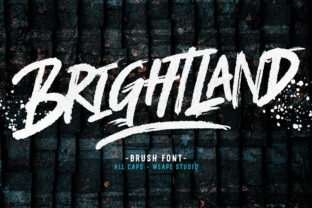
Brightland is a display typeface designed for impact—not subtlety. It’s not meant for body text, long paragraphs, or fine print. Instead, Brightland thrives where presence matters: headlines, logos, posters, packaging, and digital banners. Its defining traits—strong geometric forms, high contrast between thick and thin strokes, and subtle angular tension—give it an unmistakable urban feel. Think street signage, gallery announcements, or editorial mastheads that command attention without shouting.
What Sets Brightland Apart From Other Display Fonts
Many display fonts lean into either retro charm or futuristic minimalism. Brightland occupies a distinct middle ground: contemporary but grounded, structured yet expressive. Its letterforms avoid excessive ornamentation, but they’re never sterile. The uppercase “A,” for example, features a sharp apex and slightly flared crossbar; the lowercase “g” has a closed, almost architectural bowl. These details aren’t arbitrary—they contribute to a consistent visual rhythm that reads as confident and intentional.
Unlike variable fonts built for flexibility across weights and widths, Brightland is intentionally focused. It typically ships in a tightly curated set—often three to five weights, each with matching italics—and prioritizes typographic harmony over technical adaptability. That means it won’t scale down to 12pt and remain legible, nor does it aim to replace system fonts in UI components. Its strength lies in controlled, deliberate application—not versatility.
Where Brightland Fits Among Display Type Categories
Display fonts fall broadly into families: serif, sans-serif, slab-serif, stencil, distressed, and geometric. Brightland belongs firmly to the geometric sans-serif category—but with nuance. While fonts like Futura or Avant Garde emphasize purity of form, Brightland introduces slight asymmetries and deliberate weight shifts that prevent rigidity. It doesn’t mimic handwriting or mechanical drafting; instead, it feels like a thoughtful reinterpretation of urban typography—think painted brick walls, subway tile layouts, or neon-lit storefronts rendered in clean vector form.
This distinction matters when evaluating alternatives. If your project calls for warmth and approachability—a café menu, a boutique brand identity—Brightland may feel too assertive. But if you're designing a music festival lineup poster, a tech startup’s launch campaign, or a fashion label’s seasonal lookbook, its energy aligns naturally with bold visual storytelling.
Strengths You Can Rely On
- Immediate visual authority: Brightland establishes tone fast. Its spacing, x-height, and stroke contrast are tuned for readability at larger sizes—even from a distance or on mobile screens.
- Cohesive family structure: Weights transition smoothly, allowing designers to layer hierarchy without visual dissonance. A bold headline paired with a medium subhead maintains tonal consistency.
- Urban authenticity without cliché: It avoids graffiti motifs or forced “grunge” textures, opting instead for refined geometry that evokes city life through proportion and balance—not decoration.
- Strong licensing clarity: Most Brightland licenses cover web, desktop, and app use with straightforward terms—no ambiguity about embedding or redistribution rights.
Tradeoffs Worth Considering
No display font excels everywhere—and Brightland’s limitations are as meaningful as its strengths. First, its personality is strong enough that it can dominate a layout if overused. Pairing it with a neutral, highly legible text font (like a well-hinted humanist sans or a crisp serif) isn’t optional—it’s essential for balance.
Second, Brightland isn’t optimized for accessibility at small sizes. Its tight counters (the enclosed spaces inside letters like “e” or “a”) and relatively narrow apertures reduce legibility below ~24pt in most settings. That makes it unsuitable for interface labels, data tables, or caption text—even if stylistically tempting.
Third, while its urban character resonates in many contexts, it risks feeling incongruous in environments that prioritize tradition, elegance, or quiet refinement—such as legal documents, academic publishing, or luxury hospitality branding. There, a more restrained or historically informed typeface often communicates more effectively.
When Brightland Is the Right Choice
Brightland shines in projects where clarity, confidence, and contextual relevance converge. Consider it when:
- You’re building a brand identity for a creative studio, urban apparel line, or independent media outlet—and need a headline font that reflects ambition without pretension.
- Your design system already includes a highly functional, low-contrast text font, and you want a clear, complementary contrast for emphasis.
- You’re designing for physical applications—like large-format prints, signage, or merchandise—where its structural integrity holds up under scaling and reproduction.
- You value typographic intentionality over broad compatibility: Brightland works best when chosen deliberately, not by default.
A real-world example: A Brooklyn-based record label used Brightland for its vinyl sleeve typography and website hero banner. Paired with a modest, open-source serif for track listings and liner notes, the combination felt both rooted and forward-looking—neither nostalgic nor generic. The font didn’t distract from the music; it framed it with appropriate gravity.
When Another Option May Serve Better
Brightland isn’t the answer if your priority is flexibility across formats. For responsive websites requiring fluid typography, a well-designed variable font with optical sizing might offer more control. Similarly, if your audience includes readers with low vision—or if your content appears in mixed-media environments (PDF reports, email newsletters, printed brochures)—you’ll likely need a more accessible, versatile type system.
Also consider alternatives if your project leans heavily into specific cultural or historical references. A mid-century advertising campaign might benefit more from a carefully revived grotesque than a contemporary interpretation like Brightland. Likewise, a heritage food brand aiming for artisanal warmth would likely find more resonance in a sturdy, slightly irregular serif than in Brightland’s precise geometry.
Practical Evaluation Tips
- Test at intended size and context: Render Brightland in your actual layout—not just in a font menu. Does it support your message, or compete with it?
- Check contrast ratios: When used over imagery or colored backgrounds, ensure sufficient luminance contrast for basic readability—even if the font itself isn’t meant for long reading.
- Review pairing options: Try Brightland with two or three candidate text fonts. Look for contrast in texture, not just weight. A dense, tall-x-height sans may clash; a lower-contrast, open-form serif often complements well.
- Assess licensing scope: Confirm whether your intended use—especially in apps, SaaS dashboards, or embedded kiosks—is covered. Some display fonts restrict certain digital deployments.
Brightland doesn’t try to be everything. It’s unapologetically bold, intentionally urban, and carefully constrained. That focus is its advantage—not a limitation. Choosing it means committing to a specific kind of clarity: one that values impact, coherence, and contextual honesty over broad utility. When matched thoughtfully to purpose, audience, and environment, Brightland doesn’t just look good—it functions with precision.