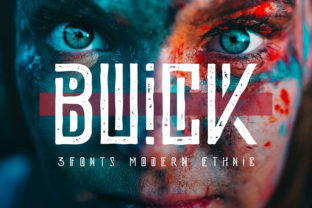
Buick: A Futuristic Font with Purpose
Buick isn’t just another display font—it’s a carefully crafted typographic tool designed for clarity, character, and contemporary impact. With its clean geometry, subtle asymmetry, and confident rhythm, Buick stands out without shouting. It bridges the gap between futuristic vision and real-world usability—making it ideal for designers who want distinction without sacrificing legibility or professionalism.
What Makes Buick Distinctive—and Why That Matters
Buick’s strength lies in its intentional contrasts: soft curves meet precise angles; open counters balance compact spacing; and vertical stress feels grounded, not rigid. Unlike many “futuristic” fonts that lean heavily into sci-fi tropes or excessive distortion, Buick uses restraint. Its letterforms suggest motion and modernity—not through gimmicks, but through thoughtful proportion and consistent internal logic.
This makes Buick especially useful when you need to signal innovation while maintaining trust. Think of a university launching a new AI research initiative, a sustainable tech startup building its first website, or an independent publisher releasing a speculative fiction anthology. In each case, Buick communicates forward-thinking energy—without alienating readers who value substance over style alone.
Creative Applications Across Real Projects
Because Buick works well at multiple sizes and weights, it adapts naturally across formats—from bold headlines on digital ads to refined captions in editorial layouts. Here’s how different creators are using it effectively:
- Branding & Identity: A Portland-based design studio used Buick Light for their client’s logo (a climate-tech SaaS platform), pairing it with a neutral sans-serif for body text. The contrast gave the brand authority and approachability—critical for B2B audiences evaluating complex tools.
- Digital Interfaces: A freelance UX designer applied Buick Medium to key UI elements—navigation labels, feature cards, and call-to-action buttons—in a wellness app redesign. Users reported improved scanability during usability testing, especially on mobile.
- Print & Packaging: An indie candle maker chose Buick Bold for product names and ingredient tags. Its strong presence held up beautifully on matte kraft paper, reinforcing craftsmanship and intentionality—key emotional cues for their audience.
- Educational Materials: An online course creator used Buick Regular for section headers in a workshop on ethical AI. Its even color and clear letter shapes helped learners quickly parse hierarchy—especially important for neurodiverse audiences.
How to Use Buick Thoughtfully—Not Just Decoratively
Like any strong typeface, Buick shines most when used with purpose—not as decoration, but as part of a deliberate visual system. Start by asking: What role does this text play? If it’s guiding attention, labeling features, or establishing tone, Buick can support that goal. If it’s meant to be read in long paragraphs, pair it wisely: use it for headings only, then switch to a highly legible, low-contrast text face like Inter, Lato, or Source Sans Pro.
Also consider context. Buick performs best in environments where visual breathing room is possible—avoid cramming it into tight spaces or overly busy backgrounds. For social media graphics, try using Buick at 48–64px for quote overlays on clean, image-based posts. On websites, apply it to H1s and interactive elements—but test contrast ratios to ensure accessibility compliance (WCAG AA minimum).
Tailoring Buick for Different Audiences and Goals
Your audience shapes how Buick reads—and how much of its personality you should emphasize.
- For educators or nonprofits: Use Buick Light or Regular in presentations or reports to convey forward momentum without overwhelming content. Avoid all-caps settings unless intentionally dramatic—sentence case keeps tone inclusive and grounded.
- For marketers and small business owners: Leverage Buick’s versatility in multi-channel campaigns. Use the same weight across email headers, landing page banners, and printed postcards—consistency builds recognition faster than changing fonts per platform.
- For developers and technical creators: Embed Buick via variable font files (if available) to reduce load time and enable smooth weight transitions in responsive interfaces. Pair with system fonts as fallbacks for maximum reliability.
- For hobbyists and students: Experiment with Buick in constrained ways—like designing a single-page portfolio or reimagining a classic book cover. Constraints sharpen decision-making and help you learn what Buick does (and doesn’t) do well.
Maintaining Clarity and Consistency
One common misstep is overusing Buick’s boldest weights or applying too many stylistic variations at once. To keep results effective: limit yourself to two weights max in any given layout (e.g., Bold for headlines + Regular for subheads), and avoid mixing Buick with other display fonts. Let it breathe—and let its structure speak for itself.
If you’re building a brand system, define clear usage rules early: which weight goes where, minimum size thresholds, acceptable background colors, and alignment conventions. These small decisions compound into stronger, more professional outcomes—especially when collaborating or handing off work.
Where Buick Fits in Your Creative Toolkit
Buick isn’t a replacement for every font—it’s a strategic option for moments that demand both distinction and credibility. It works because it’s designed with intention, not trend-chasing. That means it ages well. A brochure set in Buick today will still feel current two years from now—not dated, not generic, but quietly assured.
Whether you’re sketching a logo concept on paper, coding a CSS typography scale, or selecting fonts for a client pitch deck, Buick offers a reliable way to say something meaningful about your work: that you value precision, care about perception, and understand that good design serves people—not just aesthetics.
So next time you’re choosing a font for a project that needs to feel both fresh and trustworthy, give Buick space to do its work. Then step back—and see how clearly your message lands.