Ferghaus: A Display Font That Bridges Playfulness and Precision
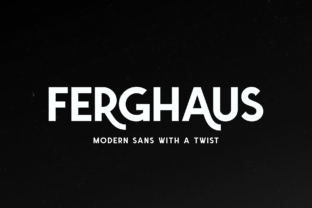
If you’ve ever spent too long scrolling through font libraries—searching for something that feels fresh but not fleeting, bold but not brash—you’re not alone. Ferghaus stands out in that crowded space: a display font inspired by modernist aesthetics, yet unburdened by dogma. It’s not just “retro” or “minimalist”—it’s both, and neither. Its letterforms balance geometric clarity with subtle warmth, giving it a timeless feel that works whether you’re designing a boutique coffee shop’s neon sign or a tech startup’s keynote slide.
Where Ferghaus Fits Naturally (and Where It Doesn’t)
Ferghaus thrives in moments of visual emphasis—not body text, not fine print, but the parts of your design that need to be felt before they’re read. Think of it as the voice that introduces the story, not the one that tells it.
It’s especially effective in contexts where personality and professionalism must coexist:
- Branding for creative studios and independent makers—A ceramicist launching a new collection might use Ferghaus for her logo and product tags. Its clean lines echo craftsmanship; its slight asymmetry hints at hand-made authenticity.
- Editorial design for culture-focused magazines and newsletters—A headline like “The Quiet Rise of Analog Living” gains quiet confidence when set in Ferghaus. It doesn’t shout—it invites closer attention.
- Digital experiences with strong visual identity—Landing pages, hero sections, and app onboarding screens benefit from Ferghaus’s spatial awareness. Letters breathe without crowding, and spacing feels intentional, not automated.
- Printed ephemera with tactile appeal—Think event posters, gallery invitations, or limited-run zines. When printed on textured paper or foil-stamped, Ferghaus’s structure holds up beautifully—and its elegance reads even at smaller display sizes (down to ~36pt).
That said, Ferghaus isn’t built for paragraphs. Its high contrast, open apertures, and distinct terminals make it less legible in long-form settings. You wouldn’t use it for a blog post or legal disclaimer—and that’s by thoughtful design, not oversight. It’s meant to elevate, not explain.
Who Benefits—and How
Designers working solo or in small teams appreciate how Ferghaus simplifies hierarchy. With just one weight (often enough for impactful display use), it removes decision fatigue. Pair it with a neutral sans-serif like Inter or a warm humanist typeface like Lora, and you’ve got a system that feels cohesive—not curated.
Founders and marketers launching direct-to-consumer brands find Ferghaus useful because it conveys intentionality without requiring a full brand guideline document. A skincare line using Ferghaus for its “Vitamin C Serum” label communicates care and clarity—no extra copy needed.
Educators and workshop facilitators use it to make learning materials visually memorable. One university lecturer told us she applies Ferghaus to slide titles and key concept cards—students report remembering those frames longer, likely due to the font’s distinctive rhythm and balanced proportions.
Even developers integrating custom fonts into websites find Ferghaus straightforward to implement. Its OpenType features are light but meaningful: standard ligatures improve flow in headlines, and alternate characters (like the double-story ‘a’ or curved ‘t’) offer subtle customization without complexity.
What to Consider Before Using Ferghaus
Like any strong personality, Ferghaus asks for context—and respect.
Contrast matters more than usual. Because Ferghaus has relatively tight letter spacing by default, it needs breathing room. Avoid pairing it with other high-contrast or tightly spaced fonts. Instead, give it generous margins, ample line height in headings, and background color or texture that lets its forms stand out—not compete.
Watch your medium. On low-resolution screens or older mobile devices, some of Ferghaus’s finer details (like the tapered stroke endings) may soften. Test at actual size—not just in your design tool. If your audience includes users on legacy systems, consider serving a fallback font via CSS @font-face rules.
License clarity is key. Ferghaus is available under commercial licenses that cover web, desktop, and app use—but always verify the scope. Some versions allow unlimited projects; others restrict usage by monthly pageviews or number of domains. If you’re building client work, confirm licensing upfront to avoid surprises later.
Don’t force versatility. Ferghaus isn’t trying to be everything. It doesn’t come with an italic, condensed, or variable axis—and that’s part of its strength. Trying to simulate an italic with CSS transforms or stretching the font breaks its integrity. Let it do what it does best: anchor attention, convey tone, and hold space with quiet authority.
Small Details, Big Impact
You’ll notice Ferghaus’s lowercase ‘g’—a single-story form with a graceful descender—that nods to mid-century modern signage. Or the uppercase ‘M’, whose outer stems flare just slightly, adding stability without stiffness. These aren’t quirks; they’re cues. They tell viewers this isn’t generic. This was chosen.
One designer shared how switching from a popular geometric sans to Ferghaus for her client’s rebrand shifted perception overnight: “People started describing the brand as ‘thoughtful’ and ‘grounded’—words we hadn’t even used in our brief. The font did half the work.”
That kind of resonance comes from restraint. Ferghaus doesn’t overload with alternates or stylistic sets. It offers a focused vocabulary—enough to express nuance, not so much that it dilutes meaning.
When Simplicity Is Strategic
In a landscape saturated with variable fonts, AI-generated type, and hyper-customized systems, Ferghaus reminds us that clarity can be compelling. It doesn’t chase trends—it observes them, then steps back to hold its ground.
It’s the kind of font that works equally well on a hand-painted mural in Lisbon and a digital billboard in Seoul—not because it’s neutral, but because its logic is legible across cultures and contexts. Its modernist roots show in proportion and balance; its playfulness lives in rhythm and surprise.
So if your next project needs a voice that’s confident but not cold, distinctive but not distracting—Ferghaus isn’t just another option. It’s the quiet alternative that makes everything else feel louder by comparison.