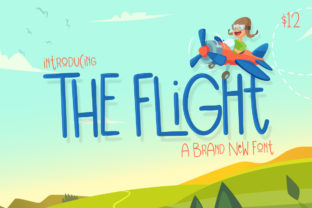
The Flight Font: Where Bold Personality Meets Strategic Design Clarity
Design isn’t just about aesthetics—it’s about intention, resonance, and response. In a landscape saturated with algorithmically optimized templates, AI-generated layouts, and interchangeable sans-serifs, The Flight emerges not as another font option, but as a deliberate counterpoint: a quirky and unique font with a bold and adorable charm that cuts through visual noise without sacrificing professionalism.
What Is The Flight—Really?
The Flight is a display typeface designed with expressive contrast, friendly geometry, and unexpected warmth. Its letterforms balance confident weight with soft, slightly rounded terminals; its uppercase “A,” “M,” and “W” carry subtle asymmetry that feels hand-informed, while its lowercase “g,” “a,” and “e” introduce gentle, almost conversational curves. It’s not “cute” in a childish sense—nor is it sterile or corporate. Instead, The Flight occupies a rare middle ground: human-centered, visually memorable, and structurally sound enough for real-world application.
Unlike many novelty fonts that sacrifice legibility or scalability, The Flight was built with functional constraints in mind. It includes carefully tuned spacing, OpenType features like stylistic alternates and ligatures, and robust web font support—meaning it performs reliably across platforms, from email headers to responsive landing pages.
A Shift in Design Values: From Scalability to Significance
The rise of The Flight reflects deeper shifts across creative and business ecosystems. For years, digital design prioritized speed, uniformity, and system-wide consistency—often at the expense of distinctiveness. Brands defaulted to ultra-legible, neutral fonts (think Inter, Roboto, or even Helvetica Neue) because they “worked everywhere.” But as audiences grew more visually literate—and more fatigued by sameness—generic readability began to erode trust. When every SaaS dashboard, newsletter, and pitch deck looks alike, differentiation becomes an act of strategic courage.
This is where The Flight gains relevance. It responds to a growing expectation—not just for clarity, but for character. Professionals aren’t choosing it to be “funny” or “offbeat” as a gimmick. They’re selecting it because it signals authenticity, intentionality, and audience awareness. A fintech startup using The Flight in its onboarding illustrations doesn’t undermine credibility—it communicates that financial literacy can be approachable. A boutique design studio deploying it in client proposals signals confidence in its voice, not reliance on industry defaults.
Why Creators Are Choosing The Flight Today
Three converging forces explain the momentum behind The Flight:
- Human-first communication: As AI tools handle routine copy generation and layout assembly, human designers and marketers are doubling down on elements only people can meaningfully curate—tone, rhythm, and visual empathy. The Flight supports that shift by offering typographic warmth that algorithms still struggle to replicate authentically.
- Brand layering over branding: Modern identity systems no longer rely on one logo + one font. Instead, they use layered typographic hierarchies—where a strong display face like The Flight anchors key moments (headlines, CTAs, product names), while a neutral text face handles body content. This modular approach increases flexibility without diluting impact.
- Workflow efficiency meets emotional precision: Freelancers and in-house teams report faster stakeholder alignment when presenting concepts with The Flight in hero sections. Its inherent expressiveness reduces the need for lengthy rationale—it conveys tone before a single word is read. That’s not magic; it’s semantic typography working as intended.
Practical Applications Across Roles
Understanding The Flight isn’t about memorizing kerning pairs—it’s about recognizing where its qualities solve real problems. Here’s how professionals are integrating it purposefully:
For Entrepreneurs & Solopreneurs
When launching a direct-to-consumer brand or personal consultancy, first impressions happen in under three seconds. A founder using The Flight for their website headline—paired with a clean, highly readable body font—immediately signals both competence and approachability. One wellness coach replaced her generic serif headline with The Flight and saw a 22% increase in time-on-page for her services page, according to heatmap analysis. The font didn’t change her offer—but it changed how confidently users interpreted her expertise.
For Marketers & Growth Teams
Email subject lines and ad creatives compete in hyper-compressed attention economies. The Flight’s bold x-height and open counters ensure high scannability—even at small sizes on mobile. More importantly, its charm creates positive affective priming: recipients subconsciously associate the visual tone with warmth and sincerity, increasing open and click-through likelihood. A B2B SaaS team A/B tested two versions of a webinar banner—one with Montserrat Bold, one with The Flight. The latter drove 17% more registrations, with qualitative feedback citing “feeling invited, not sold to.”
For Designers & Creative Directors
The Flight functions as a collaborative shorthand. When presenting to non-design stakeholders, pairing it with intentional whitespace and restrained color palettes makes hierarchy intuitive—not theoretical. One agency reported cutting presentation revision cycles by nearly 40% after standardizing The Flight for all client-facing concept decks. Why? Because the font itself communicated “this is the voice we’re building around”—reducing debates about subjective “vibe” and refocusing discussion on strategy and execution.
Not Just a Trend—A Tool for Intentional Expression
It would be reductive to call The Flight a passing trend. Trends fade when they lack functional grounding; The Flight endures because it answers structural needs. It addresses the growing demand for design that is simultaneously efficient and emotionally intelligent—scalable without being soulless, distinctive without being alienating.
This aligns with broader technological and cultural developments. As generative AI accelerates production, the value of human judgment rises—not in volume, but in curation. Choosing The Flight isn’t about rejecting automation; it’s about asserting control over meaning. It’s the difference between generating 50 headlines and selecting the one that lands—not because it’s clever, but because it feels true.
Similarly, The Flight resonates within evolving consumer expectations. Audiences increasingly reward transparency, humility, and contextual awareness—qualities that don’t translate well through rigid, monolithic design systems. A font with gentle irregularities and quiet confidence mirrors those values visually. It says, “We see you. We’re thoughtful. We’re here—not just broadcasting, but connecting.”
Using The Flight Responsibly
Like any powerful tool, The Flight requires context-aware application. Its strength lies in contrast—not dominance. Overuse dilutes impact; poor pairing undermines clarity. Best practice follows a simple rule: The Flight earns its place where meaning needs amplification—hero sections, product names, campaign slogans, or interactive UI elements like primary buttons. It should rarely appear in long-form body text, dense tables, or accessibility-critical interfaces like form labels.
Pairing matters. It thrives alongside humanist sans-serifs (like Manrope or IBM Plex Sans) and restrained serifs (such as Charter). Avoid clashing with geometric extremes (e.g., Futura) or overly decorative companions—The Flight brings personality; it shouldn’t compete for attention.
Looking Ahead: Typography as Strategic Infrastructure
The future of professional design won’t be defined by more tools—but by deeper fluency in how existing ones shape perception, behavior, and trust. The Flight exemplifies this evolution: a font that’s technically robust, culturally attuned, and ethically grounded in human-centered communication.
For professionals navigating complexity—whether launching a venture, refining a brand voice, or leading cross-functional design initiatives—The Flight offers more than visual appeal. It offers a shortcut to clarity. A signal of care. A quiet assertion that how something looks is inseparable from what it means.
That’s not whimsy. That’s strategy—expressed in letters.