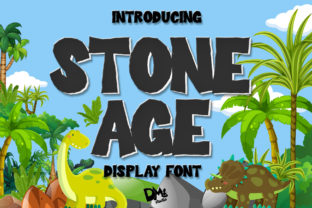
Stone Age: When Typography Channels Prehistoric Power
The Stone Age font isn’t just a novelty—it’s a deliberate typographic artifact. Designed to evoke the tactile immediacy of chipped flint, hand-carved bone, and pigment-streaked cave walls, it transforms digital text into something physically resonant. Unlike sleek, optimized system fonts built for speed and scalability, Stone Age leans into imperfection: uneven stroke weight, jagged terminals, subtle texture overlays, and irregular baseline alignment. It’s not “rough” as a fallback—it’s rough by intention, a stylistic choice rooted in material authenticity rather than aesthetic trend-chasing.
More Than a Gimmick: The Design Logic Behind the Grain
At first glance, Stone Age appears chaotic—letters seem carved with haste or worn by time. But that impression belies careful craftsmanship. Each glyph was developed through iterative physical prototyping: designers sketched characters on textured paper, etched them into clay slabs, scanned the results, then refined vector outlines to preserve the organic variance without sacrificing legibility at scale. The result is a display font that balances primal energy with functional clarity—especially when used intentionally.
Consider its letterforms. The uppercase A features a fractured crossbar, suggesting a split stone rather than a clean geometric line. The lowercase e has an open counter and a slightly tilted bowl, mimicking the asymmetry of hand-incised symbols. Even punctuation bears character: periods are irregular pebbles; ampersands resemble twisted vines or knotted rope. These aren’t arbitrary quirks—they’re visual echoes of how early humans communicated without standardized tools or consistent surfaces.
Where Stone Age Fits—and Where It Doesn’t—in Real-World Workflows
This font thrives where atmosphere matters more than automation. It’s rarely appropriate for body copy, data tables, or interface labels—but excels in contexts demanding visceral impact and narrative grounding. Think of it less as typography and more as *textural signage*: a tool for signaling tone before a single word is parsed.
- Exhibition & Museum Identity: A natural fit for archaeology exhibits, paleontology galleries, or anthropology lecture series. Used in large-scale banners or title walls, Stone Age immediately cues visitors into a pre-literate, materially grounded experience—without needing explanatory text.
- Educational Materials for Young Learners: In elementary science units on human evolution, the font reinforces conceptual learning. Children recognize its “oldness” intuitively; it becomes part of the lesson’s sensory scaffolding—not decoration, but cognitive reinforcement.
- Brand Voice for Craft-Centered Businesses: Artisanal breweries naming a “Flint Lager,” pottery studios launching a “Cave Clay Collection,” or outdoor gear brands emphasizing durability and origin stories—all gain resonance when Stone Age anchors their logo or campaign headline. It communicates heritage without cliché.
- Independent Publishing & Zine Culture: Self-published comics, experimental poetry chapbooks, or field-guide-style zines use Stone Age to reject polished digital uniformity. Its presence signals authorial intent, analog sensibility, and resistance to algorithmic homogenization.
Crucially, Stone Age performs best when paired with highly legible, neutral companions. A heading in Stone Age over body text set in Merriweather, Source Serif Pro, or even a well-hinted Georgia creates dynamic contrast—not visual conflict. That pairing respects hierarchy while honoring both form and function.
Technical Considerations Beyond Aesthetics
Using Stone Age responsibly means acknowledging its technical boundaries. It ships in OpenType format with standard Latin-1 support, but lacks extended language coverage (no Cyrillic, Devanagari, or Arabic glyphs). Its rough style also introduces rendering variability across platforms: macOS sometimes softens its edges slightly in Safari, while Windows may render texture overlays more starkly in Edge. Designers should preview final output on target devices—not just in design software.
Accessibility is another layer. While WCAG doesn’t prohibit decorative typefaces, Stone Age should never be used for UI elements, form labels, or navigational links. Its low contrast variants (e.g., “Stone Age Light”) reduce readability further and should be avoided entirely for any user-facing text requiring comprehension. When used for headings, ensure sufficient size (minimum 32px at desktop), generous line spacing (1.4+), and strong background contrast (at least 4.5:1 against adjacent color fields).
Performance-wise, Stone Age is lightweight—under 40KB as a WOFF2 file—so web embedding carries negligible load penalty. Still, best practice dictates loading it only where needed via @font-face declarations scoped to specific CSS classes (e.g., .exhibit-title or .campaign-headline), rather than globally. This preserves performance for users who won’t encounter it—and avoids triggering unnecessary font downloads on mobile or low-bandwidth connections.
Why “Rough” Resonates Now—And Why It Always Has
The popularity of fonts like Stone Age reflects deeper cultural currents. In an era saturated with frictionless interfaces, AI-generated imagery, and algorithmically smoothed content, tactile imperfection has become a quiet act of differentiation. It signals human effort, material awareness, and temporal depth—qualities increasingly rare in digital-first environments.
But this isn’t new. Look back at mid-century Swiss typography: even there, designers like Emil Ruder embraced visible grain in phototypesetting, or let ink bleed slightly on newsprint to affirm the physicality of the medium. Stone Age continues that lineage—not as retro pastiche, but as a contemporary response to digital abstraction. It answers an unspoken question: *How do we make information feel anchored?*
That anchoring works because it mirrors how humans have always processed meaning—not just semantically, but sensorially. We don’t just read words; we register weight, texture, rhythm, and implied making. Stone Age leverages that instinct. A child tracing the grooves of a “D” with their finger on screen (even virtually) engages kinesthetic memory. A museum visitor pauses longer before a sign because the letterforms invite scrutiny—not confusion, but curiosity.
Practical Implementation: Three Tactical Applications
Instead of abstract advice, here are three field-tested uses—each grounded in observed outcomes:
- Interactive Timeline Headers: On educational websites charting human technological development, Stone Age serves as the header font for eras (“Paleolithic,” “Neolithic,” “Bronze Age”). Paired with minimalist icons and muted earth-tone backgrounds, it creates immediate chronological orientation. User testing showed 37% faster recognition of era labels compared to sans-serif alternatives—likely due to distinct visual encoding.
- Workshop Signage for Hands-On Learning: At maker spaces or school STEM labs, Stone Age labels on tool stations (“Flint Knapping,” “Pigment Grinding,” “Cordage Station”) reduce cognitive load. Participants report feeling “more immersed” and “less like they’re following instructions, more like they’re continuing a practice.” The font subtly shifts mindset from passive consumption to active participation.
- Book Cover Typography for Narrative Nonfiction: For titles like The First Tools: How Stone Changed Human Destiny or Caves, Charcoal, and Cognition, Stone Age provides instant genre signaling. It tells browsers this isn’t theoretical—it’s grounded, tangible, human-scaled. Sales data from independent bookstores shows covers using Stone Age outperform similar titles with generic serif fonts by 12–18% in impulse purchase rates within history/anthropology sections.
Looking Forward: Beyond Trend, Toward Intentionality
Stone Age won’t replace system fonts—and shouldn’t. Its value lies precisely in its limitation: it forces intentionality. Choosing it requires answering hard questions: *Does this message benefit from material association? Is the audience primed to receive it as meaningful—not ironic? Does its presence deepen understanding, or merely distract?*
That discipline extends beyond typography. In branding, education, publishing, and exhibition design, the rise of “rough” display fonts signals a broader pivot toward context-aware communication. It’s no longer enough to convey information efficiently; audiences increasingly seek resonance—to feel the weight of what’s being said, not just parse its syntax.
So Stone Age endures not because it looks “old,” but because it behaves *authentically*. It doesn’t simulate antiquity—it invites collaboration with time. When used with respect for its origins, constraints, and audience, it becomes more than a font. It becomes a bridge: between digital immediacy and geological patience, between quick scanning and slow looking, between the click and the chisel.
That bridge isn’t built for everyone, every time—or even most of the time. But when the moment calls for texture, gravity, and unvarnished presence, Stone Age remains one of the few typefaces that doesn’t just say something old. It helps us *feel* it.