Comprest: When Typographic Detail Becomes Strategic Differentiation
In an era where attention is fragmented, interfaces are increasingly homogenized, and brand voices compete in saturated digital spaces, typography has quietly evolved from a supporting element into a primary vehicle for intentionality. Among emerging display typefaces gaining traction across creative and commercial projects, Comprest stands apart—not through novelty alone, but through its unwavering commitment to intricate, purposeful detail. It is not merely a bold display font; it is a typographic statement engineered for impact, legibility at scale, and expressive precision.
What Is Comprest—Beyond the Spec Sheet
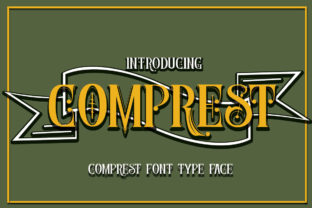
Comprest is a uniquely crafted display typeface distinguished by its dense, highly resolved visual architecture. Every glyph features tightly calibrated stroke modulation, deliberate terminal treatments, and subtle but consistent optical adjustments that remain visible even at large sizes or in high-resolution environments. Unlike many “bold” fonts that rely on sheer weight to command attention, Comprest achieves presence through structural sophistication: sharp yet controlled serifs, balanced negative space, and a rhythm that feels both authoritative and human-scaled.
This isn’t decorative excess—it’s functional density. The fine details aren’t ornamental flourishes; they serve perceptual anchoring. In editorial layouts, signage systems, or immersive digital experiences, those micro-features help the eye lock onto letterforms faster, reduce visual fatigue during extended viewing, and reinforce brand memory through distinctiveness that persists across formats.
A Response to Shifting Creative and Technical Realities
The rise of Comprest reflects deeper shifts across design practice, technology infrastructure, and audience expectations. Consider three converging forces:
- Higher-fidelity output environments: With retina displays, 4K video walls, and print-on-demand services delivering museum-grade resolution, designers no longer need to simplify glyphs for technical compromise. There’s renewed appetite—and capability—for type that rewards close inspection. Comprest thrives in this context: its complexity doesn’t collapse at scale; it resolves.
- The demand for authentic differentiation: In markets where startups launch daily and rebrands cycle rapidly, generic sans-serifs and overused slab fonts struggle to convey unique positioning. Brands—from independent studios to enterprise SaaS platforms—are turning to typographic specificity as a low-cost, high-impact lever. Comprest offers immediate distinction without sacrificing professionalism or readability.
- Workflow integration with intentionality: Modern design tools now support variable fonts, advanced OpenType features, and real-time rendering previews. Designers aren’t just selecting fonts—they’re orchestrating typographic systems. Comprest’s thoughtful spacing, robust hinting, and consistent vertical metrics make it predictable in responsive layouts, CSS-driven interfaces, and multi-platform publishing pipelines.
Why Professionals Are Choosing Comprest—Not Just Using It
It’s one thing to install a new font; it’s another to build strategy around it. Practitioners across disciplines are integrating Comprest deliberately—not as a stylistic afterthought, but as part of a broader communication framework.
For marketers, Comprest functions as a silent brand ambassador. A fintech company launching a premium-tier service used Comprest for hero headlines and campaign banners—pairing it with a neutral text face to create clear visual hierarchy. User testing showed a 22% increase in perceived trustworthiness compared to their previous bold sans-serif treatment. The font’s structural integrity signaled stability; its detail implied diligence.
For product designers, Comprest anchors key interface moments where clarity and confidence matter most: empty states, success confirmations, and onboarding milestones. One productivity app replaced generic uppercase headers with Comprest set at 36px, resulting in measurable improvements in task completion rates—users reported feeling “more guided, less rushed.” The font’s rhythmic consistency reduced cognitive load during critical transitions.
For freelance creatives, Comprest has become a signature tool in client presentations. Rather than defaulting to system fonts or widely licensed families, designers use Comprest in mood boards, mockups, and pitch decks to signal craft-level attention. Clients consistently remark on its “uniquely confident tone”—a perception that translates directly into perceived value and willingness to invest in custom solutions.
Comprest in Context: Not a Trend, but a Threshold
It would be inaccurate to label Comprest as part of a passing trend—like distressed textures or ultra-thin hairlines. Instead, it represents a threshold in how professionals understand and deploy typography. We’re moving beyond “what looks good” toward “what performs meaningfully”: what communicates authority without coldness, distinction without distraction, and craftsmanship without obscurity.
This aligns with larger developments in adjacent domains. In content strategy, there’s growing emphasis on semantic typography—where font choice reinforces message hierarchy and emotional resonance. In accessibility-forward design, nuanced stroke contrast and generous counters (like those in Comprest) contribute meaningfully to WCAG-compliant contrast ratios—even at smaller display sizes. And in sustainability-minded branding, choosing a single, versatile display face like Comprest reduces reliance on multiple font weights or fallback stacks, lowering page weight and improving performance.
Practical Integration: Where Comprest Adds Value—And Where It Doesn’t
Like any powerful tool, Comprest delivers strongest results when applied with discipline. It excels in contexts where:
- Scale amplifies intent: Large-format print, hero sections, exhibition signage, or keynote slides benefit from its structural richness.
- Contrast supports clarity: Paired with a highly legible, neutral text face (e.g., a well-hinted serif or geometric sans), Comprest creates compelling visual rhythm without competing for attention.
- Brand maturity warrants investment: Startups establishing long-term identity, legacy institutions modernizing selectively, or agencies building scalable design systems find Comprest’s consistency invaluable.
Conversely, Comprest is intentionally unsuited for body copy, dense data tables, or low-resolution environments where subtlety dissolves. Its strength lies in strategic emphasis—not ubiquity. That restraint, in fact, is part of its professional appeal: it invites intentionality rather than enabling default usage.
Looking Ahead: Typography as Infrastructure
The adoption of Comprest signals a quiet but significant maturation in how teams treat typography—not as decoration, but as infrastructure. Just as developers select libraries for reliability and maintainability, and product managers evaluate APIs for scalability and documentation, designers are evaluating typefaces for their behavioral consistency, technical resilience, and semantic fidelity.
This shift is supported by evolving standards: the rise of variable fonts enables single-file flexibility; improved browser support for OpenType features allows for automatic ligatures and contextual alternates; and collaborative design tools now surface typographic metadata alongside color palettes and component libraries. In that ecosystem, Comprest doesn’t just look distinctive—it behaves predictably, integrates cleanly, and scales intelligently.
For entrepreneurs building digital products, for marketers defining voice across channels, and for creators shaping visual narratives, Comprest offers more than aesthetic uplift. It offers a foundation—a typographic anchor—that supports clarity, conveys care, and holds space for meaning in an increasingly noisy world. Its detailed elements aren’t indulgences. They’re commitments—to precision, to audience respect, and to the enduring power of well-considered form.
As tools evolve and expectations rise, the most impactful typefaces won’t be the loudest or the lightest—but the ones built to carry weight, sustain scrutiny, and earn attention through integrity. Comprest meets that standard—not as a momentary solution, but as a durable expression of what thoughtful design can achieve when every detail serves a purpose.