Whirlwind: A Bold, Playful Font for Distinctive Visual Identity
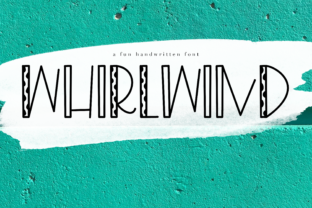
Whirlwind is a display typeface that stands out through intentional contrast—its thick, rounded letterforms carry energy without sacrificing legibility. Designed for impact rather than extended reading, Whirlwind balances whimsy and confidence. It’s not a neutral workhorse font; it’s a deliberate stylistic choice, one that signals approachability, creativity, or lighthearted authority depending on context.
What Makes Whirlwind Distinctive?
At first glance, Whirlwind feels familiar—its rounded terminals and generous x-height recall friendly sans-serifs—but its rhythm and proportions set it apart. The uppercase letters feature subtle asymmetry: the A has a slightly off-center crossbar, the S curves with uneven tension, and the Q’s tail loops with a gentle, unforced flourish. These details aren’t arbitrary; they introduce visual interest without compromising clarity at medium to large sizes.
Unlike many playful fonts that rely on exaggerated distortions or cartoonish exaggeration, Whirlwind maintains structural integrity. Its weight distribution is even, its spacing considered, and its baseline alignment consistent. That means it scales well across formats—from a bold website headline to a printed poster—and retains character without collapsing into noise.
Where Whirlwind Fits in the Typeface Landscape
Typefaces like Whirlwind occupy a specific niche: expressive display fonts intended for short-form, high-visibility use. They sit alongside other humanist, rounded, or geometric-inspired options—but differ in tone and execution. Some alternatives prioritize strict geometry (think uniform stroke widths and perfect circles), while others lean into hand-drawn irregularity. Whirlwind lands between those poles: structured enough for professional settings, warm enough to avoid sterility.
Compared to widely used rounded sans-serifs such as Nunito or Quicksand, Whirlwind has greater visual personality and less neutrality. That’s an advantage when brand differentiation matters—but a limitation if flexibility across varied content types is required. Nunito, for example, includes multiple weights and italics, supporting body text, captions, and UI labels. Whirlwind typically ships in one or two weights, optimized for headlines, logos, or callouts—not paragraphs.
Strengths: When Whirlwind Delivers Real Value
Whirlwind excels where tone and memorability matter more than typographic versatility. It works especially well for:
- Brand identities seeking warmth and distinction—particularly in lifestyle, education, creative services, or children’s products (when paired thoughtfully with supporting type)
- Digital interfaces needing a strong visual anchor—like hero sections, app onboarding screens, or campaign landing pages
- Printed materials where scale supports impact—event posters, packaging accents, or exhibition signage
- Design systems that intentionally limit typographic variety to reinforce cohesion and reduce cognitive load
In practice, a small business selling handmade ceramics might use Whirlwind for its shop name and product tags—pairing it with a clean, low-contrast serif for descriptions. A university’s summer enrichment program could apply Whirlwind to promotional banners to convey enthusiasm without informality. These uses succeed because Whirlwind isn’t asked to do everything—it’s assigned a precise role and supported accordingly.
Tradeoffs and Practical Limitations
No typeface performs equally well across all conditions, and Whirlwind is no exception. Its most notable constraints relate to scope and context:
- Legibility at small sizes: Whirlwind’s rounded forms and tight counters can blur below 16px, especially on lower-resolution screens. It’s not suitable for footnotes, data tables, or mobile interface labels.
- Limited language support: While it covers Latin-based languages thoroughly, extended diacritic sets or non-Latin scripts may be absent or inconsistently rendered. Projects targeting multilingual audiences should verify glyph coverage before committing.
- Narrow functional range: Without true italics, small caps, or optical sizing variants, Whirlwind offers fewer typographic tools for nuanced hierarchy. Designers often pair it with a complementary font to handle subheadings, quotes, or captions.
- Licensing considerations: As with many independent typefaces, usage rights vary by vendor. Web embedding, desktop use, and commercial redistribution each require review—especially for agencies managing multiple client projects.
How Whirlwind Compares in Real-World Use Cases
Imagine designing a newsletter for a local community garden. You want the subject line to feel inviting but grounded—not cutesy, not corporate. Whirlwind could serve well there: its roundness echoes organic shapes, its boldness ensures visibility in crowded inboxes, and its friendliness aligns with the organization’s ethos. Pair it with a modest, highly readable sans-serif like Inter or Lato for body copy, and you’ve created clear visual hierarchy without competing personalities.
Now consider a financial advisory firm launching a new retirement planning tool. Here, Whirlwind would likely misfire. Users expect trust, precision, and stability—qualities better conveyed through restrained, high-legibility typefaces with strong typographic tradition. A font like Source Sans Pro or IBM Plex Sans would support credibility more directly. Whirlwind’s charm becomes a distraction when seriousness and clarity are primary goals.
The difference isn’t about “good” or “bad”—it’s about alignment. Whirlwind doesn’t replace utility fonts; it supplements them. Its value emerges when the design challenge involves standing out *with purpose*, not just standing out.
Decision Factors: Is Whirlwind Right for Your Project?
Before selecting Whirlwind—or any expressive display font—consider these practical questions:
- What’s the primary message? If the goal is warmth, energy, or approachability, Whirlwind supports that. If the priority is neutrality, authority, or technical precision, another option may serve better.
- Where will it appear? Review every intended use case: web headers, email subject lines, social graphics, printed brochures. If more than 20% of placements fall below 20px or require fine detail, reconsider.
- What’s the supporting typography? Whirlwind rarely works alone. Identify a secondary font that complements—not competes—with its voice. Look for contrast in weight, proportion, and texture.
- Who is the audience? Younger demographics often respond well to Whirlwind’s energy. Older or more conservative audiences may perceive it as overly casual unless carefully contextualized.
- What’s the implementation timeline? If rapid prototyping or frequent iteration is needed, confirm that Whirlwind is available in your team’s standard tools (Figma, Adobe Fonts, Google Fonts, etc.) and that licensing allows for collaborative use.
These aren’t hurdles—they’re checkpoints. They help ensure Whirlwind enhances your work instead of complicating it.
Final Thoughts: Intention Over Impulse
Choosing a font like Whirlwind is less about aesthetics in isolation and more about intentionality in application. It won’t solve weak messaging or inconsistent branding—but in the right setting, with thoughtful pairing and disciplined usage, it adds unmistakable character. Its bold charm isn’t accidental; it’s calibrated. That makes Whirlwind valuable not as a default, but as a decision—a deliberate choice to signal something specific, clearly and memorably.
When evaluating Whirlwind alongside other options, focus less on whether it’s “trendy” and more on whether its distinct rhythm, warmth, and structure align with what your project needs to communicate—and how it will function across real environments. That kind of grounded evaluation leads to choices that last longer than the next design cycle.