Forever Free: The Bold Display Font Reshaping Authentic Visual Communication
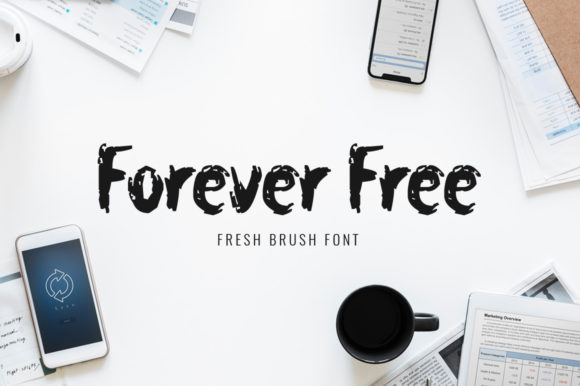
In an era where digital saturation demands instant recognition and emotional resonance, typography has evolved from silent infrastructure to a strategic voice. Among the rising tools redefining how professionals communicate visually, Forever Free stands out—not as another polished, algorithm-optimized typeface, but as a deliberate departure. It is a bold display font with a unique charm: hand-drawn in spirit, unrefined in execution, and intentionally imperfect in form. Its rough texture, uneven stroke weights, and expressive irregularities aren’t flaws—they’re features calibrated for authenticity in a world fatigued by over-polished aesthetics.
A Typeface Born from Cultural Shifts, Not Just Design Trends
Forever Free arrives at a pivotal moment—one where consumer trust hinges less on perfection and more on perceived sincerity. Consider the broader landscape: social platforms now reward raw, behind-the-scenes content over studio-perfect posts; brands like Glossier and Duolingo built loyalty through human-centered voice and visual humility; even enterprise SaaS interfaces increasingly adopt illustrated micro-interactions and typographic warmth to soften technical complexity. This isn’t nostalgia—it’s a recalibration of credibility. Audiences no longer equate polish with professionalism. They associate consistency, intentionality, and humanity with authority.
In that context, Forever Free functions as a quiet act of alignment. It doesn’t try to mimic handwriting or simulate analog imperfection with filters. Instead, it embodies a confident embrace of asymmetry—its capitals tilt slightly, its terminals fray, its spacing breathes unevenly. That’s not randomness; it’s rhythm rooted in human gesture. For creators building brands, campaigns, or products aimed at real people—not personas—Forever Free offers typographic shorthand for approachability without sacrificing impact.
Why Professionals Are Choosing Rough Over Refined
The adoption of Forever Free isn’t driven by novelty alone. It reflects measurable shifts in workflow, expectation, and audience behavior:
- Speed-to-authenticity matters more than speed-to-perfection. Freelancers launching landing pages, marketers designing limited-run email headers, or founders crafting pitch decks need standout visuals fast—without outsourcing to illustrators. Forever Free delivers high visual contrast and memorability in one font file, reducing reliance on custom lettering or layered graphics.
- Accessibility-aware design now includes perceptual accessibility. While legibility at small sizes remains outside its scope (as intended for display use), its strong x-height, open counters, and high contrast make it highly scannable at scale—especially against textured or gradient backgrounds common in modern web and app UIs. Its “roughness” actually enhances figure-ground separation in dynamic layouts.
- Brand systems are expanding beyond rigid grids. Modern identity design embraces controlled flexibility—modular logotypes, variable tone-of-voice applications, and responsive typography that adapts across touchpoints. Forever Free thrives in this space: it pairs effectively with clean sans-serifs (like Inter or Manrope) for hierarchy, or with monospaced fonts for tech-forward contrast. Its personality is distinct but not domineering—making it a versatile anchor rather than a stylistic dead end.
Real-World Applications Across Disciplines
Let’s ground this in practice. A freelance UX writer uses Forever Free for hero section headlines in a fintech dashboard redesign—not to signal “fun,” but to humanize complex financial data. The font’s weight and texture create immediate visual anchoring, helping users parse information faster while subtly reinforcing the brand’s promise of transparency over opacity.
A sustainable apparel startup selects Forever Free for its seasonal campaign banners and Instagram story covers. Here, the font’s tactile quality echoes their material choices—organic cotton, undyed linen, screen-printed tags. It doesn’t shout sustainability; it feels materially honest. Customers report higher dwell time on those assets—not because of novelty, but because the typography signals congruence between message and medium.
Even in B2B contexts, relevance emerges. A cybersecurity firm deploying Forever Free in its annual threat report cover (paired with precise, neutral body text) leverages cognitive contrast: the font’s boldness underscores urgency, while its irregularity hints at the unpredictable, human-driven nature of cyber risk—moving beyond clichéd “shield” iconography to typographic storytelling.
Technology Enables, But Intention Directs
Technically, Forever Free benefits from modern font delivery standards: variable axes (where available), OpenType features like stylistic alternates, and robust web font loading via @font-face or CDN integration. Yet its power lies not in technical sophistication—but in how it interacts with contemporary constraints. With Core Web Vitals prioritizing perceived performance, lightweight display fonts like Forever Free (often under 40KB WOFF2) support fast-loading hero sections without sacrificing visual distinction.
Moreover, its design accommodates responsive environments intuitively. Unlike ultra-thin or ultra-condensed display fonts that collapse unpredictably on mobile, Forever Free’s generous proportions and sturdy construction retain legibility and impact—even when scaled down to 48px on a narrow viewport. That practical resilience makes it not just stylistically relevant, but operationally sound.
Not a Trend—A Tool for Intentional Expression
It would be inaccurate to label Forever Free a “trend.” Trends fade; tools endure when they solve persistent problems. What Forever Free addresses is fundamental: the growing gap between how brands speak and how people actually experience the world. We live in a multisensory, fragmented, attention-scarce environment—yet much commercial typography still defaults to neutrality or sterile futurism. Forever Free answers that disconnect with clarity and confidence.
This isn’t about rejecting refinement—it’s about redefining where refinement belongs. Refinement lives in research, in user testing, in ethical data practices, in inclusive copywriting. Typography, especially at display scale, serves a different role: it sets tone, triggers recognition, and creates space for emotion before a single word is read. In that role, Forever Free doesn’t compete with Helvetica or Roboto. It complements them—providing the human pulse beneath the structured system.
Looking Ahead: Typography as Ethical Infrastructure
As AI-generated visuals become ubiquitous, the value of human-authored, intentionally imperfect assets will only increase. Tools like Forever Free represent a subtle but significant counterbalance—not to technology itself, but to homogenization. When every landing page uses the same three variable fonts, differentiation becomes impossible. When every brand voice sounds like a corporate chatbot, trust erodes.
Choosing Forever Free is a small, daily act of authorship. It signals that the creator values texture over uniformity, resonance over reach, and meaning over metrics—at least in the right moments. That mindset extends beyond fonts: it informs how we structure teams (prioritizing craft alongside efficiency), how we brief agencies (asking for intent before aesthetics), and how we measure success (tracking emotional engagement alongside click-through rates).
For professionals navigating rapid change—whether launching a solopreneur venture, leading a design system overhaul, or repositioning a legacy brand—Forever Free offers more than visual flair. It offers a lens: a reminder that authenticity isn’t found in stripping away complexity, but in honoring the beautiful, necessary roughness of real human expression.
So the next time you face a blank canvas—be it a keynote slide, a product launch banner, or a brand manifesto—consider what your typography says before you say anything else. With Forever Free, you’re not just choosing a font. You’re choosing presence.