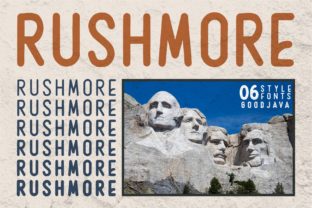
Rushmore: Bold, Authentic Display Font
When your headline needs to stop scrolling thumbs, command attention in a crowded feed, or anchor a brand identity with unmistakable presence—Rushmore delivers. It’s not just another bold font. It’s a display typeface built on confident proportions, intentional contrast, and subtle human rhythm. Designed for impact without sacrificing readability, Rushmore stands apart because it feels both modern and grounded—not trendy, but time-aware.
Why Rushmore Works Where Other Display Fonts Fall Short
Many bold display fonts sacrifice legibility at scale or feel overly stylized—great for one-off posters, less so for consistent branding or digital interfaces. Rushmore avoids that trap. Its uppercase-heavy structure has generous x-height, open counters, and carefully tuned spacing that maintains clarity even at smaller sizes (think hero section subheads or mobile app banners). Unlike ultra-narrow or exaggerated slab serifs, Rushmore balances weight and air—so it doesn’t overwhelm supporting text or clash with body fonts like Inter, Lora, or even Georgia.
This makes Rushmore especially useful when you’re designing across touchpoints: a landing page headline, a podcast cover, an Instagram Story template, or printed workshop materials. You’re not swapping fonts per platform—you’re building cohesion with one strong, adaptable voice.
Real Projects That Benefit From Rushmore’s Character
Small business owners launching a new service often struggle to communicate expertise *and* approachability at once. A café rebranding its packaging used Rushmore for its “Small-Batch Roast” label—paired with a warm, low-contrast sans-serif for ingredients. The result? Instant recognition on shelf, warmth in tone, and zero visual competition between message and medium.
Educators and course creators rely on slide decks and handouts that must hold attention without distracting from content. One university instructor switched from Montserrat Black to Rushmore for module titles in her online curriculum. Students reported improved navigation—“I knew exactly where I was in the flow”—because Rushmore’s distinctive letterforms created clear visual landmarks without requiring animation or color cues.
Bloggers and newsletter writers face shrinking attention spans—and limited design control in CMS platforms. Rushmore shines in email headers and blog post titles rendered as SVG or embedded web font. Its robust hinting ensures crisp rendering across Outlook, Gmail, and Apple Mail—even on older Android devices. No pixelation. No fallback surprises.
How Rushmore Supports Creative Efficiency
Time isn’t just saved by faster rendering—it’s preserved in decision-making. When you choose Rushmore early in a project, you reduce font pairing fatigue. Its strong personality pairs cleanly with neutral sans-serifs (like Poppins or Manrope) and even restrained serifs (such as Merriweather or Cormorant Garamond). There’s no need to audition five “bold alternatives” before settling—Rushmore’s authenticity means it rarely feels like a compromise.
That clarity extends to collaboration. Designers, developers, and marketers can align quickly around Rushmore as the “hero voice” of a campaign—no ambiguity about hierarchy or tone. A freelance designer shared how using Rushmore in her pitch deck helped clients visualize the final brand system instantly. “They didn’t ask ‘What does this look like in context?’ They asked, ‘Can we use it on the tote bag too?’”
Who Should Reach for Rushmore—and When to Pause
Rushmore serves professionals who value distinction *and* discipline: founders defining their first visual language, marketers refreshing a dated website, publishers crafting magazine covers, or educators building accessible learning assets. Its strength lies in moments where typography must do more than decorate—it must signal intent, reinforce memory, and invite engagement.
That said, Rushmore isn’t ideal for every scenario. It’s a display font—not meant for long-form body copy, UI labels, or dense data tables. If your project demands high-density information scanning (think dashboards or legal disclaimers), pair it thoughtfully: use Rushmore only for primary headings, then switch to highly legible, tested text fonts below 16px.
Also consider licensing scope. Rushmore is available through reputable foundries with clear web, desktop, and app licenses. If you’re building a SaaS product with dynamic typography, verify variable font support and embedding permissions upfront—some versions include optical sizing or weight axes that enhance responsiveness, while others are static.
Getting the Most Out of Rushmore in Practice
Start simple: apply Rushmore to your most important single line—the tagline on your homepage, the title of your lead ebook, the nameplate on your podcast logo. Test it at three sizes: large (60–90px for banners), medium (32–48px for section headers), and small (24–28px for mobile top-level navigation). Notice how spacing shifts naturally—don’t force tracking adjustments unless needed for tight containers.
Pair intentionally. Avoid other high-contrast or geometric fonts nearby—Rushmore’s character thrives alongside humanist or transitional forms. Try it with IBM Plex Sans for tech-forward clarity, or Source Serif Pro for editorial depth. Steer clear of fonts with competing stroke modulation (like Bebas Neue or League Spartan) unless you’re aiming for deliberate tension—and even then, limit usage to one element per layout.
And remember: authenticity isn’t loudness. Rushmore’s power comes from restraint. Use all-caps sparingly—sentence case often preserves its warmth better. Let its natural rhythm breathe. In a world of algorithmically optimized templates, choosing Rushmore signals intentionality—not just aesthetics.
A Final Thought on Typography as Strategy
Fonts don’t build brands—but they reinforce them, every time someone sees your name, reads your offer, or shares your work. Rushmore won’t fix unclear messaging or poor user experience. But when those foundations are solid, Rushmore helps make them unforgettable. It gives visual weight to your values: confidence without arrogance, modernity without coldness, boldness with balance.
That’s why designers return to it—not as a trend, but as a tool that keeps earning its place. Whether you're launching a Shopify store, designing a conference keynote, or refining your personal portfolio, Rushmore offers something rare in typography: a voice that’s unmistakably yours, ready to speak clearly—and be heard.